
Parking Lot Pressure Washing
In St. Louis, MO
Commercial Pressure Washing Services
1-800-STRIPER provides professional parking lot pressure washing in St. Louis, MO — removing oil staining, grime, gum, and traffic film from parking lots, garages, sidewalks, and building entrances for commercial properties across St. Louis City, St. Louis County, and the surrounding metro.
1-800-STRIPER® of St Louis PROVIDes Parking Lot Pressure Washing Services NEAR YOU
Need to blast away years of grime?
If your parking lot or parking garage looks dull and dirty, our professional crew can wash away grime, oil, stains, and slippery buildup to restore the appearance of your property.
Benefits:
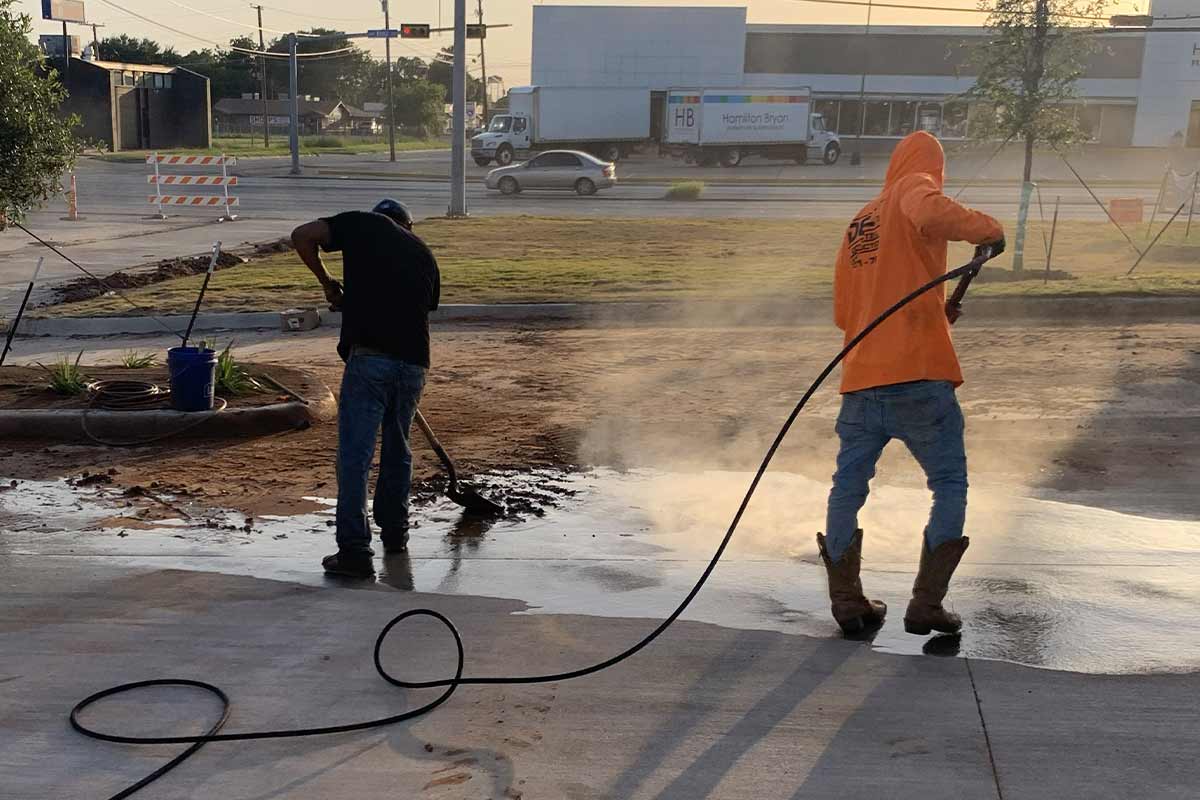
Parking Lot Pressure Washing in St. Louis, MO
A commercial lot collects a specific kind of dirt. Tire rubber and exhaust leave a grey film that dulls the whole surface. Drips from parked cars leave oil staining concentrated exactly where customers walk. Gum, bird mess, and spilled drinks cluster at entrances and cart corrals. Salt residue from a Missouri winter leaves a white bloom that lingers into spring.
Pressure washing lifts that off the surface. The visible payoff is obvious — a lot that reads as maintained rather than neglected, and a building entrance that doesn’t undercut whatever you spent on the storefront. The less obvious payoff is that clean pavement is a better substrate: fresh striping bonds to clean, sound concrete or asphalt far better than it bonds to a film of oil and rubber. That’s why washing and striping often belong in the same visit, in that order.
We wash lots, parking garages, sidewalks, drive aisles, and entrances on commercial properties across the metro.
Where the Wash Water Goes — and What Missouri Law Actually Says
This is the part of the job most contractors won’t discuss, and where most of what’s written online is wrong. So here is what we can actually source.
Missouri’s Clean Water Law binds you and us directly. Section 644.051.1 of the Missouri Revised Statutes reads: “It is unlawful for any person: (1) To cause pollution of any waters of the state or to place or cause or permit to be placed any water contaminant in a location where it is reasonably certain to cause pollution of any waters of the state.” “Person” is defined in the same chapter to include firms, companies, and private corporations — so unlike most stormwater rules, this one reaches the property owner and the contractor without any permit or municipality in between. And “water contaminant” is defined to reach contaminants that get into water “either directly or indirectly by surface runoff, by sewer” — the storm-drain pathway is named.
Two limits on that statute worth stating plainly, because they cut in your favor and we’d rather you hear them from us. First, it prohibits pollution, not merely a discharge — Missouri’s own courts have read the provision to require the addition of contaminants, and the revisor’s annotations point to State ex rel. Ashcroft v. Union Electric Co. on exactly that. Second, “waters of the state” is defined to exclude waters “entirely confined and located completely upon lands… controlled by a single person,” which is why containing wash water on your own site is a materially different situation from sending it down an inlet.
Who regulates the storm sewer here. The Metropolitan St. Louis Sewer District holds the regional municipal storm sewer permit covering St. Louis County and the City, with Kirkwood among its co-permittees. MSD’s own stormwater management program states that it uses Ordinance No. 15048 as “the legal enforcement tool” for illicit discharges, and that Article IV of that ordinance “establishes control of discharges to separate storm sewers and watercourses.”
And here is what we will not tell you. We have not read Article IV of Ordinance 15048. Its text isn’t publicly retrievable without going through MSD directly, and we’re not going to paraphrase an ordinance we haven’t read in order to sound authoritative about your lot. You will find contractor pages in this market flatly asserting that federal law bans wash water from St. Louis storm drains. That claim doesn’t trace to any statute or regulation we could find — the federal rule everyone is half-remembering imposes its duty on the sewer district, not on you, and the well-known “no detergents in pavement wash water” condition comes from an EPA permit that doesn’t operate in Missouri at all, because Missouri has run its own program since 1974.
What that adds up to is simple: the wash-water question at your property is a real one, the answer depends on your site and your jurisdiction, and it deserves a straight conversation rather than a scare line. Tell us the address and what’s on the pavement, and we’ll tell you how we’d approach it. You can read the statute yourself at Missouri Revised Statutes Section 644.051.
Why the City and the County Aren’t the Same Problem
One local fact changes the picture more than anything else on this page, and almost nobody mentions it.
The City of St. Louis is served in large part by a combined sewer system — MSD’s own permit documentation describes the drainage entering the City’s western boundary “and its combined sewer system.” In a combined system, what goes down the drain travels to treatment rather than straight to a creek. Missouri’s Clean Water Law reflects that distinction directly: Section 644.051.2 states that no permit is required “for any emission into publicly owned sewer systems tributary to publicly owned treatment works.”
Most of St. Louis County is the opposite — a separate storm sewer, where an inlet is a fast, untreated path to the nearest creek and eventually the Mississippi. That’s precisely the system MSD’s illicit-discharge ordinance exists to protect.
So “where does this water end up” has genuinely different answers on two lots ten minutes apart, and the honest version of this conversation starts with your address rather than a slogan. We’d rather ask than assume, and we’d rather tell you the boring truth than borrow a competitor’s scare line.
When Pressure Washing Is Worth It — and When It Isn’t
We’d rather you spend the money where it does something.
It’s worth it when the surface is sound and the problem is on top of it: traffic film greying out an otherwise good lot, oil staining at high-turnover stalls, gum and spills at entrances, salt bloom after winter, or a garage deck that’s gone dingy under the lights. It’s also worth doing immediately before restriping — paint bonds to clean pavement, not to a layer of rubber and oil, so washing first buys you a better-looking and longer-lasting stripe.
It’s often not worth it when the pavement itself is the problem. Washing does not fix crumbling asphalt, it does not repair a failing surface, and it will not make a lot with structural cracking read as new. If your surface is at the end of its life, washing it is money spent on the wrong layer, and we’ll say so rather than sell you the visit.
It’s also worth being honest about how long it lasts. A washed lot stays clean until traffic puts the film back, which depends entirely on your volume — a busy retail lot and a low-traffic office park are not on the same cycle, and we’re not going to hand you an interval we can’t stand behind. We’ll look at yours and tell you what we’d actually recommend.
We pressure wash for retail centers, office and medical parks, industrial and warehouse properties, HOAs and apartment communities, schools, and municipal sites — commercial work only. We can phase the work overnight or in sections so a busy lot never fully closes. Call (314) 800-0507 for a free estimate.
For a full list of our pavement marking services, visit our parking lot striping in St. Louis page.
Businesses We Serve




How it Works

GET A FREE ESTIMATE
Contact us today and we’ll have a quote to you in 24 hours

SCHEDULE AN INSTALLATION
We’ll have your installation scheduled in less than 7 days, without affecting your business hours

GET A PARKING LOT THAT POPS
For a budget-friendly price, you’ll get a parking lot that looks like new
We proudly work with:


We proudly work with:


Frequently Asked Questions About Parking Lot Pressure Washing in St. Louis, MO
Is it illegal to let pressure wash water go down a storm drain in St. Louis?
We’re going to give you the accurate answer rather than the confident one. What we can source: Missouri’s Clean Water Law, Section 644.051.1, makes it unlawful for any person “to cause pollution of any waters of the state or to place or cause or permit to be placed any water contaminant in a location where it is reasonably certain to cause pollution of any waters of the state” — and “person” expressly includes private companies, so it reaches property owners and contractors directly. The Metropolitan St. Louis Sewer District also holds the regional storm sewer permit and states that it enforces illicit discharges through its Ordinance No. 15048, Article IV. What we can’t do is tell you exactly what Article IV says, because its text isn’t publicly retrievable and we won’t paraphrase an ordinance we haven’t read. If your project turns on that question, MSD can answer it directly.
Does using detergent change whether wash water can enter the storm drain?
Probably, but not for the reason you’ll read online. The well-known rule — that pavement wash water is acceptable “provided that detergents or hazardous cleaning products are not used” — comes from EPA’s Multi-Sector General Permit, and that permit only applies where EPA is the permitting authority. Missouri has run its own program since 1974, so the MSGP does not operate here. Anyone quoting that detergent condition at a Missouri lot is citing a permit that doesn’t apply. What does apply is the Missouri statute above, which turns on whether you’re causing pollution — and detergent plainly bears on that. We’d rather tell you the citation is wrong than repeat it because it sounds good.
Do you have to collect the wash water?
It depends on the site, and that’s a genuine answer rather than a dodge. Missouri’s definition of “waters of the state” excludes water “entirely confined and located completely upon lands controlled by a single person,” so water kept on your own property sits in a different legal position than water sent down an inlet. Whether containment is warranted depends on what’s on the pavement, where your drains go, and which jurisdiction you’re in. Tell us the address and what we’d be washing off, and we’ll tell you how we’d approach it.
Does it matter that my lot is in the City rather than the County?
It matters more than almost anything else, and it’s the fact most often left out. The City of St. Louis is served largely by a combined sewer system, so what enters a drain generally travels to treatment — Missouri’s law even states that no permit is required for emissions into publicly owned sewers tributary to treatment works. Most of St. Louis County is on a separate storm sewer, where an inlet is an untreated path to the nearest creek. Two lots ten minutes apart can genuinely have different answers, which is why we start with your address.
Should I pressure wash before restriping?
Yes, and it’s the single best time to do it. Paint bonds to clean, sound pavement — not to a film of tire rubber, exhaust residue, and oil. Washing first gets you a better-looking stripe that holds longer, and it’s why we’ll often propose the two together in that order. If you’re planning a restripe anyway, washing first is the version of this service with the clearest payback.
How long will my parking lot stay clean?
Until traffic puts the film back, which depends entirely on your volume — and we’re not going to hand you a tidy interval we can’t stand behind. A high-turnover retail lot and a low-traffic office park are not on the same cycle. Worth adding: if your pavement itself is failing, washing is money on the wrong layer. It removes what’s on top of the surface; it doesn’t repair the surface. We’ll look at your lot and tell you honestly whether washing is the right spend or whether you have a bigger problem underneath. Call (314) 800-0507 for a free estimate.