Parking Lot Sign Installation
In St. Louis, MO
Sign Installation Services
1-800-STRIPER provides professional parking lot sign installation in St. Louis, MO — mounting accessible parking signs bearing the International Symbol of Accessibility, van-accessible designations, fire lane signs, and directional signage per the 2010 ADA Standards for Accessible Design and Missouri Revised Statutes Section 301.143, for commercial properties across the metro.
1-800-STRIPER® of St Louis PROVIDes Parking Lot Sign Installation Services NEAR YOU
Are you communicating clearly?
We install new signs in adherence with local regulatory standards and can repair or replace damaged signs so you can clearly communicate your parking requirements.
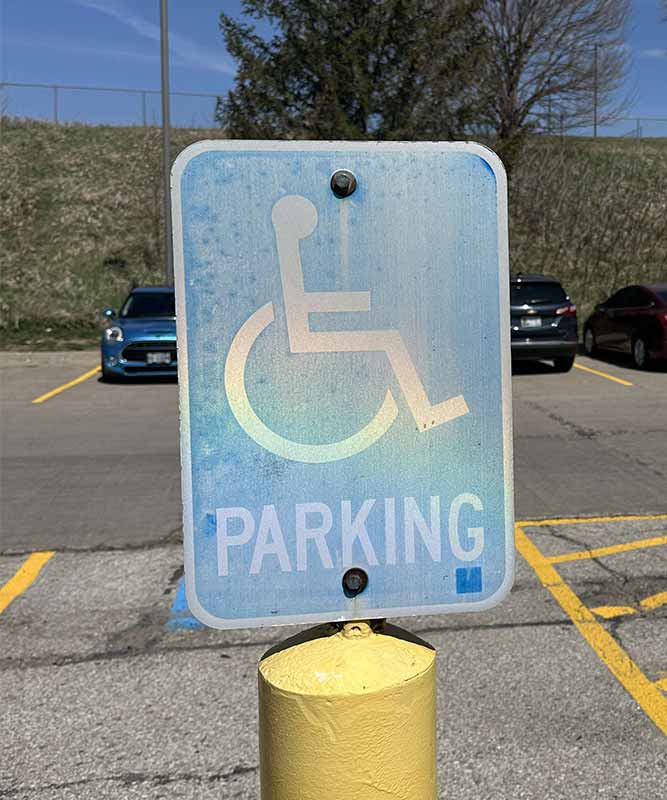
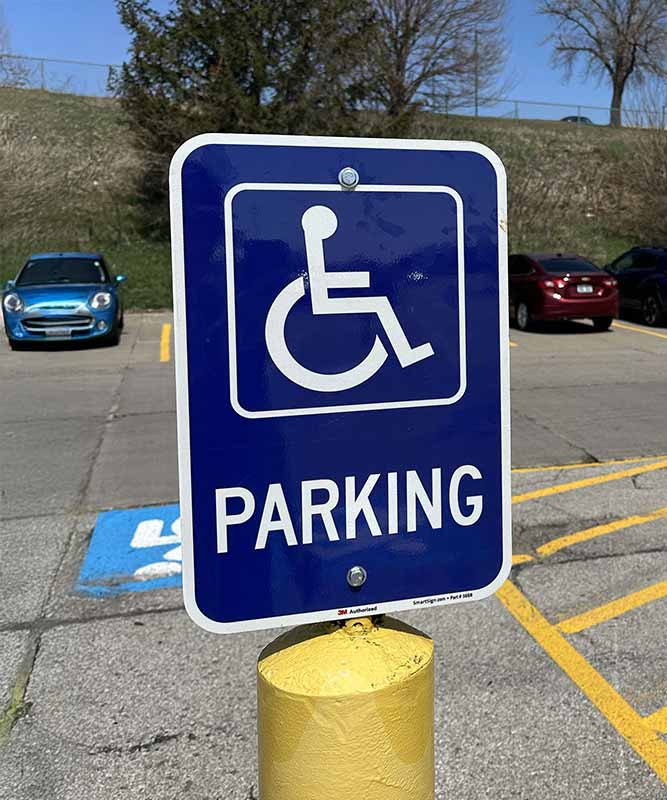
Parking Lot Sign Installation in St. Louis, MO
Signs are the part of a parking lot that does its work in words. Paint on the ground tells a driver where the stall is; the sign at the head of it tells them who the stall is for, and it’s the thing an enforcement officer, an inspector, or a plaintiff’s attorney actually looks at.
We install accessible parking signs, van-accessible designations, fire lane signage, directional and one-way signs, and stop signs on commercial properties across the metro — mounted on posts or wall-mounted, sized and placed to the requirements below.
Two rules govern most of this work in Missouri, and they stack: the federal 2010 ADA Standards for Accessible Design, and Missouri Revised Statutes Section 301.143. They don’t say the same things, and meeting one doesn’t get you the other.
What Missouri and the ADA Actually Require on an Accessible Parking Sign
Here’s the substance, from the two texts themselves.
Missouri requires private lots to designate — not just public ones. Section 301.143.2 says “Owners of private property used for public parking shall also designate parking spaces for the exclusive use of vehicles which display a distinguishing license plate or card.” That’s a duty on the property owner, not a courtesy. The same subsection says the space “shall be indicated by a sign upon which shall be inscribed the international symbol of accessibility,” and that it “may also include any appropriate wording such as ‘Accessible Parking.'” Missouri also requires that the sign carry a fine notice — we’ll tell you the exact wording when we quote the job rather than print penalty figures on a web page.
Missouri banned two specific words in 2011. Section 301.143.9 is short and absolute: “Beginning August 28, 2011, all new signs erected under this section shall not contain the words ‘Handicap Parking’ or ‘Handicapped Parking.'” If you’re ordering new signs, that language is out — and this is the single most common thing we find still being installed.
Your existing old signs are probably fine. Section 301.143.8 grandfathers them: signs or spaces in use before August 28, 2011 “shall not be in violation of this section during the useful life of such signs or spaces.” So a pre-2011 sign reading “Handicapped Parking” isn’t automatically a violation. The catch is in the next sentence — you can’t extend that useful life “by means other than those means used to maintain any sign or space on the owner’s property.” Replace it, and the replacement follows the current rule.
The ADA governs the sign itself. Section 502.6 requires that “Parking space identification signs shall include the International Symbol of Accessibility,” that “Signs identifying van parking spaces shall contain the designation ‘van accessible,'” and that signs “shall be 60 inches (1525 mm) minimum above the finish floor or ground surface measured to the bottom of the sign.” That last detail is the one most often botched — the 60 inches is a minimum, and it’s measured to the bottom of the sign, not its center or top.
And there’s an exception worth knowing. Section 216.5 requires the signs, but excepts sites with “a total of four or fewer parking spaces, including accessible parking spaces” — on those, identification isn’t required. It’s a small carve-out, but if you run a four-space lot, nobody should be selling you signage on ADA grounds.
One nuance from the ADA’s own advisory to 502.6: the “van accessible” designation “is intended to be informative, not restrictive,” and “Enforcement of motor vehicle laws, including parking privileges, is a local matter.” The sign identifies the space; it isn’t itself the enforcement mechanism.
The Restripe Trigger Most Owners Don’t Know About
This is the provision that catches people, and it’s the one genuine reason a striping job can pull signage along with it.
Section 301.143.2 again: “Beginning August 28, 2011, when any political subdivision or owner of private property restripes a parking lot or constructs a new parking lot, one in every four accessible spaces, but not less than one, shall be served by an access aisle a minimum of ninety-six inches wide and shall be designated ‘lift van accessible only’ with signs that meet the requirements of the federal Americans with Disabilities Act.”
Read what triggers it: restriping. Not new construction, not a renovation, not an alteration — repainting your existing lines. If your lot doesn’t currently have a ninety-six-inch aisle serving one in four of its accessible spaces, a restripe is the moment Missouri expects that to change, and the “lift van accessible only” sign goes with it.
We’d rather you hear that before the crew shows up than after. When we quote a restripe on a St. Louis-area lot, this is part of the walk.
Fire Lane Signs — Why There Is No Single St. Louis Answer
If you’ve been told there’s a standard fire lane sign for St. Louis, you’ve been told something that isn’t true, and the details matter.
The City of St. Louis adopted the 2018 International Fire Code — but only Appendices B, C and N. The adopting ordinance is explicit that the code is adopted “including Appendices B, C and N.” The familiar fire lane sign specification — the one contractors quote as gospel, with its stated dimensions and red-on-white lettering — lives in the IFC’s Appendix D. Appendix D is not among the appendices the City adopted. So that spec, whatever a supplier tells you, is not City of St. Louis law.
What the City did adopt is IFC Chapter 5 unamended, and its marking provision turns on a phrase worth reading carefully: fire apparatus access roads are marked where required by the fire code official. Not universally. Not to a dimension published in a catalogue. Where your AHJ says, in the way your AHJ specifies.
St. Louis County adopts no fire code at all. Its fire chapter is administrative, and the County building code expressly deletes the fire prevention hook. In the County, fire lane requirements come from your fire protection district — and those districts have adopted different editions in different years.
And Kirkwood we could not verify. Its code sits behind a portal we couldn’t read, so we don’t know which edition it adopted or whether it took Appendix D. We’re not going to guess, and we’d rather tell you that than invent a citation.
Put together: three lots ten miles apart in this metro can sit under three different fire codes with three different appendix sets — or, in parts of the County, under a fire district’s rules rather than a municipality’s. That’s why our honest answer on fire lane signage is always the same: the spec comes from your authority having jurisdiction. Call your fire marshal, or tell us the address and we’ll help you ask the right office the right question. You can read the Missouri accessible-parking statute yourself at Missouri Revised Statutes Section 301.143.
We install signage for retail centers, office and medical parks, industrial and warehouse properties, HOAs and apartment communities, schools, and municipal sites — commercial work only. Call (314) 800-0507 for a free estimate.
For a full list of our pavement marking services, visit our parking lot striping in St. Louis page.
Businesses We Serve




How it Works

GET A FREE ESTIMATE
Contact us today and we’ll have a quote to you in 24 hours

SCHEDULE AN INSTALLATION
We’ll have your installation scheduled in less than 7 days, without affecting your business hours

GET A PARKING LOT THAT POPS
For a budget-friendly price, you’ll get a parking lot that looks like new
We proudly work with:


We proudly work with:


Frequently Asked Questions About Parking Lot Sign Installation in St. Louis, MO
Does my private parking lot legally need accessible parking signs?
In Missouri, very likely yes. Section 301.143.2 of the Missouri Revised Statutes states that “Owners of private property used for public parking shall also designate parking spaces for the exclusive use of vehicles which display a distinguishing license plate or card” — a duty on the owner, not a courtesy. The same subsection requires the space be indicated by a sign “upon which shall be inscribed the international symbol of accessibility.” Federally, the 2010 ADA Standards Section 216.5 requires identification signs too, with one useful exception: where a site has four or fewer total parking spaces, identification of accessible spaces is not required.
How high does an accessible parking sign have to be mounted?
The 2010 ADA Standards, Section 502.6, require signs to be “60 inches (1525 mm) minimum above the finish floor or ground surface measured to the bottom of the sign.” Two details get botched constantly: it’s a minimum, not a target, and it’s measured to the bottom of the sign rather than its middle or top. If a sign was set by eye at roughly five feet to the center, it is probably short.
Can my sign still say “Handicapped Parking”?
Not on a new one. Missouri Section 301.143.9 is unambiguous: “Beginning August 28, 2011, all new signs erected under this section shall not contain the words ‘Handicap Parking’ or ‘Handicapped Parking.'” Missouri’s statute suggests wording such as “Accessible Parking” instead, and requires the International Symbol of Accessibility on the sign regardless. Your existing older signs are a different question — see below.
Do I have to replace my old pre-2011 signs?
Not automatically, and this is good news most owners don’t get told. Section 301.143.8 grandfathers them: signs or spaces in use before August 28, 2011 “shall not be in violation of this section during the useful life of such signs or spaces.” So an old “Handicapped Parking” sign isn’t inherently a violation. The limit is that you can’t stretch that useful life by unusual means — and once a sign is genuinely replaced, the replacement follows today’s rule, which means no “Handicapped Parking” wording.
Will restriping my lot require new signs?
It can, and this is the provision that surprises people most. Missouri Section 301.143.2 says that beginning August 28, 2011, when “an owner of private property restripes a parking lot or constructs a new parking lot, one in every four accessible spaces, but not less than one, shall be served by an access aisle a minimum of ninety-six inches wide and shall be designated ‘lift van accessible only’ with signs that meet the requirements of the federal Americans with Disabilities Act.” Note the trigger is restriping — simply repainting your lines. If your lot doesn’t already have a ninety-six-inch aisle serving one in four accessible spaces, a restripe is when Missouri expects that to change. We raise it during the walk, not after.
What are the fire lane sign requirements in St. Louis?
There isn’t one answer, and anyone who gives you a single spec is guessing. The City of St. Louis adopted the 2018 International Fire Code “including Appendices B, C and N” — and the widely-quoted fire lane sign dimensions live in the IFC’s Appendix D, which the City did not adopt. What the City did adopt requires fire apparatus access roads to be marked where required by the fire code official — meaning your AHJ sets it, not a catalogue. St. Louis County adopts no fire code at all; there, your fire protection district governs, and districts have adopted different editions. Kirkwood’s adoption we could not verify and won’t guess at. The honest answer: ask your fire marshal, or give us the address and we’ll help you ask the right office. Call (314) 800-0507 for a free estimate.