
Wheel Stop Installation
In Sarasota, FL
Concrete and Rubber Parking Stops
1-800-STRIPER provides professional wheel stop installation in Sarasota, FL — anchoring concrete, recycled-rubber, and marine-grade composite wheel stops at stall heads to protect sidewalks, storefronts, and ADA accessible routes for commercial properties throughout Sarasota, Manatee, and Charlotte counties.
1-800-STRIPER® of Sarasota PROVIDes Wheel Stops Services NEAR YOU
Need to protect vehicles or walls from accidental damage?
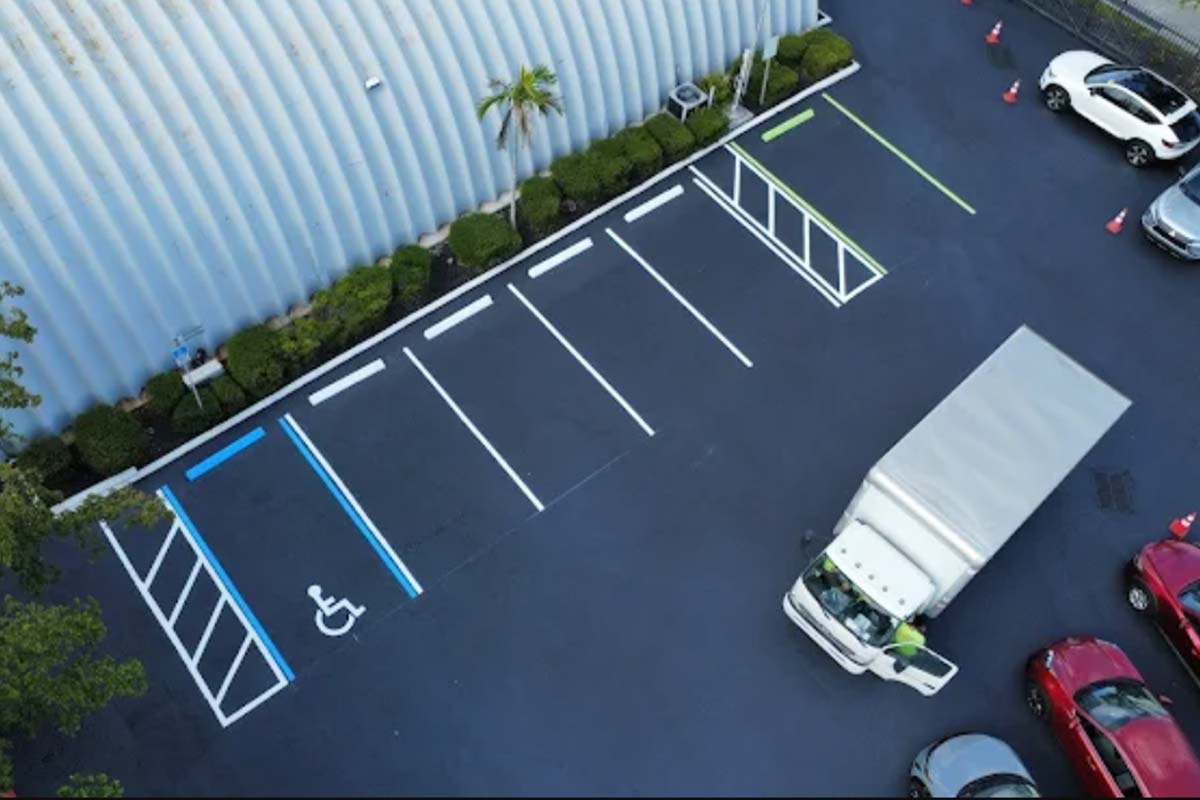
Wheel stops (also called parking blocks) protect your property, enhance safety, and improve parking lot organization.
Benefits:
Wheel stops prevent vehicles from parking too far into a space or overextending into other spots, pedestrian walkways, and other areas, while also helping with vehicle alignment. They can prevent damage to buildings, curbs, or landscaping. Wheel stops also serve as clear visual cues for proper parking and are sometimes used on slopes to prevent cars from rolling.
Why marine-grade composite outperforms concrete on Gulf-coast properties
Properties within a few miles of the Gulf, Sarasota Bay, or Charlotte Harbor get accelerated rebar corrosion in standard concrete wheel stops. Salt-laden air degrades the embedded rebar, the concrete cracks at the rust line, and the stop fails 5 to 10 years sooner than inland equivalents. Marine-grade composite wheel stops (recycled plastic with UV stabilizers) avoid the rebar problem entirely and hold up well in barrier-island commercial sites on Siesta Key, Longboat Key, and Lido Key where salt exposure is highest.
For inland Sarasota and Manatee properties away from direct salt-air exposure, standard concrete wheel stops still deliver 15 to 25 years of service life. Recycled-rubber wheel stops fall in between at 7 to 10 years average, with the advantage of softer impact absorption. The rubber is gentler on car bumpers and reduces complaint volume from customers backing into the stop too aggressively.
Wheel stop material comparison
| Material | Service life | Impact behavior | Best use |
|---|---|---|---|
| Concrete (rebar reinforced) | 15 to 25 years | Cracks at rebar line | Inland properties |
| Recycled rubber | 7 to 10 years | Absorbs impact | High customer-traffic |
| Marine-grade composite | 10 to 15 years | Flexes then returns | Gulf-coast / barrier islands |
| Concrete (no rebar) | 5 to 8 years | Cracks fully on impact | Not recommended |
The material comparison table is the structured content element.
ADA accessible-route compliance
The 2010 ADA Standards for Accessible Design require a clear accessible route from the accessible parking space to the building entrance with no vertical obstacle higher than 1/2 inch. Wheel stops at accessible spaces must not block the access aisle or the route to the curb cut. We design wheel stop placement to clear the access aisle by at least 12 inches and keep the route to the building entrance free of any vertical obstacle.
For van-accessible spaces with the 96-inch access aisle, wheel stops on the adjacent standard parking stall must be set back to avoid encroaching on the aisle from the side. We pull the access aisle dimension during the estimate and adjust wheel stop placement on adjacent stalls accordingly.
Anchor type and installation
Standard installation uses two 3/4-inch rebar pins driven 12 inches into the asphalt or concrete pavement, sealed with epoxy or asphalt sealant. Concrete wheel stops on concrete substrate use 5/8-inch threaded steel rod anchors set in epoxy. We pre-drill the anchor holes, set the wheel stop, drive the pins, and seal. Typical install runs 5 to 8 minutes per wheel stop with a two-person crew.
For removable wheel stops (rare in commercial parking, more common at delivery zones and event venues), we set sleeves into the pavement that accept the wheel stop without permanent anchors. Removable installations cost more up front but allow seasonal repositioning for snowbird overflow or event configurations.
When to remove and replace existing wheel stops
Pin-anchored wheel stops pull out with a pry bar or skid-steer attachment. We typically remove and replace at the same time as restripe to avoid duplicate mobilization. Old concrete stops that cracked at the rebar line get replaced with marine-grade composite at most Gulf-area sites to break the corrosion cycle.
Annual visual checks during restripe work catch the most common failure modes: cracks longer than 2 inches in concrete, separation at the anchor pin, and impact damage from delivery vehicles. Impact damage from box trucks and delivery vans is the most common failure mode in commercial lots. Wheel stops at delivery-zone stall heads cycle through replacement faster than stops in customer parking rows.
For a full list of our pavement marking services, visit our parking lot striping in Sarasota page.
Businesses We Serve




How it Works

GET A FREE ESTIMATE
Contact us today and we’ll have a quote to you in 24 hours

SCHEDULE AN INSTALLATION
We’ll have your installation scheduled restriped in less than 7 days, without affecting your business hours

GET A PARKING LOT THAT POPS
For a budget-friendly price, you’ll get a parking lot that looks like new
We proudly work with:


We proudly work with:


Frequently Asked Questions About Wheel Stop Installation in Sarasota, FL
Concrete vs. rubber wheel stops — which lasts longer?
Concrete wheel stops last 15 to 25 years if properly anchored — they crack from impact but rarely fail outright. Recycled-rubber wheel stops last 7 to 10 years and absorb impact better, which is gentler on car bumpers. Marine-grade composite stops fall in between (10 to 15 years) and resist Gulf-coast salt corrosion better than untreated concrete with exposed rebar. Choice depends on traffic load and proximity to salt air.
Why does Sarasota benefit from marine-grade composite wheel stops?
Properties within a few miles of the Gulf, Sarasota Bay, or Charlotte Harbor get accelerated rebar corrosion in standard concrete wheel stops. The salt-laden air degrades the embedded rebar, the concrete cracks at the rust line, and the stop fails 5 to 10 years sooner than inland equivalents. Marine-grade composite (recycled plastic with UV stabilizers) avoids the rebar problem entirely and holds up well in barrier-island commercial sites on Siesta Key, Longboat Key, and Lido Key.
Do wheel stops affect ADA accessible-route compliance?
Yes. The 2010 ADA Standards for Accessible Design require a clear accessible route from the accessible parking space to the building entrance with no vertical obstacle higher than 1/2 inch. Wheel stops at accessible spaces must not block the access aisle or the route to the curb cut. We design wheel stop placement to clear the access aisle by at least 12 inches and keep the route clear.
How are wheel stops anchored?
Standard installation uses two 3/4-inch rebar pins driven 12 inches into the asphalt or concrete pavement, sealed with epoxy or asphalt sealant. Concrete wheel stops use 5/8-inch threaded steel rod anchors set in epoxy on concrete surfaces. We pre-drill the anchor holes, set the wheel stop, drive the pins, and seal — typical install runs 5 to 8 minutes per wheel stop with a two-person crew.
How long do wheel stops last in Sarasota?
Concrete wheel stops usually last 15 to 25 years, recycled-rubber 7 to 10 years, marine-grade composite 10 to 15 years. Salt-air exposure shortens all three by 25 to 40 percent on barrier-island and direct-Gulf sites. We recommend an annual visual check during restripe work — look for cracks longer than 2 inches in concrete, separation at the anchor pin, and impact damage from delivery vehicles, which is the most common failure mode in commercial lots.
Can old wheel stops be removed and replaced cleanly?
Yes. Pin-anchored wheel stops pull out with a pry bar or skid-steer attachment — the anchor holes get cleaned, sealed, and re-drilled in slightly different positions for the new stops. We most often remove and replace at the same time as restripe to avoid duplicate mobilization. Old concrete stops that cracked at the rebar line get replaced with marine-grade composite at most Gulf-area sites to break the corrosion cycle.