
Thermoplastic Striping
In Sarasota, FL
Long-Lasting Pavement Markings
1-800-STRIPER provides professional thermoplastic striping in Sarasota, FL — long-service-life pavement markings for stop bars, crosswalks, directional arrows, and fire lanes applied at roughly 400°F per FDOT Standard Index 711 and AASHTO M249 specifications for high-traffic commercial lots across Sarasota and Manatee counties.
1-800-STRIPER® of Sarasota PROVIDes Thermoplastics Services NEAR YOU
Want to reduce the maintenance requirements for your parking lot?
Thermoplastic pavement markings are a durable, weather and vehicle-resistant striping option for your parking lot or facility.
You can utilize them for stop bars, ADA stalls, no-parking zones, directional arrows, crosswalks, or your entire parking lot.
Benefits:
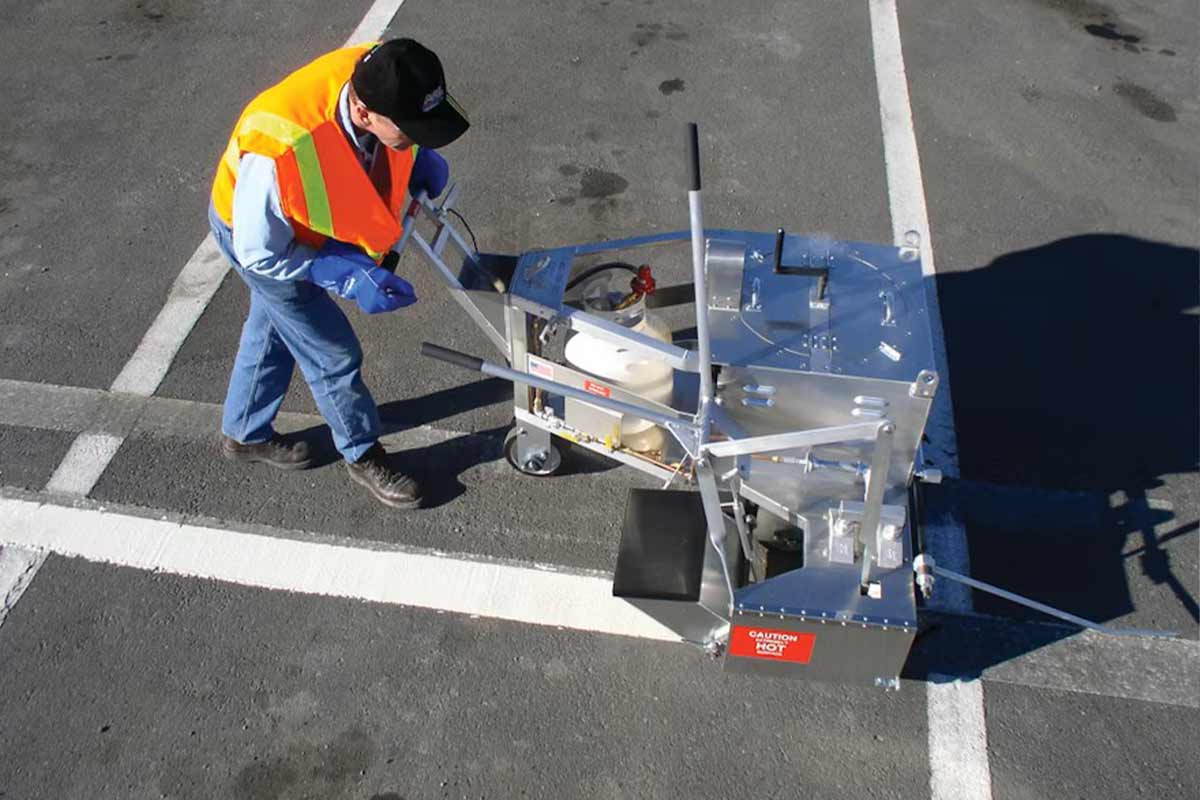
What thermoplastic is and how it bonds to asphalt
Thermoplastic pavement marking is a heat-applied plastic material (pre-formed sheet or hot-melt) that bonds to asphalt as the substrate cools. Application temperature runs roughly 400°F per AASHTO M249 specification, which is what allows the material to flow into the asphalt pore structure and form a mechanical bond. The result is a marking three to four times thicker than traffic paint, with embedded glass beads for retroreflectivity that wear into the surface as the topmost layer abrades.
Three forms of thermoplastic dominate commercial work in Sarasota: pre-formed sheet (the most common for symbols, arrows, and crosswalks), hot-applied extruded line (used on long-line work and stop bars), and spray thermoplastic (a thinner application used where extrusion is impractical). For most parking lot applications, pre-formed sheet covers the bulk of the work because it installs cleanly with a propane torch and a rubber roller without requiring the heated kettle that extruded line needs.
Service life of three to five years vs. paint’s twelve to eighteen months
Thermoplastic typically delivers three to five years of service life on Sarasota commercial parking lots. The exact number depends on traffic volume, salt-air exposure, and substrate condition. Lots near the Gulf or directly on US-41 see the lower end of the range; sheltered lots in inland Sarasota and Manatee counties hit the higher end.
Compare that to traffic paint, which cycles every 12 to 18 months in Sarasota’s UV climate. Over a five-year horizon, paint cycles three to four times while thermoplastic runs the full term. Per-foot cost evens out for high-traffic stop bars and crosswalks, and thermoplastic comes out ahead on hot spots where paint would cycle even faster. We often refresh field paint two to three times before the thermoplastic stop bars and arrows need replacement, which keeps the marking system always sharp.
Where thermoplastic makes sense and where paint wins
Thermoplastic is the right choice for high-traffic stop bars, crosswalks, and directional arrows — anywhere the line takes heavy wheel load or pedestrian wear. Hospital ED entries, big-box retail crosswalks, high-traffic shopping center stop bars, and fast-food drive-thru directional arrows are common candidates in the Sarasota market. Drive-thru paths in particular benefit from thermoplastic because the wheel-load wear pattern concentrates on the same line over and over.
Traffic paint wins on long-line parking field stripes since field stripes don’t take direct wheel load. Cars park between the lines rather than on them. Field stripes also benefit from the 12-to-18-month restripe cycle aligning with overall lot maintenance, which keeps the visual condition of the lot consistent. Most Sarasota commercial lots end up running both: thermoplastic on hot spots, paint on the field. The hybrid approach captures the long-life benefit where it matters without paying for full-lot thermoplastic coverage that the traffic load doesn’t justify.
FDOT Standard Index 711 sets the spec on roadway-adjacent commercial
FDOT Standard Index 711 sets pavement marking widths, colors, and reflectivity for any commercial parking lot adjacent to a state-maintained road. Sarasota commercial frontage on US-41, I-75, SR-72, SR-789, and other state routes typically requires FDOT-spec markings on the customer-facing pavement. The index is updated periodically; we pull the current version and the local FDOT district overrides during the estimate.
For commercial parking lot interior markings (markings not on the state-road frontage), FDOT spec is not enforced but is the recognized professional standard. We follow Index 711 internally for stripe widths and reflectivity even on private internal markings because it produces the most predictable look across multi-property portfolios and aligns with what driver training expects to see.
Thermoplastic vs. paint comparison reference
| Attribute | Traffic paint | Thermoplastic |
|---|---|---|
| Service life (Sarasota) | 12 to 18 months | 3 to 5 years |
| Application temperature | Ambient (50°F to 95°F surface) | ~400°F (per AASHTO M249) |
| Cure time before traffic | 30 to 60 minutes | 5 to 10 minutes (cool-down) |
| Cost per linear foot | Lower (baseline) | 3x to 5x baseline |
| Best use | Field stripes, ADA stalls, fire lanes | Stop bars, crosswalks, arrows |
| Reflectivity | Glass-bead surface application | Glass beads embedded in material |
| Equipment | Graco LineLazer striper | Pre-formed sheet + propane torch / heated kettle |
The comparison table is the structured content element for this page. Provides at-a-glance trade-off reference for property managers planning the marking system.
Application process and cure window
Pre-formed thermoplastic installation starts with surface prep: clean, dry asphalt, no oil contamination. The pre-formed sheet is laid in position, heated with a propane torch until the bottom of the material liquefies and bonds to the asphalt, then rolled with a rubber roller to seat the bond. The whole process for a single arrow takes 5 to 10 minutes per crew member; a crosswalk runs 30 to 45 minutes depending on length and complexity.
Cure is essentially instantaneous. The material is ready for traffic as soon as it cools to ambient — usually 5 to 10 minutes in Sarasota’s warm conditions, faster in winter. This near-zero cure window is one of the practical advantages of thermoplastic over paint in active commercial lots: a thermoplastic crosswalk installed at 9 AM is open to traffic by 9:15 AM. Paint would require the full 30-to-60-minute cure window.
For hot-applied extruded line work, the equipment is more involved (heated kettle on a wheeled cart) and the application speed is slower (50 linear feet per hour vs. 200 to 300 linear feet per hour for paint), but the material profile is identical to pre-formed sheet once laid down.
Substrate temperature and humidity requirements
Asphalt substrate temperature should be at least 50°F at the time of application. Sarasota almost never falls below this threshold even in winter, which means thermoplastic can be installed year-round here without the seasonal restrictions that limit work in northern markets. Surface dryness matters more than ambient humidity. A recently rained-on lot needs to dry fully before thermoplastic goes down because the material will not bond to wet asphalt.
Hot summer surface temperatures (95°F+ on dark asphalt) can complicate application. The material liquefies on contact with the hot surface and may flow before it can be rolled into position. We typically work early-morning starts during peak summer to catch the lower surface temperatures of dawn through 10 AM, then break for the hottest part of the day and resume in late afternoon.
When to choose thermoplastic on a Sarasota commercial lot
Common scenarios where thermoplastic is the right call:
- Hospital, urgent care, or medical office crosswalks at the patient drop-off zone
- Big-box retail or shopping center stop bars at the main entrance
- Drive-thru directional arrows at quick-service restaurants
- Distribution center / industrial site lane markings at gate entries
- Hotel and resort entry circles where wear concentrates on the same line repeatedly
For everything else (interior parking field stripes, ADA stalls, fire lane curbs — which are vertical, not horizontal markings) paint is typically the more economical choice. We size the thermoplastic coverage during the estimate based on traffic volume and wear pattern rather than recommending one material for the whole lot.
For a full list of our pavement marking services, visit our parking lot striping in Sarasota page.
Businesses We Serve




How it Works

GET A FREE ESTIMATE
Contact us today and we’ll have a quote to you in 24 hours

SCHEDULE AN INSTALLATION
We’ll have your installation scheduled restriped in less than 7 days, without affecting your business hours

GET A PARKING LOT THAT POPS
For a budget-friendly price, you’ll get a parking lot that looks like new
We proudly work with:


We proudly work with:


Frequently Asked Questions About Thermoplastic Striping in Sarasota, FL
What is thermoplastic striping and how does it differ from paint?
Thermoplastic is a heat-applied pavement marking material — pre-formed plastic sheet or hot-melt material applied at roughly 400°F per FDOT Standard Index 711 and AASHTO M249 specifications. It bonds to asphalt as the substrate cools and creates a thicker, more durable line than traffic paint. Service life runs three to five years vs. 12 to 18 months for traffic paint.
Where does thermoplastic make sense vs. traffic paint?
Thermoplastic is the right choice for high-traffic stop bars, crosswalks, directional arrows, and fire lanes — anywhere the line takes heavy wheel load or pedestrian wear. For typical parking field stripes (the long lines between stalls), traffic paint amortizes better because it cycles every 12 to 18 months along with the rest of the lot. Mixing the two is common on Sarasota commercial sites, thermoplastic on hot spots, paint on the field.
Does Florida require thermoplastic for any markings?
FDOT Standard Index 711 sets pavement marking requirements for state roadways and some commercial frontage adjacent to state roads. Public-road work often requires thermoplastic for crosswalks, stop bars, and longitudinal lines. For private commercial parking lots there is no FDOT mandate — the choice is service-life and cost-driven. Hospital ED entries, big-box retail crosswalks, and high-traffic shopping center stop bars are common thermoplastic candidates.
How long does the application process take?
Application speed depends on line type. Stop bars and crosswalks (preformed thermoplastic) install at roughly 50 linear feet per hour per crew. Directional arrows install at about 15 to 20 per hour. Long-line thermoplastic (less common in parking lots) runs 200 to 300 linear feet per hour. Cure is essentially instant — the line is ready for traffic as soon as it cools, in most cases 5 to 10 minutes in Sarasota’s warm ambient.
How long does thermoplastic last in Florida?
Three to five years on most commercial parking lot applications. The number varies with traffic volume, salt-air exposure, and substrate condition. Lots near the Gulf or directly on US-41 see the lower end of the range; sheltered lots in inland Sarasota and Manatee counties hit the higher end. We typically refresh field paint two to three times before the thermoplastic stop bars and arrows need replacement, which keeps the marking system always sharp.
What is the cost difference vs. paint?
Thermoplastic most often runs three to five times more per linear foot than traffic paint upfront. Over a five-year horizon — paint cycles every 12 to 18 months while thermoplastic runs the full five, the per-foot cost evens out for most installations and thermoplastic comes out ahead on high-traffic hot spots where paint would cycle more frequently. We provide a side-by-side cost comparison during the estimate so the trade-off is clear.