
Parking Lot Layout Design
In Sarasota, FL
Customized Parking Lot Layouts
1-800-STRIPER provides professional parking lot layout design in Sarasota, FL — custom-engineered layouts that maximize parking capacity, ensure ADA compliance per the 2010 ADA Standards for Accessible Design, and meet FDOT Standard Index 711 pavement marking specifications using Graco LineLazer precision striping equipment.
1-800-STRIPER® of Sarasota PROVIDes New Layouts Services NEAR YOU
Are you ready to create a great first impression?
A proper parking lot layout with clear markings is critical for any business that serves the public. Let us help you make a great first impression with an attractive, well-organized, and safe parking lot.
Benefits:
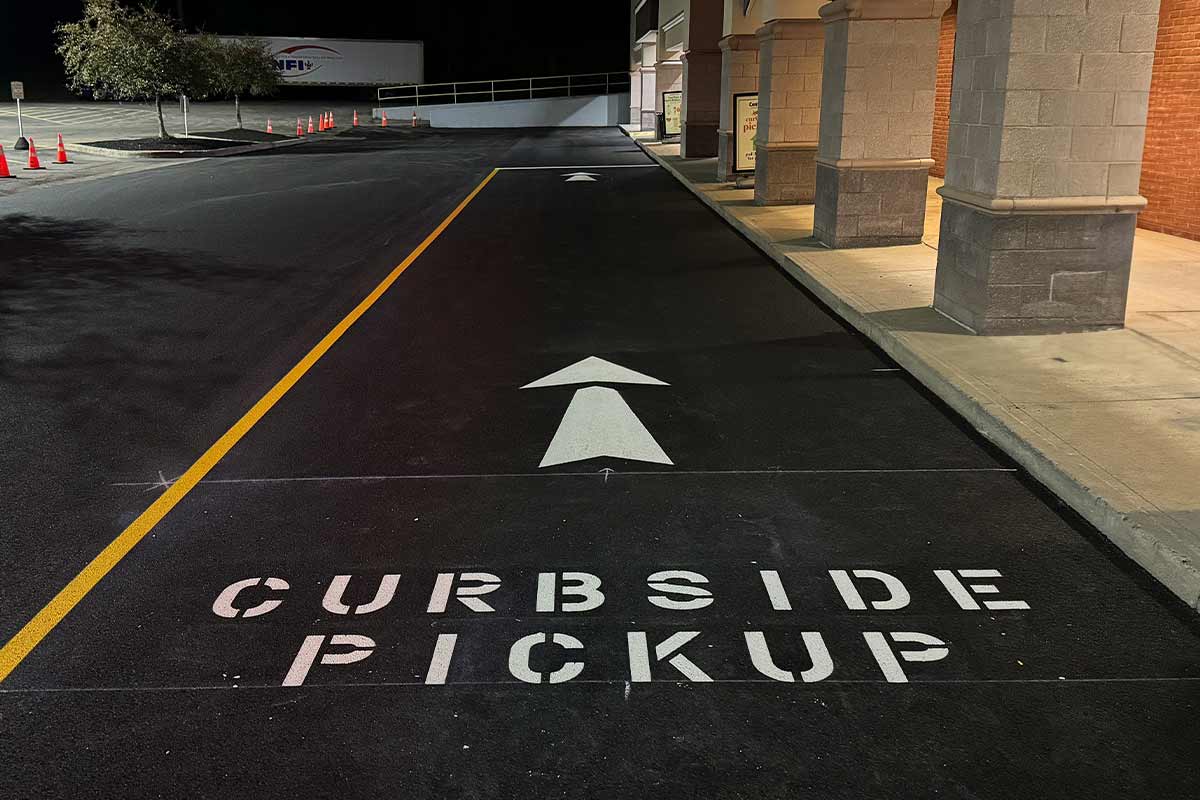
15 to 20 percent more capacity from a redesigned layout
A well-engineered parking lot redesign typically gains 15 to 20 percent more usable parking compared to a poorly planned or aging layout. On Sarasota’s growing commercial corridors along US-41, Lakewood Ranch Boulevard, and the Bee Ridge Road retail strip, that can translate to 15 to 30 additional stalls on a mid-size retail lot. Enough to relieve parking pressure during the snowbird season without adding asphalt or expanding the property footprint. The capacity gain comes from better stall angles, optimized aisle widths, and removal of dead zones between traffic flow paths and stall rows.
Stall angle is the single biggest lever. A 90-degree (perpendicular) layout maximizes capacity per square foot but requires wider drive aisles (24 feet minimum) for two-way traffic. A 60-degree angled layout reduces aisle width to about 18 feet for one-way circulation, and net capacity often comes out higher than 90-degree on lots that can accommodate one-way circulation. A 45-degree layout further reduces aisle width to 14 feet but loses raw stall count. We model the trade-off during the estimate to find the right angle for the property’s traffic pattern.
Stall angle comparison
| Angle | Stall width | Aisle width (one-way / two-way) | Stalls per 100′ row | Notes |
|---|---|---|---|---|
| 90° | 9′ | n/a / 24′ | 11 | Maximum density per square foot |
| 60° | 9′ | 18′ / n/a | 10 | Best balance for one-way circulation |
| 45° | 9′ | 14′ / n/a | 8 | Lowest density but tightest aisle |
| 30° | 9′ | 11′ / n/a | 6 | Rare; specialty long-narrow lots |
The comparison table is the structured content element. We model the property-specific layout in CAD using the actual lot dimensions, ADA requirements, and traffic flow priorities.
ADA accessible-space placement drives the layout sequence
Accessible spaces must be on the shortest accessible route to the building entrance per the 2010 ADA Standards for Accessible Design and Florida Building Code Chapter 11. We design the accessible route plus aisle network first, then layer in standard stalls. This sequence keeps the ADA layout from being treated as an afterthought, which is the most common mistake in older parking lots that have been incrementally re-striped without a full redesign.
For Sarasota properties under the Florida Building Code Chapter 11 review, the minimum required accessible spaces also need to be distributed appropriately when the property has more than one accessible building entrance. Each entrance gets its own proportional share of accessible spaces. We pull the building footprint and entrance locations during the survey and model the accessible-space distribution accordingly.
HOA architectural review process
Most Sarasota HOAs and condo associations require architectural-review committee approval before parking lot redesign work begins, including documentation of the new layout. We deliver layout drawings in the format committees expect (scaled site plan at 1 inch = 20 feet, stall count summary, ADA compliance worksheet, FBC reference, paint specification), so review can move on the first submission rather than bouncing back for revisions.
For multi-property property management companies running redesigns across several HOAs, we coordinate the ARC submission timing so committee reviews can move in parallel rather than back-to-back. Submissions packaged together also reduce per-property documentation overhead since paint specifications, FBC compliance notes, and ADA standards reference the same source documents.
FDOT Index 711 on commercial frontage
FDOT Standard Index 711 governs pavement marking widths, colors, and reflectivity for commercial parking lots adjacent to state-maintained roads. Sarasota commercial frontage on US-41, I-75 frontage roads, SR-72, SR-789, and other state routes typically requires FDOT-spec markings on the customer-facing rows. We pull the FDOT class for the property’s road frontage during the estimate so the stripe widths and paint reflectivity match the spec on the customer-facing pavement.
For internal parking field markings (not on the state-road frontage), FDOT spec is not enforced but is the recognized professional standard. We follow Index 711 internally for stripe widths and reflectivity even on private internal markings because it produces the most predictable look across multi-property portfolios and aligns with what driver training expects to see.
Barrier-island commercial and Coastal Construction Setback Line
Commercial properties on Siesta Key, Longboat Key, Lido Key, and other barrier-island sites in the Sarasota market fall under the Florida Coastal Construction Setback Line (CCSL). The CCSL adds permitting and design overlays for any work near the dune line, including parking lot layout changes that affect site grading, stormwater, or building setback. We coordinate with the Sarasota County Building Department and, where applicable, the Florida Department of Environmental Protection during the estimate phase for any barrier-island commercial layout work.
For most barrier-island parking lot redesigns, the CCSL impact is procedural rather than design-restrictive. The project moves through a slightly longer permit window but the actual layout work is similar to inland sites. Properties directly facing the Gulf may need additional setback documentation from a licensed surveyor, which we coordinate during the project as a separate trade.
When does an existing parking lot need a full redesign?
Three triggers usually justify a full redesign over a like-for-like restripe:
- ADA compliance gap — stall count, access aisle dimensions, or accessible route fail current code
- Stall efficiency under 350 to 400 square feet per car — the layout is wasting space that could become additional stalls
- Traffic pattern change — building expansion, new entrance, or change of tenant mix has shifted how customers approach the lot
Most Sarasota commercial properties get five to eight years out of a layout before redesign pays off. Until then, restriping the existing layout is the more economical choice. We evaluate the redesign-vs-restripe question during every estimate and recommend the lower-cost option when the existing layout is still functional.
For a full list of our pavement marking services, visit our parking lot striping in Sarasota page.
Businesses We Serve




How it Works

GET A FREE ESTIMATE
Contact us today and we’ll have a quote to you in 24 hours

SCHEDULE AN INSTALLATION
We’ll have your installation scheduled in less than 7 days, without affecting your business hours

GET A PARKING LOT THAT POPS
For a budget-friendly price, you’ll get a parking lot that looks like new
We proudly work with:


We proudly work with:


Frequently Asked Questions About Parking Lot Layout Design in Sarasota, FL
How much extra parking can a redesigned layout deliver?
A well-engineered redesign usually gains 15 to 20 percent more usable parking compared to a poorly planned or aging layout. On Sarasota’s growing commercial corridors along US-41 and Lakewood Ranch Boulevard, that can translate to 15 to 30 additional stalls on a mid-size retail lot — enough to relieve parking pressure during the snowbird season without adding asphalt or expanding the property footprint.
How do ADA-accessible spaces fit into the layout count?
ADA-accessible spaces must be on the shortest accessible route to the building entrance per the 2010 ADA Standards for Accessible Design and Florida Building Code Chapter 11. Required count scales with total stalls — a 100-stall lot needs four accessible spaces; one of every six must be van-accessible. We design the accessible route plus aisle network first, then layer in standard stalls.
How does HOA architectural review affect project timing?
Most Sarasota HOAs and condo associations require architectural-review committee approval before any layout-altering parking lot work. We deliver layout drawings in the format committees expect — scaled site plan, stall count summary, ADA compliance worksheet, and FBC reference — so review can move on the first submission rather than bouncing back for revisions.
Do you follow FDOT specifications for commercial parking layouts?
Yes. FDOT Standard Index 711 governs pavement marking widths, colors, and reflectivity for any commercial parking lot adjacent to a state-maintained road. We pull the FDOT spec for the property’s road frontage classification and apply matching stripe widths and paint reflectivity on the customer-facing rows so the lot reads cleanly from US-41 or other arterial frontage.
When does an existing parking lot need a full redesign vs. a restripe?
A full redesign is worth considering when stall lines have shifted from current ADA requirements, when the property has changed traffic patterns through expansion or renovation, or when stall efficiency drops below 350 to 400 square feet per car. Most Sarasota commercial properties get five to eight years out of a layout before redesign pays off — until then, restriping the existing layout is the more economical choice.
How quickly can you deliver a layout drawing for HOA review?
Most layout drawings ship within five to seven business days of the on-site survey. Larger properties (more than 200 stalls) or barrier-island sites under Florida Coastal Construction Setback Line review can take 10 to 14 days because of the additional setback documentation. Free estimates ship in 24 to 48 hours; the engineered drawing with HOA-ready documentation follows the survey.