Sports Court Striping
In Sarasota, FL
Multi-Sport Court Line Marking
1-800-STRIPER provides professional sports court striping in Sarasota, FL — marking pickleball courts to USA Pickleball specifications, basketball courts, tennis courts, and shuffleboard courts using durable acrylic traffic paint for HOAs, condo associations, and county parks.
1-800-STRIPER® of Sarasota PROVIDes Sport Court and Playground Markings Services NEAR YOU
Want to get people to come out to play?
Brighten up your faded sport courts or turn your playground into a safe, colorful, and engaging space that entices people to come out and play.
Sport Court Specialties:
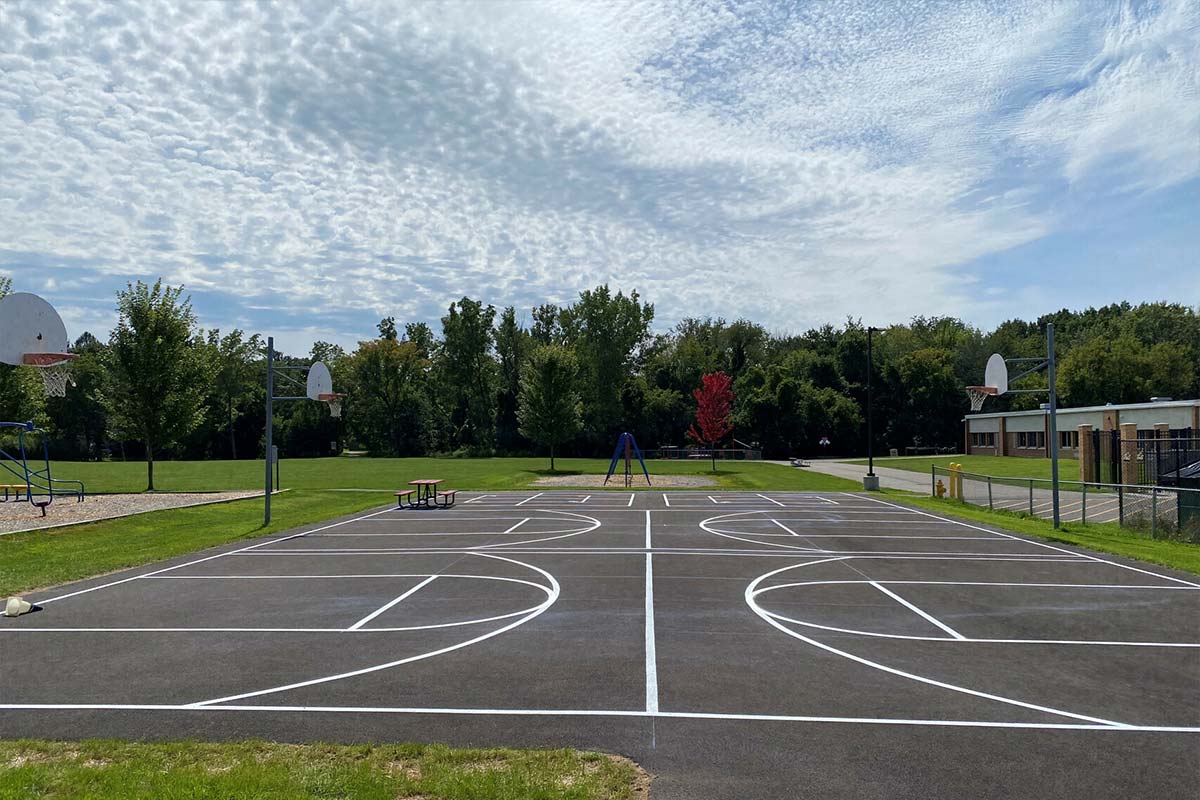
Pickleball drives most new court demand in Sarasota
Pickleball has surged across Sarasota County faster than any other court sport in the past decade. Sarasota County Parks operates more than 30 pickleball facilities, and HOA private courts have multiplied across Lakewood Ranch, Venice, and the Punta Gorda residential corridor. Standard pickleball court dimensions are 20 by 44 feet with a 7-foot kitchen (non-volley zone) on each side of the net per USA Pickleball court specifications. Singles and doubles play to identical exterior dimensions; only the service area markings differ.
Court orientation matters for outdoor pickleball in the strong Florida sun. North-south alignment keeps morning and afternoon sun glare out of the server’s eyes during typical play windows. Site constraints (drainage, fence lines, existing slab) sometimes force a different angle, and we adjust orientation accordingly. For any orientation that puts low-angle morning sun on the receiving side of the court, we recommend a covered or screened backdrop.
Multi-court layouts on a single concrete pad
Most Sarasota HOA and condo association courts get multiple sports painted on a single 30 by 60-foot or 36 by 78-foot pad. A common layout pairs one regulation tennis court with two pickleball courts oriented sideways, or four pickleball courts in a 2×2 grid on a larger pad. Color-coded line systems let players identify the active sport at a glance: pickleball lines in white, tennis lines in green or yellow, basketball lines in blue or red.
The trade-off in multi-sport layouts is line clutter. Players new to a multi-court can struggle to see only the lines for their sport. We use color contrast and line weight (pickleball lines slightly heavier than secondary sport lines) to make the primary sport visually dominant. For private HOA clubhouse pads where pickleball is clearly the primary use, single-sport painting and a separate small pad for the secondary sport is sometimes the better answer than crowding the primary pad.
Florida sun and the sports court paint cycle
Acrylic court paint in Sarasota typically holds 18 to 36 months depending on UV exposure and traffic load. Outdoor courts in heavy daily play cycle closer to 18 months; HOA private courts that see weekend-only use can stretch to 36 months. Indoor courts at HOA clubhouses and private fitness facilities often run 4 to 6 years because they avoid direct UV.
We use a high-grade acrylic court paint system designed for outdoor sports courts in subtropical climate. The pigment is UV-stabilized, but the resin layer still degrades over time, and salt-air corrosion at properties on barrier islands or directly on the Gulf accelerates the degradation. Lakewood Ranch and inland Sarasota properties get the longer end of the paint life range; Siesta Key and Longboat Key courts cycle faster.
Restripe pairs with an acrylic resurface every 6 to 8 years on outdoor courts because the underlying acrylic surface degrades on a similar timeline and crack-fills become visible through the line work. The resurface is a separate trade we coordinate with court surfacing specialists; line painting follows the resurface after a full cure window of 24 to 48 hours.
Court dimension reference table
| Sport | Court size | Net height | Notes |
|---|---|---|---|
| Pickleball (singles + doubles) | 20′ x 44′ | 36″ sidelines, 34″ center | 7′ kitchen each side |
| Tennis (full) | 36′ x 78′ (with doubles) | 42″ sidelines, 36″ center | 27′ singles width |
| Tennis (half / red ball) | 36′ x 36′ | 36″ | Junior development |
| Basketball (regulation) | 50′ x 94′ | 10′ rim | NCAA / NBA standard |
| Basketball (high school) | 50′ x 84′ | 10′ rim | More common at HOA pads |
| Basketball (half-court) | 50′ x 47′ | 10′ rim | Most common HOA layout |
| Shuffleboard (regulation) | 6′ x 52′ | n/a | 6’6″ triangles each end |
The court dimension table is the structured content element for this page. We size the pad and orient the lines to whatever combination the facility needs.
Sarasota County Parks and county-park procurement
Sarasota County Parks, Recreation and Natural Resources operates the largest network of public pickleball, tennis, and basketball facilities in the area. The Sarasota County Parks, Recreation and Natural Resources procurement process for striping work is straightforward: written scope, certificate of insurance naming the county, and a maintenance schedule are typically all that is required. Major county sites include Bobby Jones Golf Complex tennis and pickleball facilities, the Lakewood Ranch sports complex, and several neighborhood park courts.
City of Sarasota and City of Venice park systems run separate procurement processes with similar documentation requirements. Most municipal court restripe work happens between the November-to-April high-traffic season and the lower-volume summer months when crews can mobilize without disrupting league play.
HOA and condo association court approval process
Private courts at HOAs and condo associations almost always require architectural-review committee (ARC) approval before striping work, even on a like-for-like restripe. We deliver written estimates, scope documents, and color/layout specifications in the format committees expect on first submission, which avoids the bouncing-back-for-revisions cycle that wastes weeks.
For new courts (first-time striping on a freshly resurfaced pad), the ARC submission usually requires a full layout drawing showing court dimensions, line colors, paint specifications, and a maintenance schedule. We provide all of that as part of the estimate package. ARC review tends to move faster on courts that exactly match an existing facility elsewhere on the property; new layouts that change the visible character of the recreation area can trigger longer review.
Surface prep before sports court striping
New courts on freshly poured concrete need an acrylic resurface system (typically two coats of an acrylic court paint base) before final striping. This is a separate trade we coordinate with court surfacing specialists. Existing courts that need only fresh lines get a pressure wash, crack-fill on the underlying acrylic, and a 24-to-48-hour dry window before line paint goes down.
We do not lay sports court stripes directly on bare concrete or asphalt that has not been resurfaced. Line bond fails on unsealed substrate within months and the paint lifts in chunks rather than fading gradually. Where a customer wants striping on a tennis or basketball pad without paying for a full acrylic resurface, we recommend a primer-and-paint system instead, with the trade-off that line life will be shorter than on a properly resurfaced court.
Pickleball, tennis, basketball, and shuffleboard — what we paint
Our standard sports court striping work covers pickleball (singles and doubles, including kitchen), tennis (full court, half-court, and red-ball junior), basketball (regulation, high school, and half-court — the most common HOA layout), and shuffleboard. We can also paint custom game markings (four square, hopscotch, foursquare grids) on existing acrylic court surfaces or playground pads, though true playground game markings are usually folded into a separate scope from competitive sports court striping.
Outdoor courts at retiree HOAs in Sarasota and Charlotte counties often combine pickleball and shuffleboard on adjacent pads. Both sports skew older and pair well in a clubhouse layout. We coordinate the multi-court visual design so the two sports read clearly without competing for the same line color. Lakewood Ranch and other multi-generational communities tend toward pickleball-tennis-basketball combinations on a single recreation campus.
For a full list of our pavement marking services, visit our parking lot striping in Sarasota page.
Businesses We Serve




How it Works

GET A FREE ESTIMATE
Contact us today and we’ll have a quote to you in 24 hours

SCHEDULE AN INSTALLATION
We’ll have your play space restriped in less than 7 days, without affecting your playtime

GET A PARKING LOT THAT POPS
For a budget-friendly price, you’ll get a parking lot that looks like new
We proudly work with:


We proudly work with:


Frequently Asked Questions About Sports Court Striping in Sarasota, FL
What are the official pickleball court dimensions you stripe?
Standard pickleball courts are 20 by 44 feet with a 7-foot kitchen (non-volley zone) on each side of the net, per USA Pickleball court specifications. We stripe singles and doubles courts to identical exterior dimensions; only the service area markings differ. Court orientation is typically north-south to minimize sun glare during morning and afternoon play, which matters for outdoor courts in the strong Florida sun.
Can you stripe multiple sports on one court?
Yes. Multi-court layouts are common in Sarasota HOAs and county parks — a single 30 by 60-foot pad can carry one tennis court (36 by 78 feet adjusts down for a half-court layout), two pickleball courts side-by-side, and shuffleboard alleys at the perimeter. Color-coded line systems let players read the active sport quickly. We coordinate stripe colors to match facility branding when requested.
How long does sports court paint last in the Florida sun?
Acrylic court paint in Sarasota most often holds 18 to 36 months depending on traffic load and direct UV exposure. HOA private courts that see weekend play hit the longer end; county park courts in heavy daily rotation cycle closer to 18 months. We use a high-grade acrylic system designed for outdoor courts in subtropical climate — pigment is UV-stabilized but the resin layer still degrades over time.
Do you stripe courts at Sarasota County Parks and Lakewood Ranch?
Yes. Sarasota County Parks operates more than 30 pickleball facilities including major sites at Bobby Jones Golf Complex and Lakewood Ranch, and we work with both county and private facility managers across the area. The Sarasota County Parks, Recreation and Natural Resources procurement process tends to be straightforward — written scope, certificate of insurance, and a maintenance schedule are often all that is needed.
How often do courts need to be restriped?
Outdoor court restripe cycles run 18 to 36 months in Sarasota’s UV climate. Indoor courts at HOA clubhouses and private fitness facilities can stretch to 4 to 6 years because they avoid direct UV. We typically pair restripe with an acrylic resurface every 6 to 8 years, since the underlying acrylic surface itself degrades and crack-fills become visible through the line work.
Do you handle surface prep before striping a new court?
Yes — but with a sequence. New courts need an acrylic resurface system (usually two coats) before final striping, which is a separate trade we coordinate with surfacers. Existing courts that just need fresh lines get a pressure wash and crack-fill before paint. We do not lay sports court stripes on bare asphalt or concrete that has not been resurfaced, because the line will not bond properly to the unsealed substrate.