Warehouse Line Painting
In Sarasota, FL
OSHA-Compliant Safety Markings
1-800-STRIPER provides professional warehouse line painting in Sarasota, FL — OSHA-compliant aisle lines, pedestrian walkways, and safety zone markings per OSHA 1910.22 requirements using durable epoxy and traffic paint for distribution centers and industrial facilities along the I-75 corridor.
1-800-STRIPER® of Sarasota PROVIDes Warehouse Floor Markings Services NEAR YOU
Want your indoor space to operate more efficiently?
Warehouse and interior markings ensure clear traffic lanes, organized storage zones, and designated spaces designed to help your business operate safely and efficiently.
Benefits:
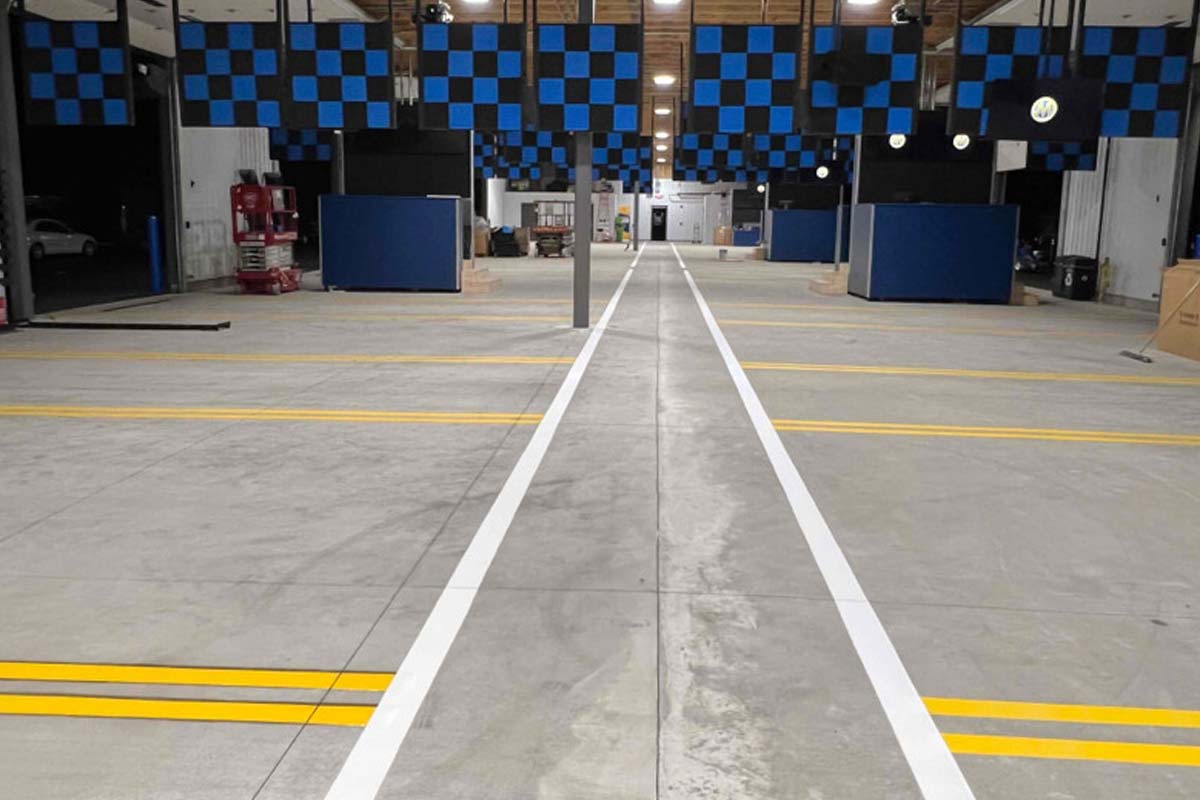
OSHA 1910.22 sets the warehouse marking standard
OSHA 1910.22 requires permanent aisles and passageways inside warehouses to be appropriately marked. The standard stays silent on color, line width, and pattern; those decisions belong to the facility. What it does set is the underlying obligation that every commercial warehouse in Sarasota and Manatee counties has to meet. Inspectors and insurance carriers expect a marking system that is permanent, conspicuous, and consistent. Most distribution centers along the I-75 corridor default to the ANSI Z535.2 color-coding system, since it satisfies OSHA’s general intent and lines up with what forklift operators have been trained to recognize across the industry.
A typical Sarasota warehouse runs five categories of marked zones: aisle pathways, pedestrian walkways, equipment-staging boxes, hazard zones, and emergency-equipment locations. Each category gets a different color under ANSI convention, which lets a forklift operator scan the floor and read the active environment in a single glance. Mixing systems creates problems. If aisle paths get marked in red because that is what an out-of-state facility used, the confusion compounds across shift turnover and contractor visits. Sticking with one standard for the whole site is the cleaner choice.
ANSI Z535.2 color coding for warehouse safety lines
ANSI Z535.2 maps colors to function. We follow this standard on every Sarasota warehouse job unless a customer’s existing system requires otherwise.
| Color | Meaning | Common warehouse use |
|---|---|---|
| Yellow | Caution / physical hazards | Aisle borders, ramps, low-clearance zones |
| Red | Fire equipment, emergency stops | Fire extinguisher stations, emergency exit paths |
| Blue | Information, equipment marking | Equipment staging boxes, charging stations |
| Green | Safety equipment | Eyewash stations, first aid, AED locations |
| Black-yellow diagonal | Physical hazards (do not stand) | Roll-up door swing zones, machine guarding |
| White | Storage and operational zones | Pallet positions, picking zones, receiving lanes |
| Orange | Energized equipment, safety hazard | Electrical panels, control boxes |
ANSI Z535.2 safety color coding is our default reference for layout decisions. After install, we hand over an as-built drawing so facility managers can train new staff and update the safety plan against an accurate diagram.
Two-component epoxy vs. traffic paint for warehouse floors
Sarasota warehouses choose between two-component epoxy and traffic paint based on traffic load and downtime tolerance. Both have specific roles.
Two-component epoxy holds up to forklift traffic for three to five years. Application requires mixing the resin and hardener on-site, and cure time runs 8 to 24 hours depending on humidity and temperature. Sarasota’s warm year-round ambient pulls cure to the lower end of that range. Epoxy costs more per linear foot than paint and requires a longer floor closure window, but the long service life makes it the right call for main forklift travel paths in active distribution centers.
Traffic paint cycles every 12 to 24 months in a warehouse environment. Sherwin-Williams Fast-Dry and equivalent commercial-grade paints cure in 30 to 60 minutes, which means a freshly painted aisle is back in use the same shift. Lower cost per linear foot and short cure time make paint the right choice for picking aisles, low-traffic zones, and any area where the marking layout might change as the facility evolves.
Most Sarasota warehouses end up running both: epoxy on main travel paths, paint on lower-traffic outer zones. A hybrid approach captures the long-life benefit where it matters most without paying for full-floor epoxy coverage that the traffic load doesn’t justify.
Working around active warehouse operations
Distribution centers along I-75 in Sarasota and Manatee counties usually run 24/7 or near-24/7 schedules. We mobilize on off-shifts, typically 10 PM to 6 AM, and segment the work zone-by-zone so picking and shipping operations continue uninterrupted. Forklift operators stay clear of newly painted zones during cure (30 to 60 minutes for paint, longer for epoxy), and we rotate active zones to keep the floor productive while the work moves through it.
A typical 100,000-square-foot distribution center can complete a full restripe inside three to five overnight shifts using this rotation method. Larger facilities (250,000+ square feet) run two-week sequences with multiple zones per night. Before the first night, we coordinate with the facility’s safety officer and shift supervisors to set the rotation order and lockout-tagout procedures for the affected zones.
When a facility can take a planned weekend shutdown, the work often wraps in a single 48-to-72-hour window. Weekend mobilizations are common in Sarasota during the slower June-through-August period when distribution volume drops between snowbird and back-to-school cycles.
Pedestrian walkway and forklift separation marking
OSHA-recommended best practice (and what most insurance carriers expect) is physical separation between forklift travel paths and pedestrian walkways inside the warehouse. Where physical barriers are not practical, painted walkway boundaries with a contrast color do the job. We typically use yellow striped at 4-inch width on each side of the walkway to create a visible separation. Pedestrian-only zones use a solid yellow border with diagonal hatching at the entry where forklift traffic might cross.
Walkway routes get designed around the natural flow from break rooms, restrooms, and supervisor offices to the operational floor, without forcing pedestrians to cross main forklift travel paths. Crossings, when they have to exist, get high-visibility ladder-style striping with stop bars on the forklift side. Compliance with OSHA 1910.22 is the baseline; what we deliver is a layout that holds up under daily traffic load.
I-75 corridor distribution center experience
Sarasota and Manatee counties have grown into one of the major distribution hubs of southwest Florida, anchored by the I-75 corridor between Tampa and Fort Myers. Distribution centers serving the Sarasota–Bradenton–Lakewood Ranch retail base, Port Charlotte–Punta Gorda residential growth, and the broader Gulf-coast retail corridor all need OSHA-compliant warehouse marking. Lakewood Ranch industrial parks, Sarasota County’s University Parkway corridor, and the Manatee County US-301 industrial zones are typical service areas for our warehouse line painting work.
Salt-air corrosion is less of a factor inside climate-controlled warehouses than out on exterior parking lots, but high-humidity periods do extend epoxy cure times. We schedule epoxy applications around the daily humidity cycle when possible. Early-morning starts catch the lowest dew point of the day on most Sarasota summer mornings. Traffic paint is less humidity-sensitive and stays on schedule through normal Florida summer conditions.
Pre-paint surface prep makes or breaks line life
Warehouse floor lines fail more often from poor surface prep than from inadequate paint quality. Concrete that has been sealed with a curing compound, or contaminated with hydraulic fluid, oil, or wash residue, won’t bond paint or epoxy properly, and the line will lift or chip within months. Surface prep on a warehouse job usually includes a deep clean (mechanical scrubbing or shot blasting on heavily contaminated floors), a chemical wash to remove oil and grease, and a 24-to-48-hour dry window before paint goes down.
For epoxy installations on new concrete floors, an acid etch or shot-blasted profile is required so the epoxy bonds to the substrate rather than sitting on top of the surface laitance. We coordinate with the facility’s maintenance crew or a flooring subcontractor on the prep step. Most Sarasota warehouses have an existing janitorial relationship that can handle the cleaning portion if scheduled in advance of our mobilization.
As-built documentation and OSHA inspection readiness
After every warehouse line painting job, we deliver an as-built diagram of the marked floor. The diagram shows aisle widths, walkway routes, hazard zones, and emergency equipment locations, with the color-coding key called out in the legend. This is the document facility managers hand to OSHA inspectors, insurance carriers, and corporate safety auditors when the question of compliance comes up.
Repainting decisions and floor-layout changes also work better against an accurate as-built. When the operations team needs to reconfigure picking zones for a new product line or expand staging for a higher-volume vendor, the as-built diagram gives them a starting point that doesn’t require a full site re-survey. We update the diagram during any subsequent restripe so the document stays current with the actual floor.
For a full list of our pavement marking services, visit our parking lot striping in Sarasota page.
Businesses We Serve




How it Works

GET A FREE ESTIMATE
Contact us today and we’ll have a quote to you in 24 hours

SCHEDULE A STRIPING
We’ll have your space restriped in less than 7 days, without affecting your business hours

GET A PARKING LOT THAT POPS
For a budget-friendly price, you’ll get a parking lot that looks like new
We proudly work with:


We proudly work with:

Frequently Asked Questions About Warehouse Line Painting in Sarasota, FL
What does OSHA require for warehouse line marking?
OSHA 1910.22 requires permanent aisles and passageways to be appropriately marked. The standard does not specify color, width, or pattern — it leaves the marking system to the facility, but ANSI Z535.2 color coding and the OSHA “permanent and conspicuous” requirement effectively set the standard most insurance carriers and inspectors expect. We default to ANSI color coding unless a customer’s existing system requires otherwise.
What do the OSHA color codes mean for warehouse lines?
ANSI Z535.2 color coding maps yellow to caution and physical hazards, red to fire equipment and emergency stops, blue to information and equipment-specific marking, green to safety equipment (eyewash, first aid), and yellow-and-black diagonal stripes to physical-hazard zones. We use ANSI Z535.2 safety color coding as the default system on Sarasota distribution and manufacturing sites along the I-75 corridor.
Should I use epoxy or traffic paint for warehouse lines?
Two-component epoxy holds up to forklift traffic for three to five years, traffic paint cycles 12 to 24 months. Epoxy costs more per linear foot and requires longer cure (8 to 24 hours), so most Sarasota warehouses use epoxy in main forklift aisles and traffic paint in lower-traffic outer zones. Distribution centers along I-75 and US-41 in most cases choose epoxy for the main travel paths and paint for picking aisles.
How long does the warehouse need to be down for line painting?
We schedule warehouse striping around your operation. Off-shift work (nights or weekends) is common for active distribution centers — paint cures within 30 to 60 minutes, epoxy needs 8 to 24 hours depending on temperature and humidity. Sarasota’s warm year-round climate keeps cure times on the fast end. Most projects can run one zone at a time so the warehouse never goes fully offline.
Can you work in active warehouses without shutting down operations?
Yes. We mobilize on off-shifts (usually 10 PM to 6 AM) and segment the work by zone so picking and shipping operations continue uninterrupted. Forklift traffic stays out of newly-painted zones during cure (30 to 60 minutes for paint, longer for epoxy), and we sequence the work so the active zones rotate. Distribution centers along I-75 in Sarasota and Manatee counties typically run this off-shift pattern.
ANSI vs. ISO color coding — which should I use?
ANSI Z535.2 is the U.S. standard and the default for Sarasota warehouses. ISO 3864 is the international equivalent and uses some different color assignments — facilities serving European or Asian-headquartered parent companies sometimes default to ISO. We mark to whichever system the customer specifies; mixing the two on a single floor causes confusion for forklift operators and is not recommended. Most U.S. insurance carriers expect ANSI.
Do you handle hot-pour thermoplastic lines on warehouse floors?
Hot-pour thermoplastic is more typical of exterior pavement than interior warehouse floors — the application temperature (around 400°F per AASHTO M249) is harder to manage indoors safely. For interior warehouse marking we use either two-component epoxy (long life, cold-applied) or traffic paint. If a customer specifically needs the thermoplastic durability profile indoors we coordinate with a specialist subcontractor and follow AASHTO M249 application practice.