ADA Parking Lot Striping
In South Denver, CO
ADA-Compliant Accessible Parking
1-800-STRIPER provides ADA-compliant parking lot striping in South Denver, CO — installing accessible spaces, van-accessible stalls, access aisles, ISA symbols, and required signage per the 2010 ADA Standards for Accessible Design and ICC A117.1.
1-800-STRIPER® of South Denver PROVIDes ADA Compliance Services NEAR YOU
Need to make your property more accessible?
Upgrade your facility to become fully ADA compliant by partnering with us to create clear, accessible parking for all your visitors.
Our ADA Compliant line striping services include:
ADA Parking Lot Striping in South Denver, CO
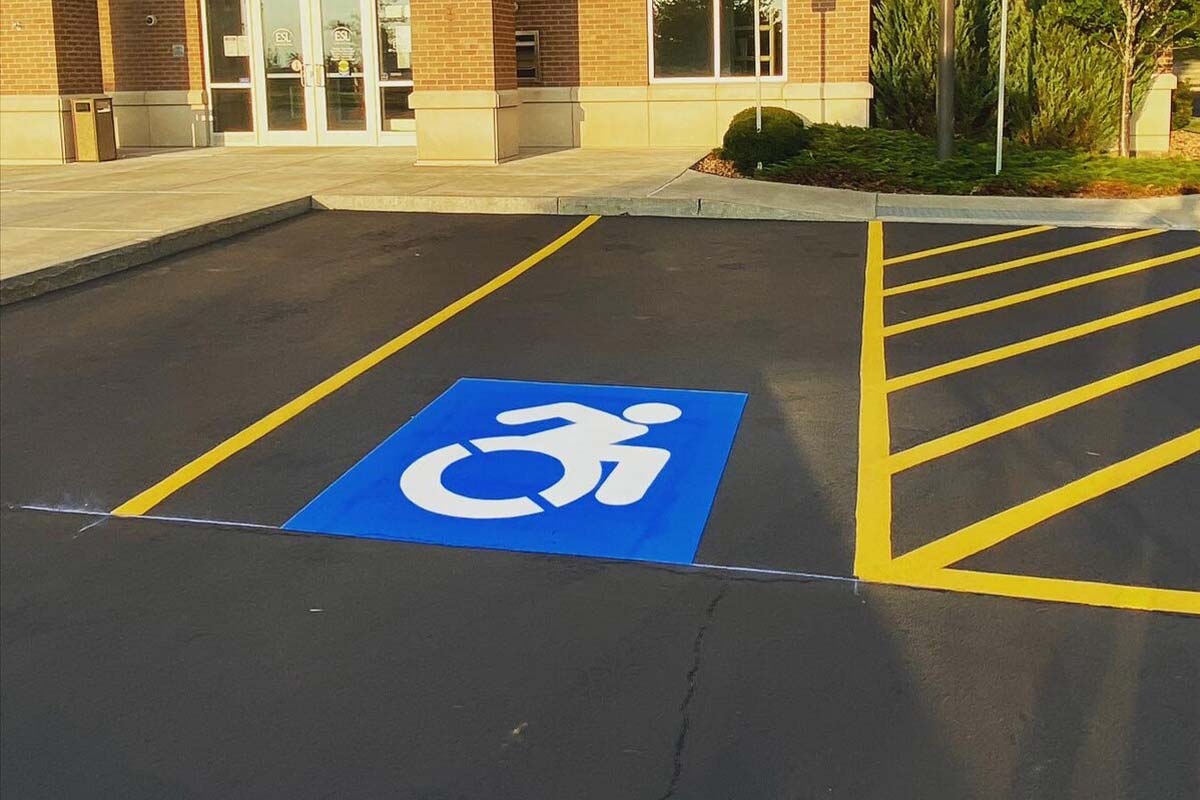
ADA parking lot striping brings the accessible spaces on a commercial lot into line with federal accessibility rules. That means the right number of accessible stalls, access aisles of the correct width, the International Symbol of Access painted on the pavement, and upright signage at each space. 1-800-STRIPER of South Denver installs and refreshes accessible parking for retail centers, medical offices, restaurants, and industrial sites across the south Denver metro and Colorado Springs. Accessible parking is one of the most common reasons a lot draws a complaint or fails an inspection, and the rules are specific, so getting the count, placement, and dimensions right protects both your visitors and your property. We handle new accessible layouts and corrections to spaces that have faded or fallen out of compliance.
ADA Accessible Parking Requirements
The number of accessible spaces a lot needs scales with its total size under the 2010 ADA Standards for Accessible Design. A lot with 1 to 25 spaces needs at least one accessible stall; 26 to 50 needs two; and the ratio continues upward from there. At least one of every six accessible spaces must be van-accessible. Each accessible space needs an adjacent access aisle — 60 inches wide for a car space and 96 inches for a van space — that connects to an accessible route to the building entrance. Section 208 of the Standards sets the counts and Section 502 sets the space and aisle geometry. We size the requirement to your specific lot rather than guessing.
Signage and ISA Symbols
Every accessible space needs both pavement markings and an upright sign, and both have rules. The International Symbol of Access — the familiar wheelchair symbol — is painted within the stall, and van-accessible spaces carry an added van designation. The upright sign must sit high enough to stay visible when a vehicle is parked in the space; the 2010 ADA Standards require the bottom of the sign to be at least 60 inches above the ground. Signs follow the R7-8 accessible-parking format that the Manual on Uniform Traffic Control Devices sets as the national convention. We install compliant signs along with the pavement markings so each space is complete.
How We Bring a Lot Into Compliance
Bringing an existing lot into compliance follows a clear sequence.
- Audit your existing accessible parking against the current Standards — counting spaces, measuring access-aisle widths, checking sign heights, and confirming each space connects to an accessible route.
- Identify where the lot falls short, since lots striped years ago often miss on aisle width or van-space count as the rules tightened over time.
- Lay out the corrections — adding or relocating spaces, widening aisles, repainting symbols, and replacing signage.
- Flag any fix that requires more than paint, such as a curb ramp or a route regrade, and explain the scope.
- Deliver a lot that would pass an accessibility review.
Colorado Accessibility Standards
Federal ADA rules apply everywhere, but the technical construction details are enforced locally. Colorado is a home-rule state with no single statewide building code, so each jurisdiction adopts its own — and the accessibility geometry those codes reference comes from ICC A117.1, the standard for accessible and usable buildings and facilities. Denver enforces its adopted accessibility code based on ICC A117.1 through the Denver Building Code, and southern jurisdictions such as Colorado Springs adopt the same family of standards through their own building departments. We design accessible parking to satisfy both the federal 2010 ADA Standards and the local ICC A117.1 requirements that a Colorado plan reviewer will actually check.
For a full list of our pavement marking services, visit our parking lot striping in South Denver page.
Businesses We Serve




How it Works

GET A FREE ESTIMATE
Contact us today and we’ll have a quote to you in 24 hours

SCHEDULE AN INSTALLATION
We’ll have your installation scheduled in less than 7 days, without affecting your business hours

GET A PARKING LOT THAT POPS
For a budget-friendly price, you’ll get a parking lot that looks like new!
We proudly work with:


We proudly work with:

Frequently Asked Questions About ADA Parking Lot Striping in South Denver, CO
How many ADA spaces does my lot need?
It scales with your total number of parking spaces under the 2010 ADA Standards. A lot of 1 to 25 spaces needs at least one accessible stall, 26 to 50 needs two, 51 to 75 needs three, and the count keeps climbing from there. Separately, at least one in every six accessible spaces must be van-accessible. Medical and outpatient facilities that treat mobility conditions carry higher ratios. We calculate the exact requirement from your lot’s total count so you get the number a plan reviewer will expect to see.
What makes a space van-accessible?
A van-accessible space pairs the parking stall with a wider access aisle so a side- or rear-mounted wheelchair lift has room to deploy. Under the 2010 ADA Standards, the access aisle for a van space is 96 inches wide, versus 60 inches for a standard accessible car space, and the space needs enough vertical clearance along the van’s route for a raised roof. The upright sign adds a van-accessible designation. At least one of every six accessible spaces on a lot has to meet this van standard, and we mark and sign them accordingly.
How high must the accessible-parking sign be mounted?
The 2010 ADA Standards require the bottom edge of the accessible-parking sign to sit at least 60 inches above the ground, measured to the bottom of the sign. Mounting it that high keeps the symbol visible over the hood and roof of a vehicle parked in the space, so drivers and enforcement can see it from a distance. The sign itself uses the R7-8 accessible-parking format from the Manual on Uniform Traffic Control Devices, with a van-accessible plaque added where required. We set every sign to the correct height when we install accessible parking.
What are the ISA symbol and access-aisle marking rules?
Each accessible space is painted with the International Symbol of Access inside the stall, and the access aisle beside it is marked with diagonal stripes and often the words NO PARKING so it stays clear. The access aisle must be level, connect to an accessible route to the entrance, and run the full length of the space. Car spaces get a 60-inch aisle and van spaces a 96-inch aisle under Section 502 of the 2010 ADA Standards. Keeping these markings sharp is part of staying compliant, since a faded symbol or aisle can be treated as a missing one.
Does Colorado add requirements beyond federal ADA?
The federal 2010 ADA Standards apply statewide, but Colorado enforces the technical details through local building codes rather than a single state code, because it is a home-rule state. Those local codes reference ICC A117.1 for the accessible geometry — stall and aisle dimensions, slopes, and clearances. In practice that means an accessible space has to satisfy both the federal Standards and the ICC A117.1 provisions your jurisdiction adopts. We design to both so the lot holds up whether it is reviewed against the federal rule or the local building code.
What are the risks of a non-compliant lot?
A lot that falls short on accessible parking exposes the property owner to complaints, civil-rights claims, and failed inspections, and it genuinely shuts out customers who rely on accessible spaces. The most common gaps are too few spaces, access aisles that are too narrow, missing or low-mounted signs, and faded symbols. Because the 2010 ADA Standards tightened requirements over the years, a lot that was compliant when it was first striped can be out of date now. An accessibility audit finds those gaps before someone else does, and correcting them is far cheaper than defending a claim.