Wheel Stop Installation
In Tulsa, OK
Concrete and Rubber Parking Stops
1-800-STRIPER® provides professional wheel stop installation in Tulsa, OK — anchoring concrete and recycled-rubber wheel stops at stall heads to protect sidewalks, storefronts, and landscaping while keeping accessible routes and access aisles clear per the 2010 ADA Standards for Accessible Design.
1-800-STRIPER® of Tulsa PROVIDes Wheel Stop Installation Services NEAR YOU
Need to protect vehicles or walls from accidental damage?
Wheel stops (also called parking blocks) protect your property, enhance safety, and improve parking lot organization.
Benefits:
Wheel stops prevent vehicles from parking too far into a space or overextending into other spots, pedestrian walkways, and other areas, while also helping with vehicle alignment. They can prevent damage to buildings, curbs, or landscaping. Wheel stops also serve as clear visual cues for proper parking and are sometimes used on slopes to prevent cars from rolling.
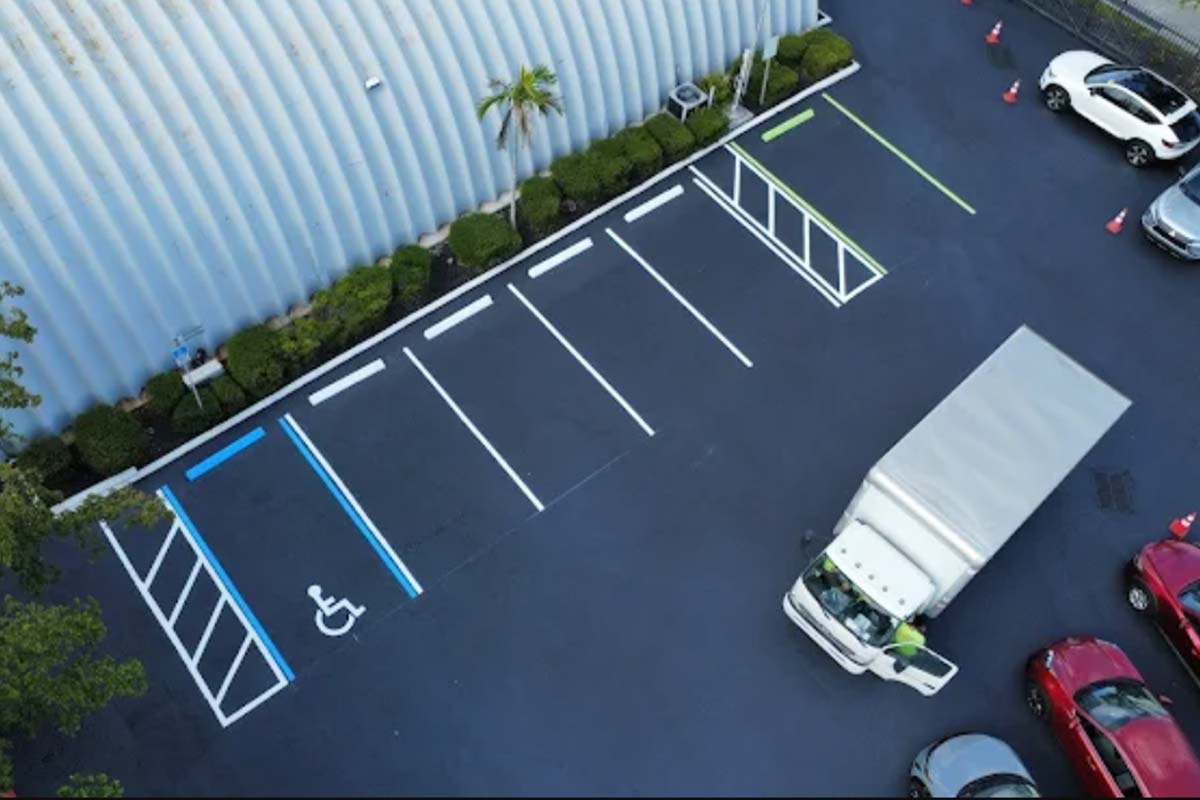
Wheel Stop Installation in Tulsa, OK
Wheel stops are the low barriers set at the head of a parking stall that stop a vehicle before its bumper reaches whatever is behind it. They go by several names — parking blocks, parking curbs, bumper blocks, and wheel stoppers all describe the same product — and in Tulsa they are one of the most requested items on a commercial lot after striping itself.
What they do is straightforward. They stop vehicles overrunning into sidewalks, storefronts, landscaping, fencing and utility equipment. They give drivers a positive stop so cars park at a consistent depth instead of creeping forward. And on sloped lots they stop a vehicle rolling further than intended.
We supply and install wheel stops as a standalone job or alongside striping, which is usually the more sensible sequence since the stall layout determines where each one belongs.
Where Wheel Stops Go and How They Are Anchored
Placement is the part that gets done badly. Wheel stops are set at the head of the stall, positioned so a vehicle of typical length stops with its bumper clear of whatever is being protected, and set back from the front edge so the vehicle’s tires — not its underbody — meet the block.
The accessibility constraint is the one worth taking seriously. Under Section 502.7 of the 2010 ADA Standards for Accessible Design, parking spaces and access aisles must be designed so that vehicles, when parked, cannot obstruct the required clear width of adjacent accessible routes. Wheel stops are one of the main tools for satisfying that, because they stop a vehicle overhanging a sidewalk that forms part of the accessible route. Used carelessly they can create the opposite problem: a wheel stop placed into an access aisle or across a route becomes a trip hazard and an obstruction in the very space that must stay clear. Access aisles beside accessible stalls must remain unobstructed.
On material, the two common choices are concrete and recycled rubber:
Precast concrete. Heavier, more rigid, and long established. The default on most commercial lots and the one most people picture when they hear parking block.
Recycled rubber. Lighter, will not spall or chip the way concrete does under freeze-thaw, and easier to handle and replace — which matters on a lot where stops get moved or damaged.
Anchoring, whichever you choose. Both are fixed to the surface, never simply laid on it, with the fixing method matched to asphalt or concrete. An unanchored wheel stop migrates under repeated contact and eventually becomes the hazard it was meant to prevent.
Set-back position. Placed at the head of the stall and set back from the front edge, so a vehicle’s tires meet the block and its underbody clears — and clear of access aisles and accessible routes, which must stay unobstructed.
For a full list of our pavement marking services, visit our parking lot striping in Tulsa page.
Businesses We Serve




How it Works

GET A FREE ESTIMATE
Contact us today and we’ll have a quote to you in 24 hours

SCHEDULE AN INSTALLATION
We’ll have your installation scheduled restriped in less than 7 days, without affecting your business hours

GET A PARKING LOT THAT POPS
For a budget-friendly price, you’ll get a parking lot that looks like new
We proudly work with:


We proudly work with:


Frequently Asked Questions About Wheel Stop Installation in Tulsa, OK
Where should wheel stops be installed?
At the head of the stall, set back so the tires make contact and the underbody clears, and positioned so the bumper stops clear of whatever is being protected. They belong wherever vehicles would otherwise overrun sidewalks, storefronts, landscaping, fencing or utility equipment, and on sloped areas where roll-away is a risk. What they must never do is intrude into an access aisle beside an accessible stall or across an accessible route, because those spaces have to stay clear.
What is the difference between a wheel stop and a bollard?
They solve different problems. Wheel stops are low blocks at the head of a stall that stop a parked vehicle at a set depth — they position vehicles, they do not resist a moving one. Bollards are vertical posts, usually concrete-filled steel, designed to physically block or absorb a vehicle strike and protect a building entrance, storefront glass, fuel equipment or a pedestrian area from an impact. If the risk is a car creeping forward, use wheel stops. If it is a car arriving with force, use bollards.
What else are wheel stops called?
Several things, which is why searching for them is confusing. Parking blocks, parking curbs, bumper blocks, parking stops and wheel stoppers all describe the same product. Some suppliers use the term parking bumper as well. There is no functional difference behind the naming — it is regional and supplier habit. If you have been quoted for any of those, you have been quoted for wheel stops, and we install all of them under whichever name you prefer.
Are concrete or rubber wheel stops better?
It depends on the property. Concrete is heavier, rigid and long established, and it suits sites wanting maximum mass. Recycled rubber is lighter, will not spall or chip the way concrete can under freeze-thaw cycles, and is far easier to handle, replace and reposition if a layout changes. Rubber tends to look tidier for longer on customer-facing properties. We will talk through which suits your surface, your traffic and your appearance requirements at the estimate.
How are wheel stops anchored to the lot?
They are physically fixed to the surface, and the fixing method depends on whether the lot is asphalt or concrete. This matters more than it sounds: an unanchored wheel stop shifts under repeated vehicle contact, drifts out of alignment with the stall, and eventually becomes a trip hazard and an obstruction — the opposite of what it was installed to do. Proper anchoring is also what allows a wheel stop to actually resist a vehicle rather than simply being pushed along the surface.
Can wheel stops be used in accessible parking spaces?
Yes, and they are often exactly the right tool there, because Section 502.7 of the 2010 ADA Standards requires that parked vehicles not obstruct the clear width of adjacent accessible routes. A wheel stop stops a vehicle overhanging the sidewalk that route runs along. The critical limit is that the wheel stop itself must not intrude into the access aisle or across the route. Placement in accessible parking needs care rather than avoidance.