Parking Lot Restriping
In Fairfax, VA
Restripe Existing Lines and Markings
1-800-STRIPER provides professional parking lot restriping in Fairfax, VA — refreshing faded stalls, ADA accessible spaces and access aisles, fire lane markings, and directional arrows with fast-dry traffic paint for commercial properties across Fairfax County and Northern Virginia.
1-800-STRIPER of Fairfax PROVIDes Restriping Services NEAR YOU
Need to brighten up your faded parking lot?
Keep your parking lot safe and attractive by restriping annually to freshen up lines and symbols that have faded from the sun, weather, and traffic. Nothing beats a fresh coat of paint!
Benefits:
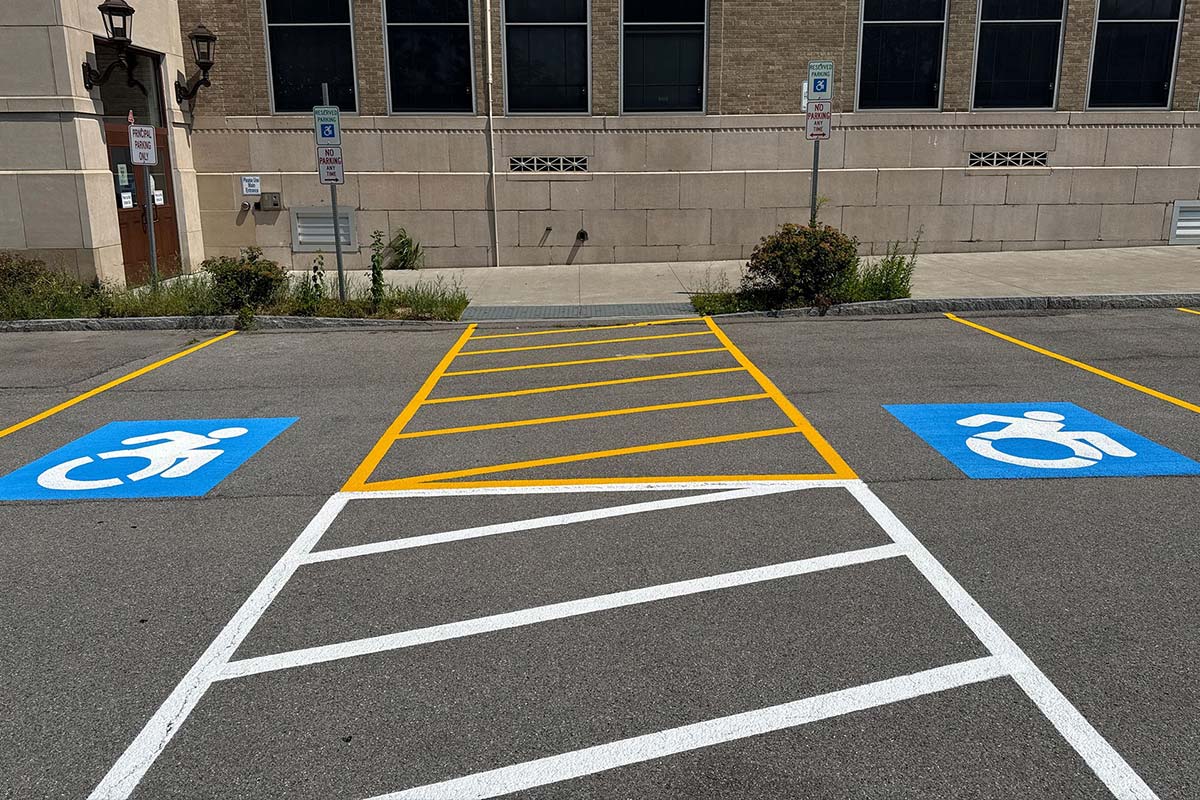
Parking Lot Restriping in Fairfax, VA
Restriping is the repainting of a parking lot’s existing markings in their existing positions. It is maintenance rather than design: the layout has already been decided, and the job is to bring faded lines, worn accessible markings, dulled fire lane paint, and washed-out directional arrows back to full contrast.
That distinction matters more than it sounds, and it is the first thing we establish on a site walk. Restriping repaints what is there. Relayout changes what is there — different stall angles, a different count, reconfigured circulation. The two jobs have different costs, different timelines, and, critically, different compliance consequences. A property that asks for a restripe and actually needs a relayout will be told so before anything is scheduled.
When a Parking Lot Needs Restriping
The honest test is legibility from a driver’s seat, not the date of the last service. Most commercial lots in Northern Virginia come due somewhere between eighteen months and three years, but that range is wide because wear is driven by traffic volume, winter plowing, and sun exposure rather than by the calendar. A retail center with constant turnover and an aggressive plow contract loses lines faster than a low-traffic office park.
The signals worth acting on are specific. Stall lines that read as gray rather than white. Accessible spaces where the ISA symbol or the access-aisle hatching has lost contrast. Fire lane paint that has dulled to the point where the boundary is ambiguous. Directional arrows and stop bars that drivers are visibly ignoring. Snowplow scarring along a whole run of stalls.
Two of those carry more weight than the rest. Faded accessible markings and faded fire lane markings are compliance exposure, not cosmetics — the first because accessible spaces have to remain identifiable as such, the second because the Fire Marshal’s designation does not lapse when the paint does.
How Restriping Works
Restriping is a four-step sequence, and most of the value is in the first two.
- Assess. We walk the lot and record what is actually on the ground: stall count and condition, accessible spaces and their access aisles, fire lane extents, arrows, stop bars, crosswalks, and any curb painting. Pavement condition is noted at the same time, because paint applied to a failing surface fails with it.
- Verify the layout. Before anything is repainted we check the existing layout against what it is required to be. This is the step that separates a restripe from a repaint, and it is where accessible spaces get their dimensions and count checked rather than assumed.
- Mask and protect. The lot is cleaned, the work area is closed in sections, and adjacent surfaces, curbs, and landscaping are protected. Sectional closure is standard — very few of the properties we work for can surrender the whole lot at once.
- Apply and cure. Fast-dry traffic paint is applied over the verified layout. In warm dry conditions the surface is typically walk-ready in about thirty minutes and open to vehicles in roughly one to two hours. Cool, humid, or shaded conditions extend that, and we sequence the sections so the lot stays usable while each one cures.
Restriping and ADA Compliance
This is where the restripe-versus-relayout distinction stops being terminology and starts having consequences.
Repainting an accessible space exactly as it was is maintenance. But if the existing accessible spaces do not meet the requirements — too few for the lot size, an access aisle below the required width, a missing van-accessible space, a sign mounted too low — then repainting them faithfully reproduces a non-compliant condition in fresh paint. The markings look new and the exposure is unchanged.
Because of that, we verify accessible spaces against the 2010 ADA Standards for Accessible Design as part of step two on every restripe, and we report what we find before applying paint rather than after. Where the lot is short on count or dimension, correcting it during a restripe is far cheaper than correcting it as a separate mobilization later, because the crew, the closure, and the equipment are already on site.
Altering stall geometry to fix a deficiency moves the job from restriping into relayout, and we say so explicitly rather than quietly re-drawing lines under a maintenance heading.
For a full list of our pavement marking services, visit our parking lot striping in Fairfax page.
Businesses We Serve




How it Works

GET A FREE ESTIMATE
Contact us today and we’ll have a quote to you in 24 hours

SCHEDULE AN INSTALLATION
We’ll have your installation scheduled in less than 7 days, without affecting your business hours

GET A PARKING LOT THAT POPS
For a budget-friendly price, you’ll get a parking lot that looks like new
We proudly work with:


We proudly work with:

Frequently Asked Questions About Parking Lot Restriping in Fairfax, VA
What is parking lot restriping?
Restriping is repainting a parking lot’s existing markings in their existing positions — stalls, accessible spaces and access aisles, fire lanes, directional arrows, stop bars, and crosswalks — to bring faded lines back to full contrast. It is maintenance rather than design. The layout is not changed. Where the layout itself is being altered, with different stall angles, a different space count, or reconfigured circulation, that is a relayout rather than a restripe, and it carries different cost, timeline, and compliance consequences.
Do you need a permit to restripe a parking lot?
For a straight restripe that repaints the same layout on private commercial property, Fairfax County does not require a building permit. What changes the answer is scope. Altering stall geometry, changing the number of spaces, or reconfiguring circulation can pull the work into site-plan territory, and anything touching accessible spaces has to satisfy the Virginia Construction Code and the federal accessibility standards. Fire lane markings are separately governed and designated by the Fire Marshal. Where a job is more than paint-for-paint, we confirm with the county before scheduling.
How often should parking lot striping be redone?
Most commercial lots in this region are due every eighteen months to three years, but the range is wide because the driver is wear rather than time. Traffic volume, winter plowing, and sun exposure all move it. A high-turnover retail center with an aggressive plow contract fades far faster than a low-traffic office lot. The practical test is whether the lines still read from a driver’s seat. Faded accessible markings and dulled fire lane paint should be treated as urgent rather than cosmetic, because both carry compliance exposure.
Does restriping have to bring accessible stalls up to current ADA standards?
Repainting an accessible space as it was is maintenance, but if the existing configuration is deficient then faithfully repainting it reproduces a non-compliant condition in fresh paint — the markings look new and the exposure is unchanged. We therefore check accessible spaces against the current standards as part of the layout-verification step on every restripe, and report what we find before applying paint. The U.S. Access Board publishes the parking requirements in plain language. Correcting a deficiency during a restripe is far cheaper than a separate mobilization later.
Can you restripe over faded lines, or does old paint have to come off first?
In most cases new paint goes directly over the old, which is exactly why restriping is quicker and less disruptive than a fresh layout. Removal becomes necessary in two situations: when the existing paint has built up through repeated recoating to the point where it is flaking and will take the new coat off with it, and when lines are moving, because a ghost line left beside a new one is worse than no line at all. Where lines move, we remove the old markings rather than trusting them to fade.
What temperature and weather does restriping need?
Traffic paint needs a dry surface and air and surface temperatures within the manufacturer’s range, which for most fast-dry products means comfortably above 50 degrees Fahrenheit and rising. Practically, that gives Northern Virginia a working season from spring through autumn, with cold snaps and wet spells taken out. Rain within the cure window is the main risk, so we watch the forecast rather than the calendar and will move a date rather than apply paint that will not cure properly. Shade and high humidity both extend cure times.