Warehouse Line Painting
In Midwest Houston, TX
OSHA-Compliant Safety Markings
1-800-STRIPER provides professional warehouse line painting in Midwest Houston, TX — marking OSHA-compliant aisles, pedestrian walkways, forklift lanes, and safety zones per OSHA 29 CFR 1910.176(a) using durable epoxy and traffic paint for industrial facilities.
1-800-STRIPER® of Midwest Houston PROVIDes Warehouse Floor Markings Services NEAR YOU
Want your indoor space to operate more efficiently?
Warehouse and interior markings ensure clear traffic lanes, organized storage zones, and designated spaces designed to help your business operate safely and efficiently.
Benefits:
What Warehouse Line Painting Includes
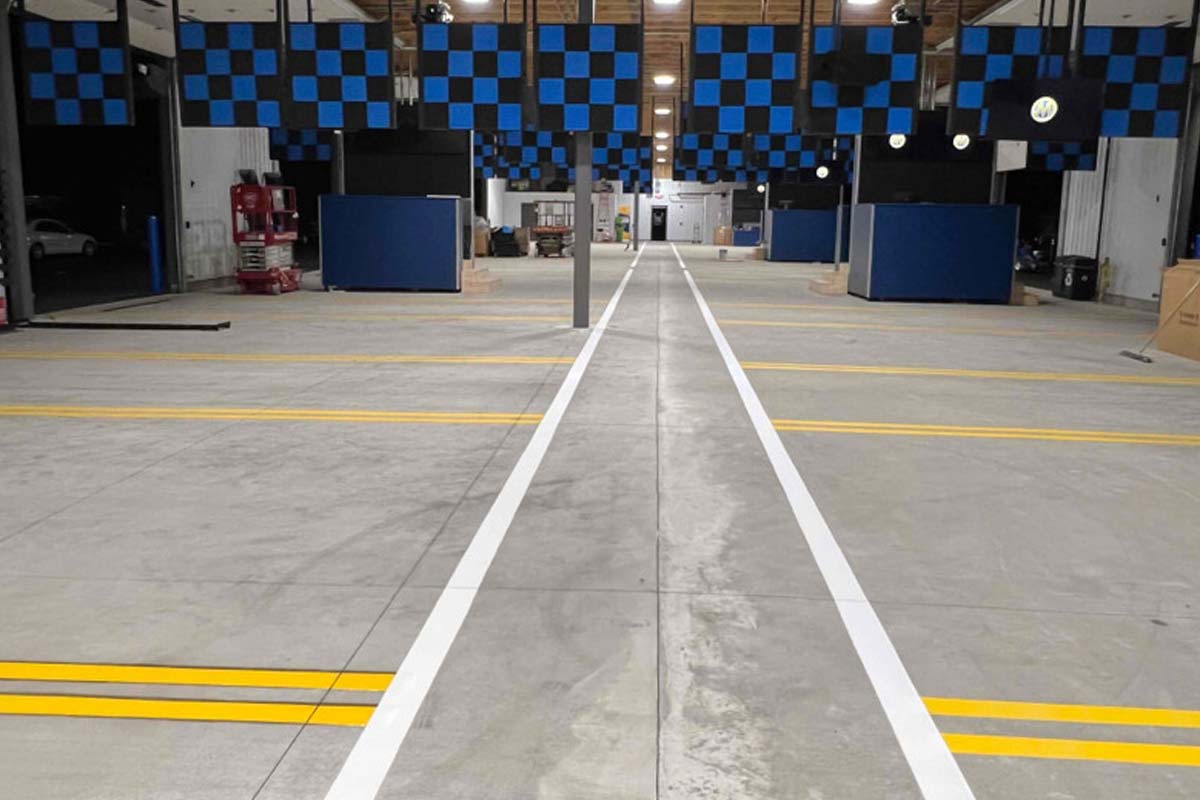
Warehouse line painting is the floor-marking system that keeps a busy facility organized and safe: the main aisles and passageways, pedestrian walkways separated from equipment, forklift and traffic lanes, staging and storage zones, dock and loading areas, and the hazard markings around electrical panels, eyewash stations, and exits. On a Beltway-corridor distribution building running forklifts and foot traffic in the same space, those lines are the difference between smooth flow and a near-miss.
We mark new facilities from a plan and re-mark worn floors where the old lines have been ground away by wheel traffic. The layout follows how your operation actually moves product, not a generic grid.
OSHA Aisle-Marking Requirements
Here is what the rule actually says, because it is widely misquoted. OSHA 29 CFR 1910.176(a) requires that where mechanical handling equipment is used, “permanent aisles and passageways shall be appropriately marked.” That is the mandate — aisles must be marked. What the standard does not do is set a required color, a line width, or a spacing. Those are left to the facility.
That matters for two reasons. First, an inspector is checking that your aisles are marked and kept clear, not that they are a particular shade of yellow. Second, anyone quoting you a specific OSHA-mandated color or width is repeating an industry convention as if it were the regulation. We mark to a clear, consistent standard that satisfies the requirement and works for your traffic — and we will tell you where the rule ends and the convention begins.
Line Color & Marking Conventions
Because OSHA leaves color open, most facilities follow a widely used convention drawn from ANSI Z535.1 safety-color practice: yellow for aisles and traffic lanes, white for work and storage areas, red for fire equipment and danger, and black-and-yellow or black-and-white stripes for physical hazards. It is a best practice that helps everyone read the floor the same way — not a legal mandate.
We will mark your floor to whatever color scheme your safety program or corporate standard already uses, or help you set one that follows the common convention if you are starting fresh. Consistency is what makes the markings work; the exact palette is your call.
Our Warehouse Marking Process
- Plan the flow. We map aisles, walkways, forklift lanes, and zones to how product and people actually move through the building.
- Prep the slab. Concrete has to be clean and dry for the coating to bond, so we clean and, where needed, lightly abrade the surface first.
- Mark in durable coating. We lay the lines in epoxy or heavy-duty traffic paint chosen for the wheel traffic the floor takes, with crisp edges and consistent widths.
- Cure and stage. We schedule around your operation and cordon fresh lines while they cure so forklifts do not lift the paint.
For a full list of our pavement marking services, visit our parking lot striping in Midwest Houston page.
Businesses We Serve




How it Works

GET A FREE ESTIMATE
Contact us today and we’ll have a quote to you in 24 hours

SCHEDULE A STRIPING
We’ll have your space restriped in less than 7 days, without affecting your business hours

GET A PARKING LOT THAT POPS
For a budget-friendly price, you’ll get a parking lot that looks like new
We proudly work with:


We proudly work with:

Frequently Asked Questions About Warehouse Line Painting in Midwest Houston, TX
Does OSHA require aisle markings in a warehouse?
Yes. OSHA 29 CFR 1910.176(a) requires that permanent aisles and passageways be “appropriately marked” where mechanical handling equipment like forklifts is in use. What it does not do is dictate a color, a line width, or spacing — those are left to the facility. So the requirement is real, but the specifics are yours to set, and we mark to a standard that satisfies it.
What color should warehouse aisle lines be?
OSHA does not mandate a color. Most facilities follow the common ANSI safety-color convention — yellow for aisles and traffic lanes, white for work and storage areas, red for fire equipment, and striped patterns for physical hazards. It is best practice rather than law. We will match your existing color standard or help you set one that follows the convention.
How wide should the lines be?
There is no OSHA-mandated width, so it comes down to visibility and your equipment. A common range for aisle borders is two to four inches, wider where heavy forklift traffic needs the line to read from a distance. We recommend a width based on your floor and traffic and keep it consistent throughout.
What paint holds up best on a warehouse floor?
For floors taking forklift and pallet-jack traffic, an epoxy or a heavy-duty traffic coating outlasts standard paint because it bonds hard to the concrete and resists wheel scrubbing. The right choice depends on your traffic volume and whether the floor is sealed. We match the coating to the wear the floor actually sees.
How long before forklifts can drive on the fresh lines?
It depends on the coating. Fast-cure traffic paints can take light traffic within hours, while a full epoxy may need longer to reach full hardness. We plan the cure time into the schedule and cordon the fresh lines so they are not scuffed before they set. We give you the specific window for the product we use on your floor.
Can you work around our production schedule?
Yes. We routinely mark floors in sections, on off-shifts, or during planned downtime so the facility keeps running. We plan the sequence with you up front so the areas you need stay open while we work the rest, then rotate through until the floor is done.