Warehouse Line Painting
In Allentown, PA
OSHA-Compliant Safety Markings
1-800-STRIPER provides professional warehouse line painting in Allentown, PA — marking permanent aisles, pedestrian walkways, staging bays, and safety zones per OSHA 29 CFR 1910.176(a) for distribution and manufacturing facilities across the Lehigh Valley.
1-800-STRIPER of Allentown PROVIDes Warehouse Line Painting Services NEAR YOU
Want your indoor space to operate more efficiently?
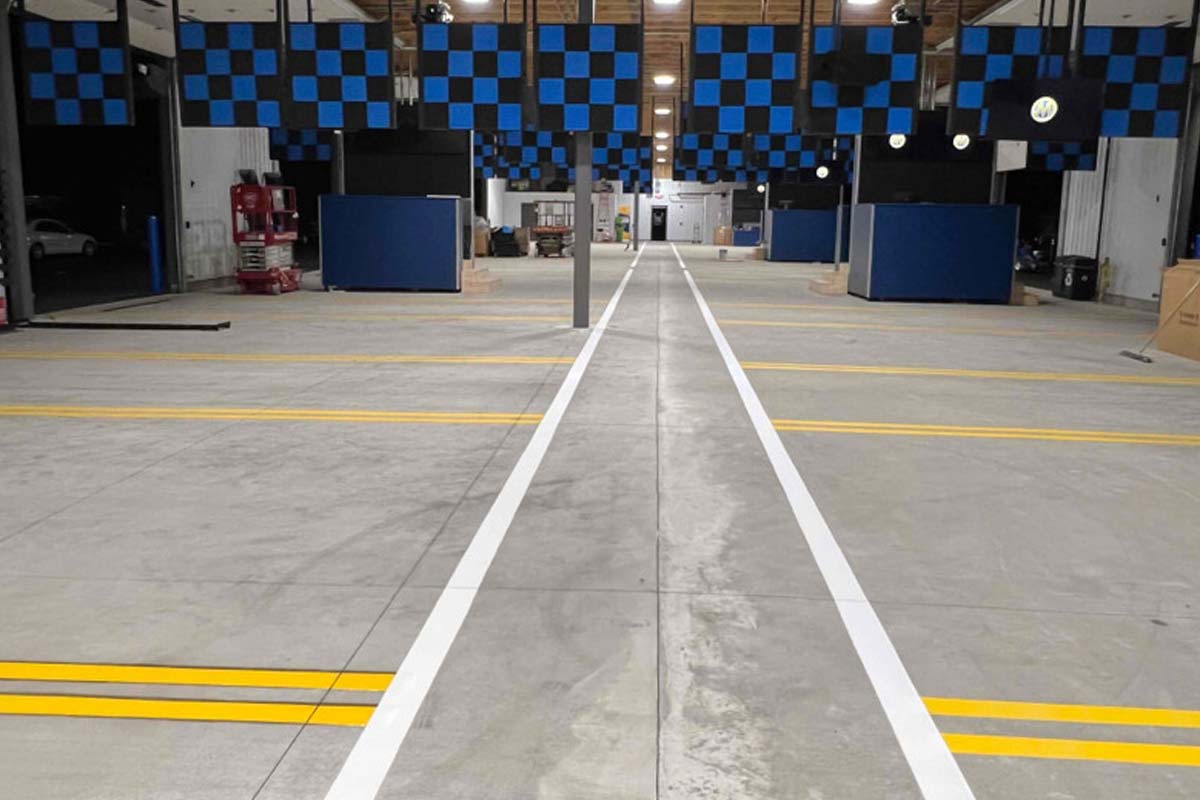
Warehouse and interior markings ensure clear traffic lanes, organized storage zones, and designated spaces designed to help your business operate safely and efficiently.
Benefits:
The citation almost everyone gets wrong
The standard routinely quoted for warehouse aisle marking is 29 CFR 1910.22. It is the wrong provision. That section covers surface conditions, loads, access and egress, and inspection — and the word “aisle” does not appear in it at all.
The provision that carries the duty is 29 CFR 1910.176(a): “Permanent aisles and passageways shall be appropriately marked.”
The stale citation propagated because OSHA’s 2016 rewrite deleted the old 1910.22(b), while a 1972 interpretation letter titled for that now-dead subsection remained findable — OSHA has since archived it with a note that it may no longer represent OSHA policy.
And no regulation gives you a number. There is no federally mandated line color, no mandated line width, and no mandated aisle width. 1910.176(a) requires only “sufficient safe clearances.” For color, 29 CFR 1910.144 governs the specific safety uses of red and yellow, which is a constraint on what certain colors mean rather than a specification for aisle lines. Anyone quoting you a required four-inch yellow line as a federal mandate is repeating convention as if it were regulation.
Convention is still useful — yellow aisle borders and consistent widths are what operators and forklift drivers already read. We mark to convention by default and to your facility’s own standard where you have one.
Line painting, floor marking, aisle striping — the same job
Facilities call this work by several different names, and the name on a quote you are comparing may not match the one you searched for. Warehouse line painting, warehouse floor marking, aisle striping and safety marking all describe the same scope: laying down the aisle, walkway and zone markings that organize a working floor. When you are collecting quotes, the useful question is not what the service is called but what is actually included — aisles only, or aisles plus walkways, staging areas, keep-clear zones and dock markings.
What we mark
- Permanent aisles and passageways — the marked routes 1910.176(a) addresses.
- Pedestrian walkways and crossings — segregating foot traffic from powered equipment.
- Staging, racking and dock areas — inbound, outbound, quarantine and hold zones.
- Equipment and safety clearances — keep-clear areas at panels, eyewash stations, extinguishers and exits.
- Directional and speed markings — traffic flow through the operation.
Working around an operating facility
Warehouse marking is scheduled work more than it is painting work. The floor has to be clear, clean and dry where lines are going, which in a running distribution operation means sequencing by zone around shifts rather than doing the building at once. Coatings for interior concrete also differ from parking lot traffic paint — cure time before forklift traffic is the constraint that usually drives the schedule. Tell us your shift pattern and the zones you can release at the estimate stage.
For a full list of our pavement marking services, visit our parking lot striping in Allentown page.
Businesses We Serve




How it Works

GET A FREE ESTIMATE
Contact us today and we’ll have a quote to you in 24 hours

SCHEDULE A STRIPING
We’ll have your space restriped in less than 7 days, without affecting your business hours

GET A PARKING LOT THAT POPS
For a budget-friendly price, you’ll get a parking lot that looks like new
We proudly work with:


We proudly work with:

Frequently Asked Questions About Warehouse Line Painting in Allentown, PA
What does OSHA actually require for warehouse aisle marking?
One sentence, and less than most suppliers imply. 29 CFR 1910.176(a) states that permanent aisles and passageways shall be appropriately marked. That is the duty. It does not specify a color, a line width or an aisle width — the same section asks only for sufficient safe clearances. The frequently quoted 29 CFR 1910.22 is the wrong provision; the word “aisle” does not appear in it. Anyone citing a specific federally mandated dimension is quoting convention, not regulation.
What color should warehouse aisle lines be?
There is no federally mandated color for aisle borders. What 29 CFR 1910.144 does is assign meanings to particular colors in safety use — which constrains what red and yellow signify rather than specifying how you outline an aisle. Yellow is the near-universal convention for aisle boundaries and it is what your operators and visiting drivers already read, so we default to it. If your facility or your customer’s audit standard specifies a scheme, we mark to that instead.
How wide do the lines and aisles need to be?
Not federally specified. The regulation asks for sufficient safe clearances, which is a performance requirement judged against your equipment and traffic rather than a number. In practice the aisle width is driven by the largest vehicle using it plus a working margin, and the line width by visibility on your floor. Facilities operating to a customer audit standard often carry their own figures — we will mark to yours if you have one and to normal convention if you do not.
Can you paint lines while the warehouse stays operational?
Normally yes, by sequencing zone by zone around your shifts rather than shutting the building. The constraints are practical: the floor must be clear, clean and dry where lines are going, and interior floor coatings need cure time before forklift traffic crosses them. That cure window is usually what shapes the schedule more than the painting itself. Give us your shift pattern and which zones can be released when, and the sequence gets planned around the operation.
What is the difference between warehouse line painting and parking lot striping?
Surface, product and traffic. Parking lot striping goes onto exterior asphalt or concrete with fast-dry traffic paint sized for tire contact and weather. Warehouse line painting goes onto interior concrete, often sealed or coated, and has to survive point loading from forklift wheels and pallet-truck traffic — which is a harsher, more concentrated abrasion than a car tire applies. Different coatings, different preparation, different cure requirements, and interior work is scheduled around production.
Do you mark pedestrian walkways as well as aisles?
Yes, and separating foot traffic from powered equipment is usually the highest-value marking in a facility. Walkways, marked crossing points at aisle intersections, and keep-clear zones at exits, electrical panels, extinguishers and eyewash stations all form part of the same layout. The aim is that a person on foot always knows where they are protected and a forklift operator always knows where to expect them. Call (484) 935-4114 for a free estimate.