ADA Parking Lot Striping
In Allentown, PA
ADA-Compliant Accessible Parking
1-800-STRIPER provides ADA-compliant parking lot striping in Allentown, PA — installing accessible stalls, van-accessible spaces, access aisles, and International Symbol of Accessibility markings per the 2010 ADA Standards for Accessible Design for commercial properties across the Lehigh Valley.
1-800-STRIPER of Allentown PROVIDes ADA Parking Lot Striping Services NEAR YOU
Need to make your property more accessible?
Upgrade your facility to become fully ADA compliant by partnering with us to create clear, accessible parking for all your visitors.
Our ADA Compliant line striping services include:
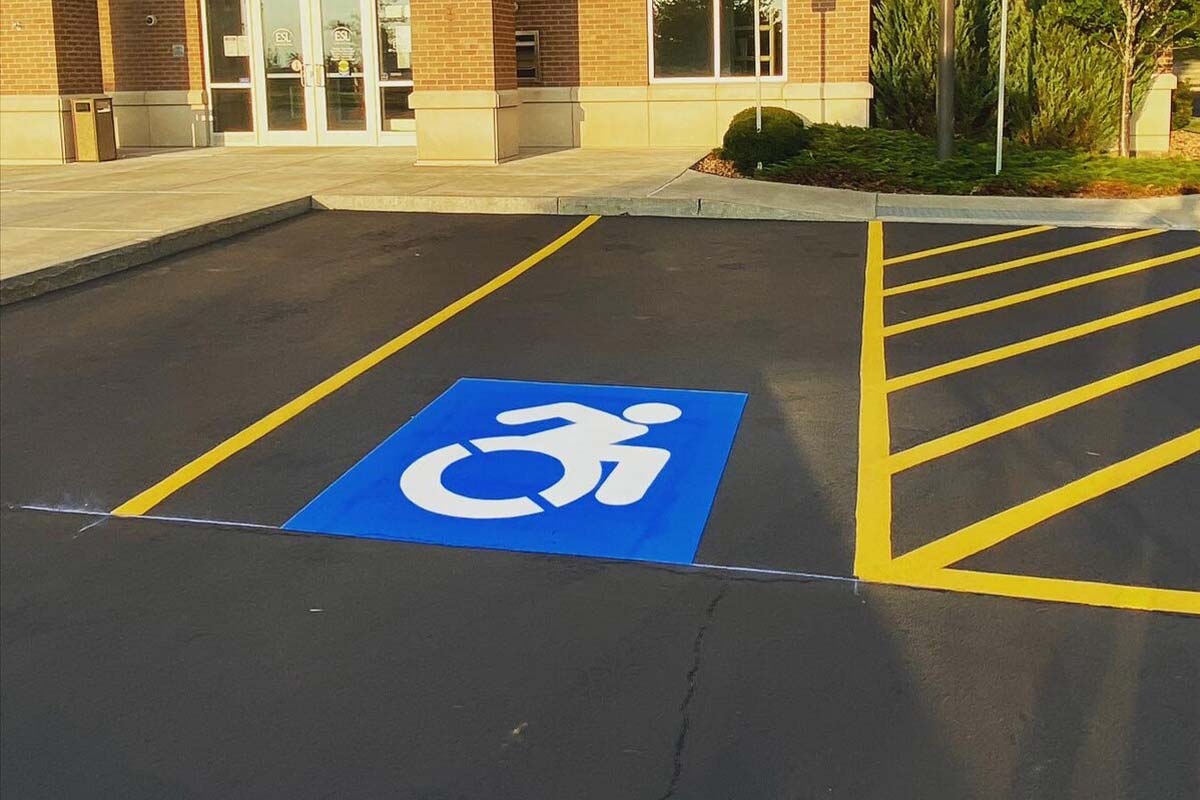
What ADA striping actually involves
The count is driven by your total. The 2010 ADA Standards for Accessible Design scale the number of accessible spaces to the total spaces provided, and a defined share of those must be van-accessible. This is federal and does not vary between Allentown, Bethlehem, Emmaus or Whitehall.
The access aisle is not a parking space. The marked aisle beside an accessible stall exists so a wheelchair or a ramp can deploy. It is the single most commonly violated element in the lots we survey — vehicles park in it because it looks like empty asphalt when the marking has faded. Keeping it clearly striped is what keeps it functioning.
Placement matters as much as count. Accessible spaces belong on the shortest accessible route to the entrance they serve. A lot with the correct number of accessible stalls in the wrong corner of the site is not compliant in any meaningful sense.
Signage and symbol. The International Symbol of Accessibility is marked in the stall, and posted signage identifies the space.
The Pennsylvania procedural fact
Accessibility is where Pennsylvania keeps authority at the state level rather than devolving it. Under 34 Pa. Code Section 403.122(k), an owner must file any appeal, variance request or extension-of-time request relating to accessibility with the state Accessibility Advisory Board — not with the municipal board of appeals that hears every other construction appeal. Section 403.142(a) says why: the Secretary holds the exclusive power to grant accessibility modifications and extensions of time and to decide questions of technical infeasibility.
The practical consequence: if your site genuinely cannot meet an accessibility requirement, the relief route is a state process, not a conversation with the local zoning board. Almost no competitor page in this market states this.
For a full list of our pavement marking services, visit our parking lot striping in Allentown page.
Businesses We Serve




How it Works

GET A FREE ESTIMATE
Contact us today and we’ll have a quote to you in 24 hours

SCHEDULE AN INSTALLATION
We’ll have your installation scheduled in less than 7 days, without affecting your business hours

GET A PARKING LOT THAT POPS
For a budget-friendly price, you’ll get a parking lot that looks like new!
We proudly work with:


We proudly work with:

Frequently Asked Questions About ADA Parking Lot Striping in Allentown, PA
How many accessible parking spaces does my lot need?
The 2010 ADA Standards for Accessible Design set the number as a function of the total spaces in the lot, with a defined proportion required to be van-accessible. Because it scales to your total, adding stalls to a lot can raise the accessible requirement — a detail that catches out expansions. The requirement is federal, so it is identical in Allentown, Bethlehem and every other Lehigh Valley municipality, unlike stall geometry, which is set locally.
What is the access aisle and can people park in it?
The access aisle is the marked area beside an accessible stall that allows a wheelchair, walker or vehicle ramp to deploy. No, it is not a parking space, and parking in it defeats the purpose of the accessible stall entirely. It is also the element that fails first in practice: once the hatching has faded, drivers read it as spare asphalt. Keeping the aisle crisply marked is the cheapest accessibility maintenance a property can do.
Do faded accessible markings still count as compliant?
Markings that can no longer be read are not doing the job the standard requires of them. An access aisle whose hatching has worn away is functionally not marked, and a stall whose symbol has faded no longer identifies itself. This is the most common accessibility problem in older Lehigh Valley lots — not that the spaces were never provided, but that they have quietly stopped being legible. Restriping resolves it without any layout change.
What if my site physically cannot meet the requirement?
In Pennsylvania that question has a specific route, and it is not the local board. Under 34 Pa. Code Section 403.122(k) an accessibility variance or extension request is filed with the state Accessibility Advisory Board rather than with the municipal board of appeals, and Section 403.142(a) gives the Secretary the exclusive power to grant accessibility modifications and to decide technical infeasibility. So a genuine dimensional impossibility goes to the state process. We can mark whatever the resulting approved arrangement specifies.
Does this apply to a privately owned commercial lot?
Generally yes, where the property is a place of public accommodation or a commercial facility — retail, medical, restaurants, offices, and similar. Private ownership is not itself an exemption; the standards attach to the nature of the facility and its use by the public. Because the analysis depends on the specific property and its history of alteration, the practical step is to have the lot surveyed against current accessible-stall counts and access-aisle marking rather than assumed either way.
Can accessible stalls be added without repaving the lot?
Usually yes. Accessible stalls, access aisles and symbols are added over sound existing pavement — old markings are removed or obscured and the new arrangement is laid out and painted. What has to be checked first is the route and the surface: the accessible space needs to sit on the shortest accessible route to the entrance, on ground level and firm enough to serve. Where the surface has failed, marking over it is a short-lived fix.