Parking Lot Restriping
In Allentown, PA
Restripe Existing Lines and Markings
1-800-STRIPER provides professional parking lot restriping in Allentown, PA — refreshing faded stalls, ADA spaces, fire lanes, and directional arrows with fast-dry traffic paint for commercial properties across Lehigh and Northampton counties.
1-800-STRIPER of Allentown PROVIDes Parking Lot Restriping Services NEAR YOU
Need to brighten up your faded parking lot?
Keep your parking lot safe and attractive by restriping annually to freshen up lines and symbols that have faded from the sun, weather, and traffic. Nothing beats a fresh coat of paint!
Benefits:
What restriping is
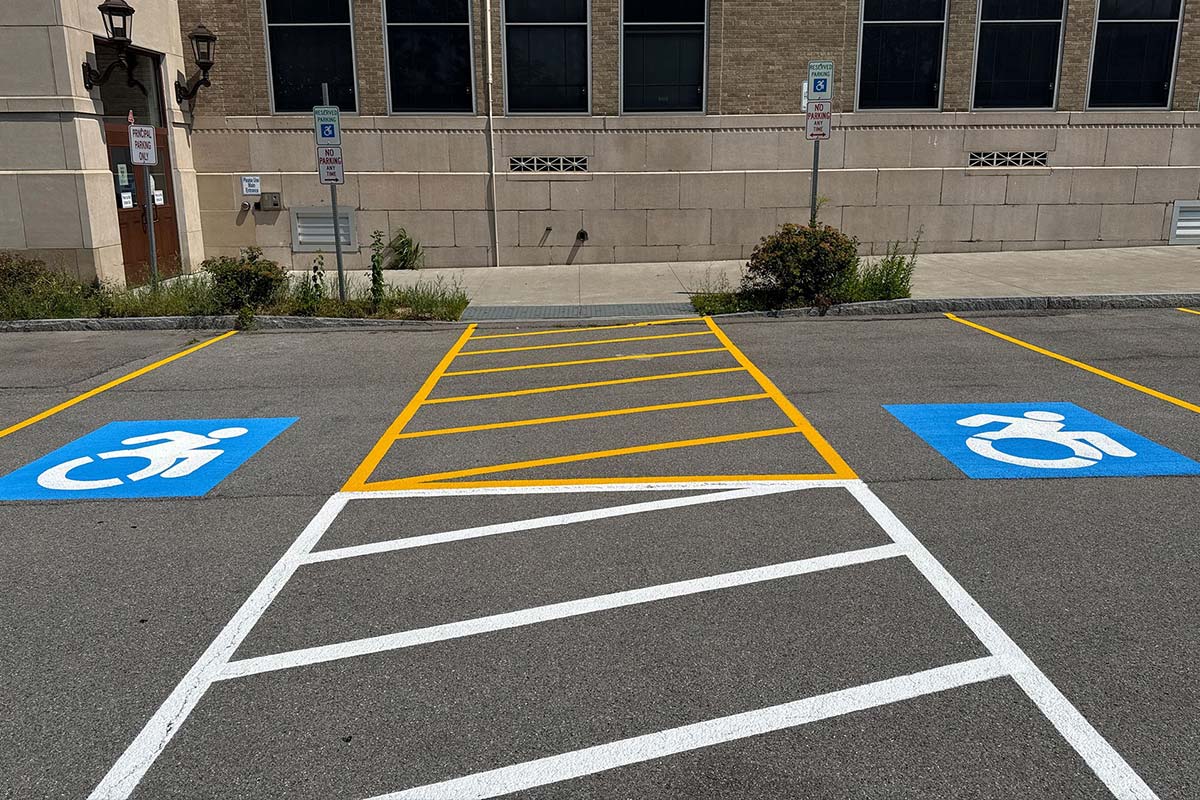
Restriping is repainting the layout already on the ground: the same stalls, the same aisles, the same accessible spaces and fire lanes, in fresh paint. It is distinct from layout design, which changes the geometry and may engage the zoning ordinance and accessibility review. Restriping is maintenance, and it is the most common single job in this market.
When a lot needs it
There is no universal interval, because wear is driven by traffic volume, surface condition, exposure and winter maintenance rather than by the calendar. The practical signals:
- Stall lines are hard to read at a distance, in rain, or at night — which is when drivers actually need them.
- The access aisle beside an accessible stall has faded, and cars have started parking in it.
- Fire lane legends are no longer legible, which undermines enforceability.
- Directional arrows and stop bars have worn, and traffic has started finding its own routes.
- The lot has just been sealcoated or resurfaced, which removes markings entirely by design.
Lehigh Valley lots take a particular beating from freeze-thaw cycling and from the salt and plow blades of winter maintenance. Markings at entrances, in turning areas and along curb lines go first.
Why faded accessible markings are the urgent case
Of everything that fades, the access aisle matters most. The 2010 ADA Standards for Accessible Design require accessible spaces to be identified and their access aisles marked. When the hatching wears away, the aisle stops being marked in any functional sense, drivers read it as spare asphalt and park in it, and the accessible stall beside it stops working for the person it exists for. That is a compliance problem and a practical one at the same time, and it is the cheapest one to fix — it needs paint, not a layout change.
What a restripe includes
- Survey the existing layout. Confirming stall positions, count and specialty markings before anything is obscured.
- Prepare the surface. Clean and dry where paint is going; paint bonds to what it lands on.
- Re-mark stalls and specialty items. Stalls, accessible spaces and access aisles, fire lanes, arrows, stop bars and crosswalks.
- Sequence around your business. Sections rather than the whole lot at once, wherever the property allows.
For a full list of our pavement marking services, visit our parking lot striping in Allentown page.
Businesses We Serve




How it Works

GET A FREE ESTIMATE
Contact us today and we’ll have a quote to you in 24 hours

SCHEDULE AN INSTALLATION
We’ll have your installation scheduled in less than 7 days, without affecting your business hours

GET A PARKING LOT THAT POPS
For a budget-friendly price, you’ll get a parking lot that looks like new
We proudly work with:


We proudly work with:

Frequently Asked Questions About Parking Lot Restriping in Allentown, PA
What does restriping a parking lot mean?
It means repainting the markings that are already there — the same stalls, aisles, accessible spaces and fire lanes, refreshed in new paint. Nothing about the layout changes. That is what separates it from layout design, which alters stall count, angles or circulation and needs measurement, a drawing and often municipal review first. If your lines have simply faded and the arrangement still suits the property, restriping is the job you want.
Do you need a permit to restripe a parking lot?
For a like-for-like refresh, normally no — repainting existing markings in their existing positions is maintenance. Where a permit question genuinely arises is when the layout changes: adding stalls, moving drive aisles, or altering accessible spaces or fire lanes can engage the zoning ordinance, which in Allentown is Chapter 660 of the City Code, and the accessibility provisions the state administers. Confirm with the City before a layout change, not before a refresh.
Can you stripe your own parking lot?
Nothing stops a property owner marking their own lot, and for a small private area it can be reasonable. Where it goes wrong is on the elements that carry obligations. Accessible stalls have federally defined counts, dimensions and access-aisle requirements; fire lanes are set by your approved site plan and the fire official with jurisdiction. Those are the parts where a well-intentioned repaint can leave you non-compliant while looking tidy — and they are most of what a commercial lot contains.
How much does it cost to have lines painted in a parking lot?
It scales with stall count and total linear footage, with specialty markings — accessible stalls, fire lanes, arrows, crosswalks — carrying more labor per unit than plain stalls. Surface condition matters too, because paint bonds differently to sound asphalt than to a worn or dirty surface, and a lot needing preparation is a different job. We quote per property rather than from a rate card. Call (484) 935-4114 for a free estimate within 24 hours.
How often should a commercial lot be restriped?
There is no fixed interval worth quoting, because wear depends on traffic volume, surface condition, sun exposure and winter maintenance. The reliable test is legibility rather than the calendar: if the stall lines are hard to read in rain or at night, if the access aisle hatching has gone, or if fire lane legends have worn, the lot is due regardless of when it was last done. High-turnover retail lots in the Lehigh Valley reach that point considerably sooner than low-traffic office parking.
Should we restripe before or after sealcoating?
After, always. Sealcoating covers the existing markings completely — that is what it does — so any striping applied first is buried. The correct sequence is to seal the surface, allow it to cure as the product requires, then restripe over it. This is also the natural moment to survey the layout before it disappears, so the new markings can be set out accurately rather than reconstructed from memory once the old lines are gone.