Wheel Stop Installation
In Durham, NC
Concrete and Rubber Parking Stops
1-800-STRIPER provides professional wheel stop installation in Durham, NC — anchoring concrete, recycled-rubber, and plastic-composite wheel stops at stall heads to protect sidewalks, storefronts, and the accessible routes required by the 2010 ADA Standards for Accessible Design at commercial properties throughout Durham County.
1-800-STRIPER® of Durham PROVIDes Wheel Stops Services NEAR YOU
Need to protect vehicles or walls from accidental damage?
Wheel stops (also called parking blocks) protect your property, enhance safety, and improve parking lot organization.
Benefits:
Wheel stops prevent vehicles from parking too far into a space or overextending into other spots, pedestrian walkways, and other areas, while also helping with vehicle alignment. They can prevent damage to buildings, curbs, or landscaping. Wheel stops also serve as clear visual cues for proper parking and are sometimes used on slopes to prevent cars from rolling.
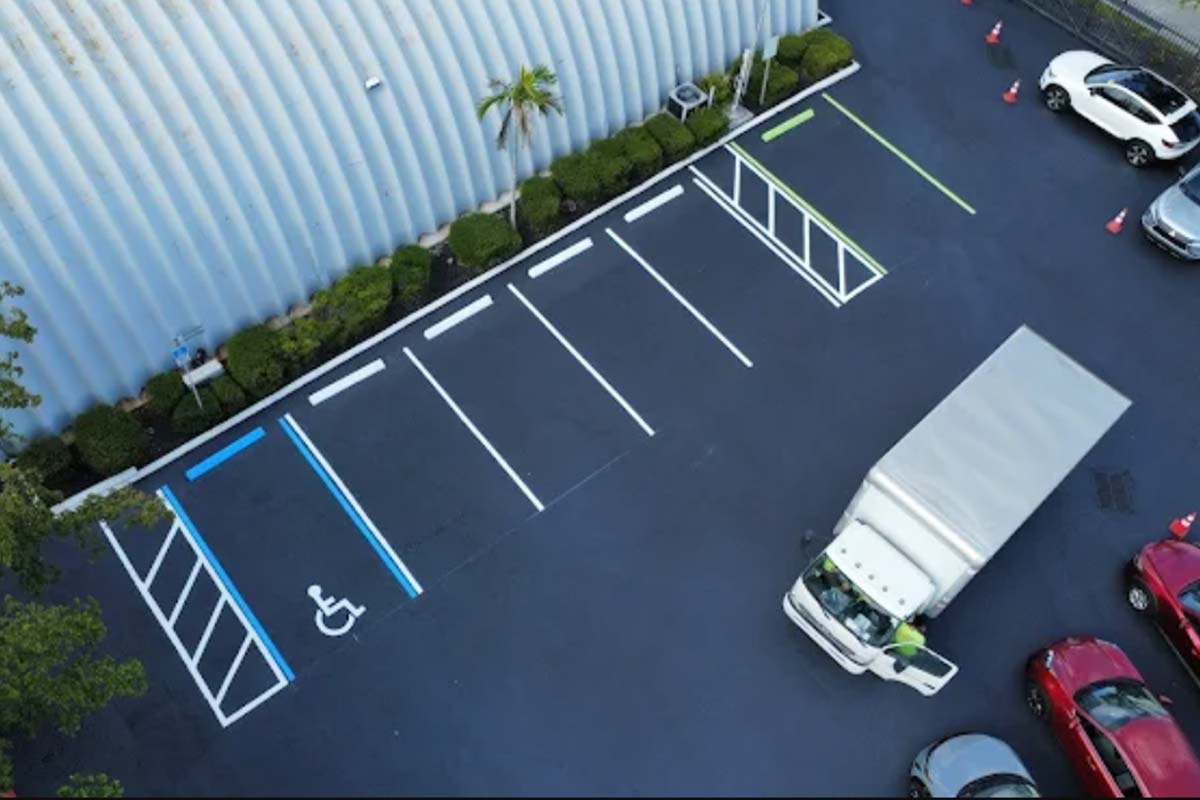
Wheel Stop Installation in Durham, NC
A wheel stop is a small object doing a structural job: it decides where a vehicle’s front overhang ends. Get it wrong and the overhang eats the sidewalk, the storefront bollard, or — the expensive one — the clear width of an accessible route. We supply and anchor wheel stops on commercial property across Durham County.
Durham’s ordinance has its own word for them. The Unified Development Ordinance defines a parking block in three words: *”A wheel stop.”*
Wheel Stop Materials
| Concrete | Recycled rubber | Plastic composite | |
|---|---|---|---|
| Relative weight | Heaviest — resists displacement by mass alone | Light | Light |
| Typical anchoring | Rebar pins or bolts, per manufacturer specification | Bolts or spikes, per specification | Bolts or spikes, per specification |
| Handling and relocation | Difficult; effectively permanent | Straightforward | Straightforward |
| Best suited to | High-traffic lots where displacement is the risk | Lots where layouts change, or where handling matters | The same, where color retention matters |
Anchor counts, pin depths, and embedment figures are absent from this page on purpose. Every number in circulation for those traces to product blogs rather than to a specification. The anchoring detail is the manufacturer’s, and it comes with the product.
Placement and ADA Route Clearance
The 2010 ADA Standards set the constraint that governs placement.
Section 403.5.1: the clear width of a walking surface — an accessible route — is 36 inches minimum, reducible to 32 inches for a maximum length of 24 inches at pinch points such as doorways.
Section 502.7: parking spaces and access aisles *”shall be designed so that cars and vans, when parked, cannot obstruct the required clear width of adjacent accessible routes.”*
And the Standards’ own advisory to §502.7 names the tool: *”Wheel stops are an effective way to prevent vehicle overhangs from reducing the clear width of accessible routes.”*
So the 2010 Standards never name a wheel stop as a required element. They do require that a parked vehicle not eat the route — and where the stall geometry would let it, a wheel stop is the ordinary way to comply. Not a mandated object; frequently the compelled means.
Installation
- Confirm the stall geometry and the route. Where does the overhang land, and what is the clear width behind it?
- Select the material against traffic, displacement risk, and whether the layout is likely to change.
- Set the position so the parked vehicle’s overhang stops short of the sidewalk, storefront, or accessible route.
- Anchor to the manufacturer’s specification, into sound pavement.
- Restripe or touch up the stall markings the installation disturbed.
For a full list of our pavement marking services, visit our parking lot striping in Durham page.
Businesses We Serve




How it Works

GET A FREE ESTIMATE
Contact us today and we’ll have a quote to you in 24 hours

SCHEDULE AN INSTALLATION
We’ll have your installation scheduled restriped in less than 7 days, without affecting your business hours

GET A PARKING LOT THAT POPS
For a budget-friendly price, you’ll get a parking lot that looks like new
We proudly work with:


We proudly work with:


Frequently Asked Questions About Wheel Stop Installation in Durham, NC
What are wheel stops made of?
Three materials in common commercial use: precast concrete, recycled rubber, and plastic composite. Concrete is the heaviest and resists being shunted out of position by mass alone. Rubber and composite are far lighter, easier to handle, and easier to move when a layout changes. Durham’s ordinance calls all of them parking blocks.
How are wheel stops anchored?
Into sound pavement, with rebar pins, bolts, or spikes, to whatever the manufacturer’s specification calls for. That specification varies by material and by product, and it ships with the product. We will not quote you an anchor count or a pin depth here — the figures in circulation for those come from product blogs, not from a spec sheet.
Can a wheel stop block an ADA accessible route?
It can, if it is placed badly — and so can the car parked against it. Section 403.5.1 of the 2010 ADA Standards requires an accessible route to keep a clear width of 36 inches minimum. Section 502.7 requires that parked cars and vans cannot obstruct that width. A wheel stop set too far back lets the overhang do exactly that.
Are wheel stops required by the ADA?
Not as an object, no — the 2010 Standards never name one as a required element. What §502.7 does require is that parked cars and vans cannot obstruct the clear width of an accessible route, and the Standards’ own advisory to that section says “wheel stops are an effective way to prevent vehicle overhangs from reducing the clear width of accessible routes.” Where your geometry produces overhang, a wheel stop is usually the means of complying with a requirement that is real.
Does every parking space need a wheel stop?
No. But Durham’s ordinance does require them in one specific case: where a vehicle use area is surfaced in loose material and holds more than ten parking spaces, parking blocks are required to designate each space. Note the condition — loose material. Nonresidential lots in Durham’s urban, suburban, compact, and downtown tiers must be paved, so in practice this rule lands on rural-tier property.
Where in the stall should a wheel stop be placed?
Far enough forward that the parked vehicle’s front overhang stops short of whatever is beyond it — a sidewalk, a storefront, or an accessible route that must keep 36 inches of clear width. That distance is a function of the vehicles using the lot and the geometry of the stall, so it gets set on site. The setback figures published on supplier websites are not code and we do not repeat them.