
Warehouse Line Painting
In Durham, NC
OSHA-Compliant Safety Markings
1-800-STRIPER provides professional warehouse line painting in Durham, NC — OSHA-compliant aisle lines, pedestrian walkways, and safety zone markings per OSHA 29 CFR 1910.176(a) aisle-marking requirements using durable epoxy and traffic paint for industrial facilities across Durham County.
1-800-STRIPER® of Durham PROVIDes Warehouse Floor Markings Services NEAR YOU
Want your indoor space to operate more efficiently?
Warehouse and interior markings ensure clear traffic lanes, organized storage zones, and designated spaces designed to help your business operate safely and efficiently.
Benefits:
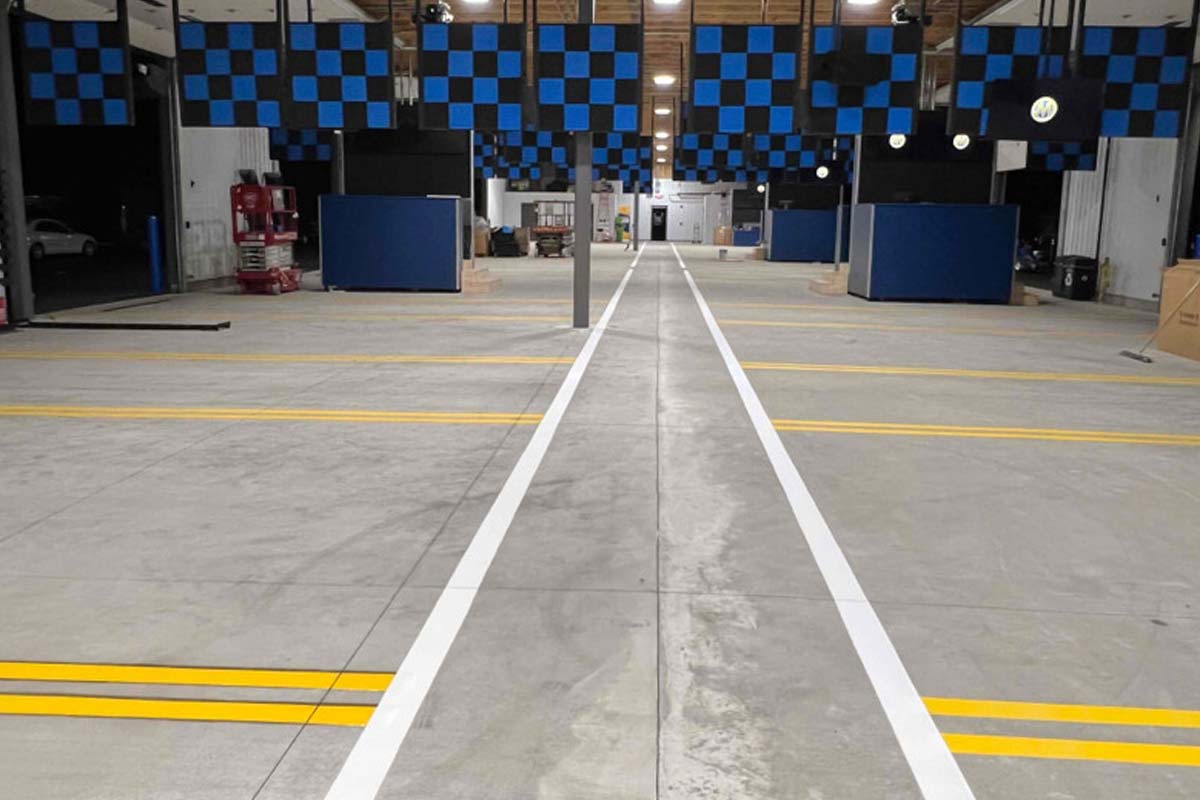
Warehouse Line Painting in Durham, NC
Interior floor marking is a safety system that happens to be made of paint. Aisles, pedestrian walkways, staging areas, equipment footprints, and hazard zones tell a forklift driver and a picker on foot where each of them belongs, in a building where being wrong is expensive. We mark warehouses, distribution centers, manufacturing floors, and parking structures across Durham County.
What surprises most facility managers is how little of this is actually prescribed. The duty is real and federal. The numbers everybody quotes are not.
What OSHA Actually Requires
| Question | What OSHA says | Where |
|---|---|---|
| Must permanent aisles be marked? | Yes. “Permanent aisles and passageways shall be appropriately marked.” | 29 CFR 1910.176(a) |
| What color must aisle lines be? | Neither section specifies one. `1910.144` assigns meanings to colors and never mentions aisles. | 29 CFR 1910.144 |
| How wide must the aisle line be? | `1910.176(a)` specifies no width. | 29 CFR 1910.176(a) |
| How wide must the aisle itself be? | No number in this section. It requires “sufficient safe clearances.” | 29 CFR 1910.176(a) |
| Then where do 2–6 in, 3 ft, and 4 ft come from? | An OSHA Standard Interpretation of 15 May 1972, which OSHA has moved to its archive and disclaims as current policy. | 1972 letter, archived |
Aisle Marking Under 29 CFR 1910.176(a)
The operative sentence is nine words long: *”Permanent aisles and passageways shall be appropriately marked.”* Two words in it do the work. Permanent means the duty attaches to aisles that are a fixed feature of the floor plan, not to a lane that exists for one afternoon. Appropriately means OSHA delegated the judgment to you and your safety officer, and then declined to define it.
The same subsection adds the only dimensional language in the regulation: aisles must have *”sufficient safe clearances”* for the equipment moving through them. That is a performance standard. It asks whether your aisle is safe for your forklift, not whether it measured a particular number of feet.
Color: What 29 CFR 1910.144 Does and Doesn’t Say
“OSHA requires yellow aisle lines” is one of the most widely repeated false statements in this trade.
The regulation people are half-remembering is `29 CFR 1910.144`, the safety color code. It says *”Red shall be the basic color for the identification of…”* fire protection equipment, danger, and emergency stops, and *”Yellow shall be the basic color for designating caution”* and marking physical hazards. Both quotes are real. What the regulation never does is mention aisles: a search of its full text returns zero occurrences of the word.
So yellow is a strong convention, and a sensible one — it is what your people already read as caution. It is not a legal requirement, and a facility that marks aisles white or blue has not violated anything.
Why OSHA Specifies No Line Width and No Aisle Width
The 2-to-6-inch line width and the 3-feet-wider-than-the-largest-vehicle aisle rule are quoted so often that they read like code. They come from a single OSHA letter of interpretation written on 15 May 1972. OSHA has since moved that letter into its archive, where it now carries three banners: OSHA Archive Document, may no longer represent OSHA Policy, and historical content, for research and review purposes only. The letter is keyed to `1910.22(b)` — a subsection OSHA deleted in 2017.
This matters practically. Designing to a fifty-year-old archived number can leave an aisle that is technically “compliant” and genuinely too tight for the reach truck you bought last year. The live standard asks the better question: is the clearance sufficient and safe for what moves through here?
Floor Coatings and Paint Systems
Warehouse floors are not parking lots. A sealed concrete slab under forklift traffic destroys the fast-dry waterborne paint that performs well outdoors on asphalt. The two systems we work with indoors are epoxy, which bonds hard to prepared concrete and survives point loads and turning tires, and traffic paint, which goes down faster and with less preparation where the traffic is lighter and the shutdown window is short. Which one your floor takes depends on the slab, the sealer already on it, the traffic, and how long you can keep the aisle closed. Surface preparation decides the result more often than the product does.
Facility Types We Mark
Distribution centers and third-party logistics floors, manufacturing plants, cold storage, parking structures, and the back-of-house areas of large retail. Aisle lines and pedestrian walkways are the core of the work; staging and rack footprints, equipment charging bays, and hazard-zone markings sit alongside them.
For a full list of our pavement marking services, visit our parking lot striping in Durham page.
Businesses We Serve




How it Works

GET A FREE ESTIMATE
Contact us today and we’ll have a quote to you in 24 hours

SCHEDULE A STRIPING
We’ll have your space restriped in less than 7 days, without affecting your business hours

GET A PARKING LOT THAT POPS
For a budget-friendly price, you’ll get a parking lot that looks like new
We proudly work with:


We proudly work with:


Frequently Asked Questions About Warehouse Line Painting in Durham, NC
Does OSHA require aisle markings in a warehouse?
Yes. The requirement lives in 29 CFR 1910.176(a), the materials-handling standard: “Permanent aisles and passageways shall be appropriately marked.” It is often misattributed to 1910.22, which contains no marking requirement at all — a confusion created when OSHA’s 2017 rewrite deleted the old 1910.22(b), which had carried the clause, while a 1972 interpretation letter still names that dead subsection in its title.
Does OSHA require aisle lines to be yellow?
No. No OSHA standard assigns a color to aisle lines. The regulation that assigns meanings to safety colors is 29 CFR 1910.144, and it never mentions aisles — red identifies fire protection equipment and danger, yellow designates caution and marks physical hazards. Yellow for aisles is an industry convention, and a good one, because it is what your staff already read as caution. It is not something an inspector can cite you for getting wrong.
How wide must warehouse aisle lines be?
The standard that carries the marking duty, 29 CFR 1910.176(a), sets no line width. The 2-inch-to-6-inch range everybody cites traces to an OSHA letter of interpretation from 1972 that OSHA has archived and expressly disclaims as current policy. Be careful how you read that: “appropriately marked” delegates the judgment to you, it does not remove it. A line too narrow to be seen from a forklift seat under your lighting is not appropriately marked, whatever the absence of a number says.
Does OSHA specify how wide the aisle itself has to be?
No. 29 CFR 1910.176(a) requires “sufficient safe clearances” and stops there — a search of the regulation’s full text returns no inch or foot figure anywhere. The frequently quoted “3 feet wider than the largest piece of equipment” and “minimum 4 feet” come from the same archived 1972 letter. The standard is performance-based on purpose: it asks whether the clearance is safe for the equipment you actually run, which is a harder question than a number and a better one.
What do the warehouse safety colors actually mean?
Under 29 CFR 1910.144, red is the basic color for identifying fire protection equipment and apparatus, danger, and emergency stop devices. Yellow is the basic color for designating caution and for marking physical hazards such as striking-against, stumbling, falling, tripping, and caught-between hazards. That is the whole of the federal color code relevant here. It says nothing about aisles, walkways, or storage zones — those conventions come from your facility, not from Washington.
What paint holds up on a warehouse floor?
Epoxy or traffic paint, and the slab decides which. Epoxy bonds hard to properly prepared concrete and takes point loads and turning forklift tires without lifting; it needs more preparation and a longer closure. Traffic paint goes down faster, with less surface preparation, and it suits lighter traffic and short shutdown windows. Neither is the fast-dry waterborne system used outdoors on asphalt. Surface preparation — what is already on the slab, and how much of it comes off — decides the outcome more reliably than the choice of product.