Parking Lot Restriping
In Durham, NC
Restripe Existing Lines and Markings
1-800-STRIPER provides professional parking lot restriping in Durham, NC — refreshing faded lines, ADA stalls, fire lanes, and directional arrows per Manual on Uniform Traffic Control Devices marking standards using fast-dry traffic paint for commercial properties across Durham, Orange, and Alamance counties.
1-800-STRIPER of Durham PROVIDes Restriping Services NEAR YOU
Need to brighten up your faded parking lot?
Keep your parking lot safe and attractive by restriping annually to freshen up lines and symbols that have faded from the sun, weather, and traffic. Nothing beats a fresh coat of paint!
Benefits:
Parking Lot Restriping in Durham, NC
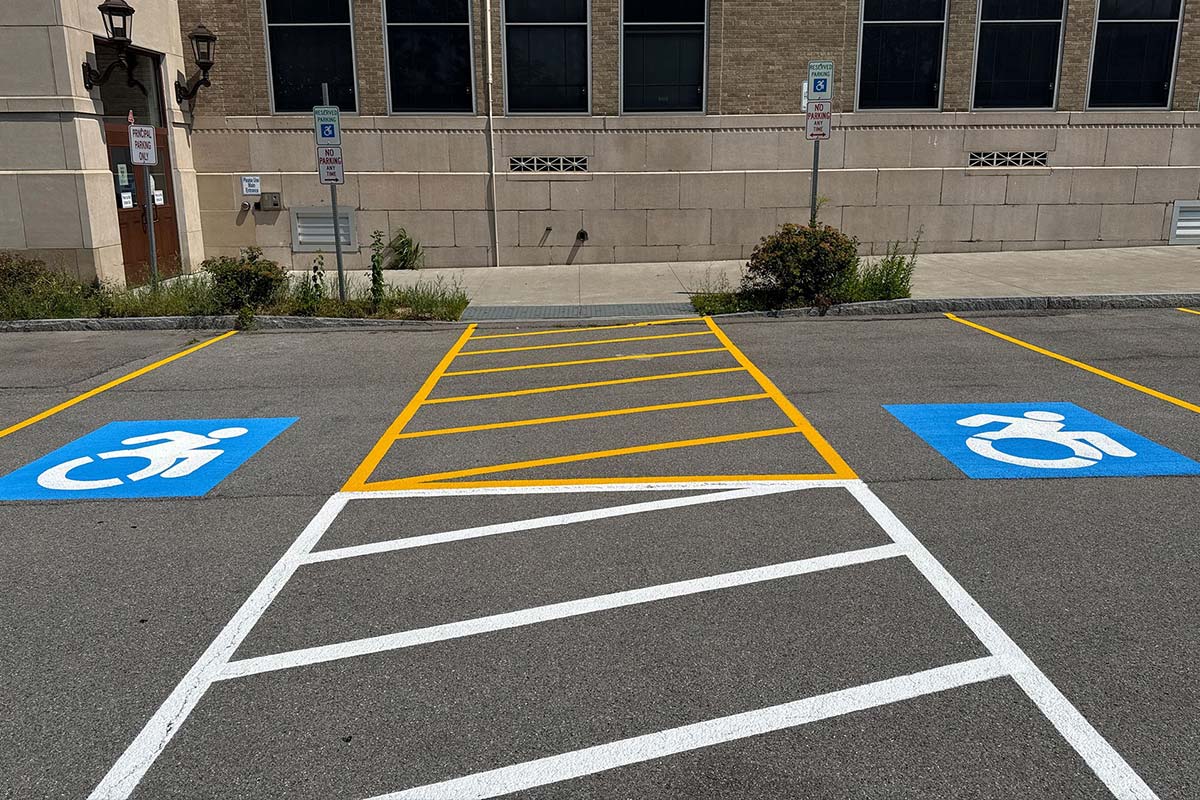
Restriping is the same layout, painted again. It is the smallest job a parking lot ever asks for and the easiest to defer, which is why most lots are a year or two overdue by the time anyone calls. Lines fade from ultraviolet light, from tire scrub in the drive aisles, and from whatever the lot gets cleaned with. They do not fade evenly — the aisles go first, the outer rows last, so a lot can look acceptable from the road and be illegible where it matters.
The Durham ordinance does not treat markings as decoration. Nonresidential and multifamily parking spaces “shall be striped on pavement or designated with some other form of permanent marking.” A lot whose lines have disappeared is not a tidiness problem.
When a Lot Needs Restriping
Work down this list. Any one of these is a reason; three of them is overdue.
- Drivers are parking crooked, or between two faded lines. The lot has stopped telling people what to do.
- The accessible spaces are ambiguous. Faded access aisles are the single highest-consequence failure on this list.
- Fire lane markings are no longer legible. The fire code requires that fire-lane designations be maintained in a clean and legible condition at all times.
- Directional arrows, stop bars, or crosswalks have worn through at the entrance, where circulation conflicts happen.
- The lot was just sealcoated or resurfaced. Sealer covers everything. Every marking comes back from zero.
- The building’s use changed. More staff, more deliveries, a new tenant — the old layout no longer matches the traffic.
- A tenant, insurer, or municipal inspector has asked about it. Somebody else has already noticed.
What We Restripe
Standard stalls, compact stalls, accessible spaces and their access aisles, fire lanes and no-parking zones, directional arrows, stop bars, crosswalks, loading zones, and numbered or reserved spaces. If the lot has warehouse or interior floor markings, those are a different paint system and live on our warehouse line painting page. If the layout itself has to change rather than be repainted, that is a re-layout, and it is a different job.
Restriping vs a Full Re-Layout
| Restriping | Full re-layout | |
|---|---|---|
| What changes | Nothing. Same lines, fresh paint | Stall count, angle, circulation, or accessible-space placement |
| What drives it | Wear, fading, sealcoating, resurfacing | Use change, capacity pressure, a compliance gap, new construction |
| City review | Not triggered by repainting in place | Nonresidential design is approved as part of site plan review |
| Old lines | Painted over, in place | Must be removed or obscured, or drivers follow ghosts |
| What we hand you | A lot that reads the way it was designed to | A drawing, then a lot that matches it |
The distinction has a federal consequence. The U.S. Department of Justice states it plainly: “When a business or State or local government restripes parking spaces in a parking lot or parking structure (parking facilities), it must provide accessible parking spaces as required by the 2010 ADA Standards for Accessible Design.” Restriping is the trigger. Repainting a handful of spaces in place as routine maintenance is not the same thing as restriping the facility — but resurfacing, resealing, and then remarking a lot is, and the accessible spaces have to come back compliant, not merely come back.
Paint Systems and Reopening Times
We use fast-dry waterborne traffic paint on asphalt and concrete lots. It is what the work wants: it goes down in traffic-manageable stages, it holds color under Carolina sun, and it does not need the lot shut for a day.
We do not publish a reopening time, and you should be wary of anyone who does. Paint data sheets describe drying in two stages that are not the same thing as “safe for a car.” No-track is the point at which a tire will not lift the marking. No-pickup comes later. Neither is a guarantee about a loaded delivery van turning across a fresh line at a temperature the data sheet did not anticipate. The reopening call is made on site, by the crew, against the product, the surface temperature, and the humidity on the day. That is why we schedule around your hours rather than promise you a number over the phone.
Marking standards themselves come from the Manual on Uniform Traffic Control Devices, the federal manual North Carolina’s statutes point to for the appearance of traffic control devices.
For a full list of our pavement marking services, visit our parking lot striping in Durham page.
Businesses We Serve



How it Works

GET A FREE ESTIMATE
Contact us today and we’ll have a quote to you in 24 hours

SCHEDULE AN INSTALLATION
We’ll have your installation scheduled in less than 7 days, without affecting your business hours

GET A PARKING LOT THAT POPS
For a budget-friendly price, you’ll get a parking lot that looks like new
We proudly work with:


We proudly work with:

Frequently Asked Questions About Parking Lot Restriping in Durham, NC
How often does a parking lot need restriping?
There is no interval that fits every lot. What drives it is traffic volume, the paint system underneath, how much direct sun the lot takes, and whether it gets sealcoated. A high-turnover retail lot in full sun will need attention long before a low-traffic office lot with mature tree cover. The franchise’s own service description puts it at annually as a general rule; the honest answer is that the aisles will tell you before the calendar does.
How soon after striping is the paint set?
Sooner than most people expect, and not on a schedule we will quote in advance. Paint data sheets describe drying as no-track first — a tire will not lift the line — and no-pickup afterwards. Neither is the same as safe for vehicle traffic. The reopening decision belongs to the crew on site, weighing the product, the surface temperature, and the humidity that day. We plan the sequence so sections of the lot reopen as we go.
Do I need to restripe after sealcoating?
Yes, in every case. Sealcoat is an opaque coating applied across the whole surface — it does not go around your lines, it goes over them. Once it cures, the lot has no markings at all: no stalls, no accessible spaces, no fire lanes, no arrows. Restriping is not an optional finishing touch after sealcoating; it is the second half of the same job, and the lot cannot lawfully operate its accessible parking without it.
What is the difference between restriping and a full re-layout?
Restriping puts fresh paint on the lines you already have. A re-layout changes them — the stall count, the parking angle, the circulation, or where the accessible spaces sit. Restriping in place does not trigger city site plan review; changing a nonresidential parking design does, because Durham’s ordinance approves parking design as part of that review. The other practical difference is the old lines: a re-layout has to deal with them, or drivers will keep following markings that are no longer there.
Does restriping trigger ADA compliance?
Yes — and this is the answer most property owners have never been given. The U.S. Department of Justice states that when a business restripes parking spaces in a parking lot or parking structure, it must provide accessible parking spaces as required by the 2010 ADA Standards for Accessible Design. Repainting a few spaces in place as maintenance is not an alteration. Resurfacing, resealing, or restriping the facility is. If your lot is going back down as fresh paint, the accessible spaces have to come back to current standard, not back the way they were.
What paint do you use for parking lot restriping?
Fast-dry waterborne traffic paint, applied with line-striping equipment rather than rollers or aerosols. It is a different material from the epoxy and coating systems used on warehouse floors, and different again from the acrylic paint used on a sports court — three surfaces, three chemistries, three sets of expectations about wear and reopening. Color, line width, and stencil work are set by the layout and the code that governs it, not by the paint.