Sports Court Striping
In Des Moines, IA
Multi-Sport Court Line Marking
1-800-STRIPER® provides professional sports court striping in Des Moines, IA — marking pickleball courts to USA Pickleball Official Rulebook dimensions, plus basketball, tennis, and multi-use game courts, in durable acrylic court coatings for schools, parks, and commercial properties across Polk, Dallas, and Story counties.
1-800-STRIPER® of Des Moines PROVIDes Sports Court Striping Services NEAR YOU
Want to get people to come out to play?
Brighten up your faded sport courts or turn your playground into a safe, colorful, and engaging space that entices people to come out and play.
Sport Court Specialties:
Sports Court Striping in Des Moines, IA
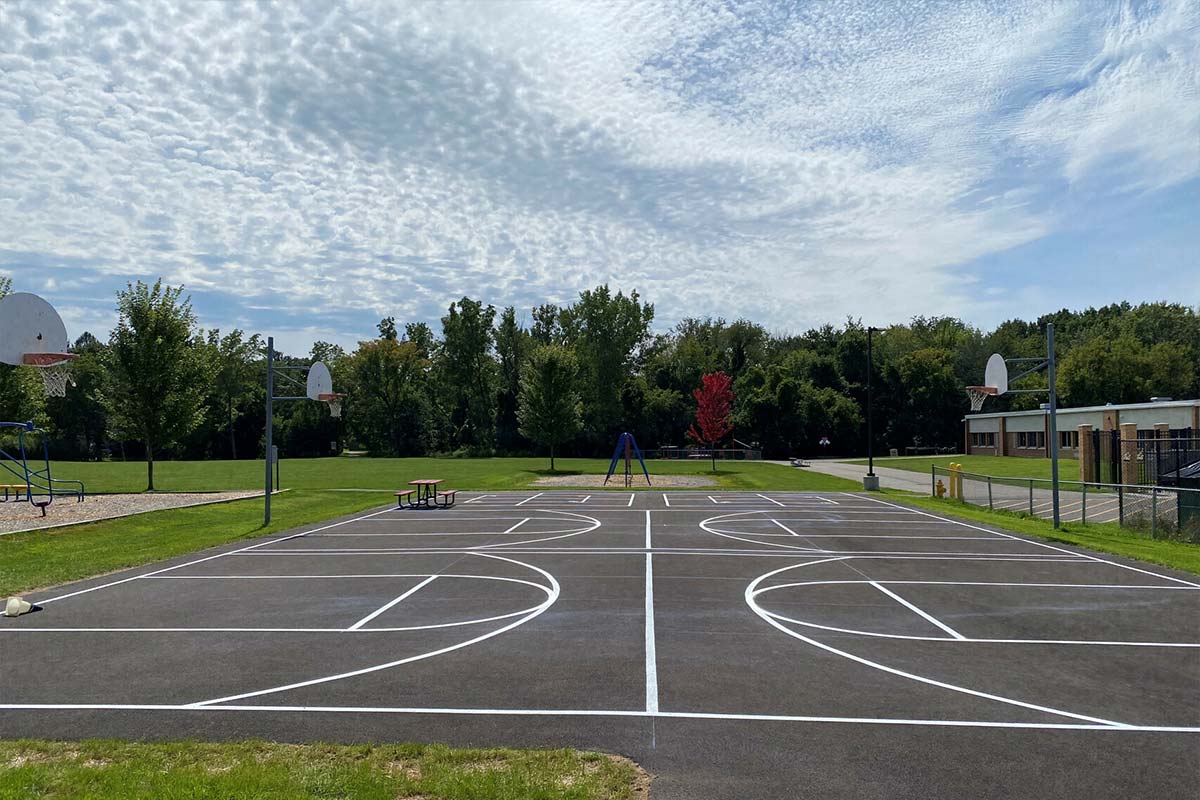
Court lines are a specification, not a decoration. Every sport has a governing body that publishes the court dimensions, and a line in the wrong place changes how the game is played and scored. Sports court striping in Des Moines, IA means laying out and marking courts to the published spec for the sport, on a surface that is already sound, in coatings made for court use rather than roadway use.
Basketball Court Striping
Basketball is the demand this page actually serves in the Des Moines market. Basketball court striping covers the boundary lines, center circle, free-throw lane and line, three-point arc and restricted area, laid out to the dimensions published for the level of play the court is built for. Those dimensions differ between recreational, high school, college and professional play, which is why the first question on any basketball job is what standard the court is meant to meet — a school retrofitting to its league’s spec and a business adding a half-court for staff are marking to different drawings.
Pickleball Court Layouts and Dimensions
Pickleball is the fastest-growing court conversion we are asked about, and it is also the one most often marked from a diagram someone found rather than from the spec. We lay out pickleball courts to the dimensions published in the USA Pickleball Official Rulebook, which is the governing document for court layout. The elements are the baselines and sidelines, the centerline dividing the service areas, the service areas themselves, and the non-volley zone extending from the net on both sides. Getting the non-volley zone right matters more than any other line, since it governs the rule players contest most.
Tennis and Multi-Use Court Markings
Tennis courts carry singles and doubles sidelines, service lines and boxes, baselines and center marks. Multi-use courts stack more than one sport onto the same surface, which is where layout skill actually shows: the sports have to be aligned so their lines overlap as little as possible, and where lines must cross, the color and sequence have to make each sport’s boundaries readable at speed. Tennis and pickleball share a surface often enough that it is worth planning the two layouts together rather than adding the second one later over lines that were never positioned with it in mind.
Striping vs. Surfacing — What We Do and What We Don’t
We stripe courts. We do not resurface or construct them, and being clear about that saves everyone time. Three layers get confused for one another, so it is worth separating them.
Court construction. The base, the drainage and the structure underneath everything else. A different trade, and the one with the longest lead time.
Surfacing. The acrylic system, crack repair, leveling and color coat that together make up the playing surface. Also a different trade, and the layer that decides how long any marking on top of it survives.
Striping. The marking applied to a finished surface — what we do.
If your court needs resurfacing, the lines go on after that work, not before, and striping a failing surface simply means the lines fail with it. When we look at a court and see a surfacing problem, we say so rather than paint over it.
Coatings and Line Colors for Shared-Use Courts
Court lines use acrylic line paint formulated for athletic surfaces, not the traffic paint used on a parking lot. Traffic paint is built for tire wear and weather on asphalt; court coatings are built to stay bonded to an acrylic system, keep a crisp edge, and hold up to shoe abrasion and ball contact. On shared-use courts the line color scheme carries real load: each sport’s lines need enough contrast against the surface and against the other sport’s lines that a player can pick out their own boundaries without hesitating. That usually means the primary sport takes the highest-contrast color and secondary sports take distinct, lower-contrast tones.
Schools, Parks and Commercial Properties We Stripe
School and park courts are the bulk of this work — outdoor basketball courts, tennis courts converted or shared for pickleball, and multi-use game areas that carry several layouts at once. Commercial and multi-family properties are the rest: apartment community courts, corporate campus courts and hotel recreation areas. Public courts usually need scheduling around programmed use, and school courts around term and athletic calendars, which is worth raising early because the surface needs uninterrupted cure time after marking. 1-800-STRIPER® works across Polk, Dallas and Story counties.
For a full list of our pavement marking services, visit our parking lot striping in Des Moines page.
Businesses We Serve




How it Works

GET A FREE ESTIMATE
Contact us today and we’ll have a quote to you in 24 hours

SCHEDULE AN INSTALLATION
We’ll have your play space restriped in less than 7 days, without affecting your playtime

GET A PARKING LOT THAT POPS
For a budget-friendly price, you’ll get a parking lot that looks like new
We proudly work with:


We proudly work with:

Frequently Asked Questions About Sports Court Striping in Des Moines, IA
How are the lines on a pickleball court laid out?
The court is set out from its baselines and sidelines, then the centerline divides the two service areas, and the non-volley zone extends from the net across the full width on both sides. We mark to the dimensions published in the USA Pickleball Official Rulebook rather than to a diagram of unknown origin. Layout accuracy matters most at the non-volley zone, because that boundary governs the rule players contest more than any other.
Can one court be striped for more than one sport?
Yes, and it is common — tennis and pickleball, or basketball with a multi-use game layout. The work is in the planning rather than the painting: the layouts have to be positioned so lines overlap as little as possible, and where they must cross, color and application order have to keep each sport’s boundaries readable at speed. Planning both layouts together produces a much cleaner court than adding the second sport later.
What are the dimensions of a basketball court?
They depend on the level of play, which is why there is no single answer worth quoting. Recreational, high school, college and professional courts differ in overall dimensions and in the three-point arc in particular. Sports court striping in Des Moines, IA starts by establishing which standard your court is meant to meet, then marking to that governing body’s published spec — not to a generic drawing that may match none of them.
Do you resurface courts, or only stripe them?
We stripe. Resurfacing and court construction are different trades, and we would rather say so than take work we are not the right people for. If your surface needs repair or a new acrylic coat, that has to happen first — striping goes on a finished surface. Lines applied over a failing surface fail along with it, so we will tell you when a court needs surfacing before it needs paint.
What paint is used on a sports court?
Acrylic line paint formulated for athletic surfaces, which is a different product from the traffic paint used on parking lots. Traffic paint is engineered for tire wear and weather on asphalt. Court line paint has to bond to an acrylic surfacing system, hold a crisp edge for a boundary that gets judged by eye during play, and resist shoe abrasion and ball contact rather than vehicle traffic.
Do you stripe school and park courts as well as commercial ones?
Yes — schools, parks and municipal recreation areas make up most of this work, alongside apartment communities, corporate campuses and hotel recreation areas. The main difference is scheduling. Public and school courts need the work planned around programmed use and athletic calendars, since the surface needs uninterrupted cure time after marking before play resumes.