ADA Parking Lot Striping
In Des Moines, IA
ADA-Compliant Accessible Parking
1-800-STRIPER® provides ADA parking lot striping in Des Moines, IA — installing accessible spaces, van-accessible stalls, access aisles, and international symbol of accessibility markings per the 2010 ADA Standards for Accessible Design and Iowa Code Chapter 321L for commercial properties across Polk, Dallas, and Story counties.
1-800-STRIPER® of Des Moines PROVIDes ADA Parking Lot Striping Services NEAR YOU
Need to make your property more accessible?
Upgrade your facility to become fully ADA compliant by partnering with us to create clear, accessible parking for all your visitors.
Our ADA Compliant line striping services include:
ADA Parking Lot Striping in Des Moines, IA
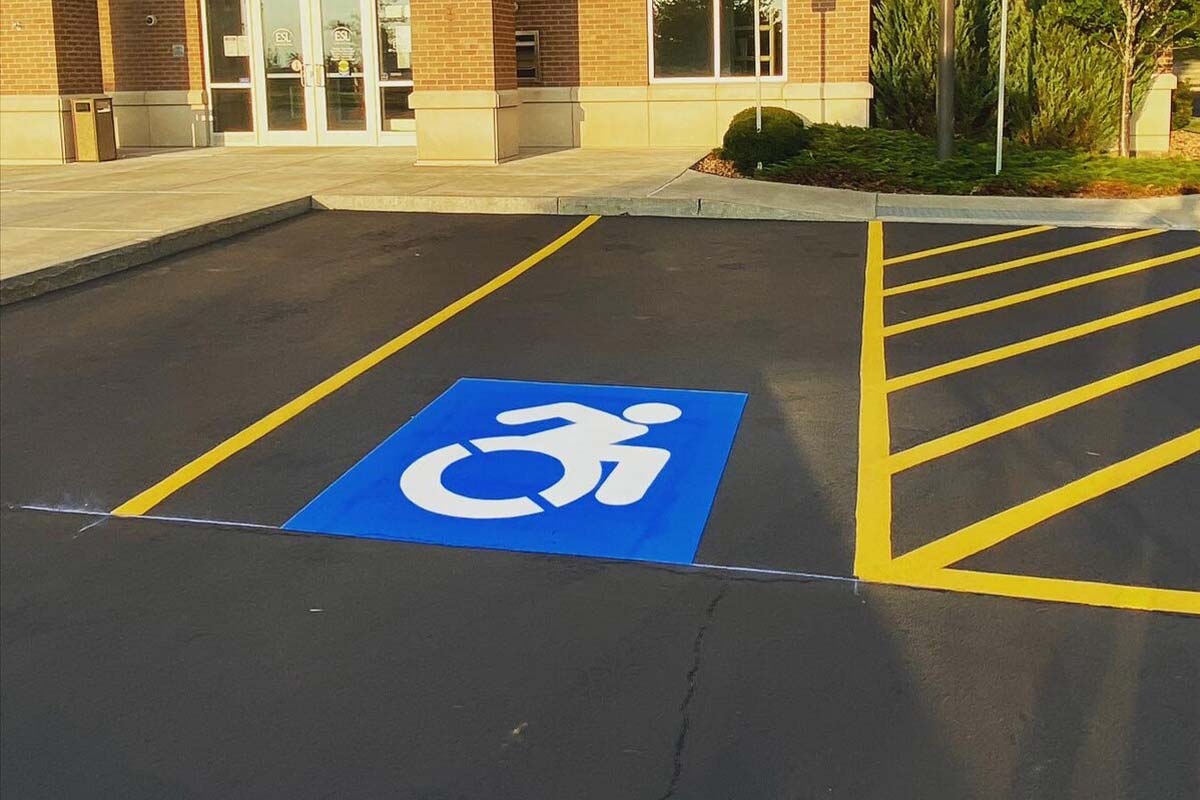
Accessible parking is the part of a commercial lot most likely to be non-compliant without anyone noticing, partly because the requirements sit in two instruments at once. The federal 2010 ADA Standards for Accessible Design apply nationally; Iowa Code Chapter 321L applies here as well, and in two places says something the federal text does not. ADA parking lot striping in Des Moines, IA has to satisfy both, which is what 1-800-STRIPER® checks a lot against before quoting it.
How Many Accessible Spaces Iowa Requires
Iowa has its own scoping table, with its own trigger. Iowa Code Chapter 321L requires that a new nonresidential facility in which construction was completed on or after July 1, 1991, and which provides parking to the general public, supply accessible spaces on a sliding scale set against the lot’s total space count.
| Total parking spaces in the lot | Minimum accessible spaces |
|---|---|
| 10 to 25 | 1 |
| 26 to 50 | 2 |
| 51 to 75 | 3 |
| 76 to 100 | 4 |
| 101 to 150 | 5 |
| 151 to 200 | 6 |
| 201 to 300 | 7 |
| 301 to 400 | 8 |
| 401 to 500 | 9 |
| 501 to 1,000 | 2 percent of total |
| 1,001 and over | 20 plus 1 for each 100 over 1,000 |
The numbers track the federal table closely, but the Iowa statute is a separate instrument with its own completion-date trigger, and it binds an entity providing nonresidential parking directly. One gap is worth naming: Iowa’s table starts at 10 spaces, while the federal table starts at 1. A small public lot below ten spaces is outside the Iowa table and still inside the 2010 ADA Standards, which require one accessible space from the first stall.
Access Aisles, Van-Accessible Stalls and the Shortest Accessible Route
An accessible space is not just a wider stall. The access aisle beside it is what makes it usable — the level, marked area where a lift or ramp deploys, and parking in it defeats the space entirely. Van-accessible stalls carry additional width or aisle requirements plus vertical clearance along the van’s route, and under the 2010 ADA Standards for Accessible Design at least one in every six accessible spaces, and always at least one, must be van accessible. Iowa Code Chapter 321L also requires accessible spaces and access loading zones to sit on the shortest accessible route to the nearest accessible entrance.
A Painted Symbol Is Not a Sign — What Iowa Statute Actually Says
This is the single most useful thing an Iowa property owner can know about accessible parking, and almost nobody publishes it. Iowa Code Chapter 321L states that the persons with disabilities parking sign shall be affixed vertically on another object so that it is readily visible to a driver of a motor vehicle approaching the space, and then says explicitly that a space designated only by the international symbol of accessibility being painted or otherwise placed horizontally on the parking space does not meet the requirements of that subsection. In plain terms: in Iowa, painting the symbol on the pavement does not substitute for a post-mounted sign. That is a statutory statement, not an interpretation. It is also a common finding, because the pavement symbol is the visible part and the sign is what gets taken out by a plow or a delivery truck and never replaced.
Sign Color, Placement and Who Supplies Them
Iowa Code Chapter 321L sets the sign itself: a blue background bearing the international symbol of accessibility in white. It also requires a city, for property inside its corporate limits, or the county for property outside them, to provide the signs at cost on request to an entity required to provide accessible spaces. On the pavement side the statute is permissive: a space on a paved surface may be painted with a blue background bearing the symbol in white or yellow, but the blue background paint may be omitted. The ground marking has latitude the vertical sign does not.
Resurfacing Triggers ADA Scoping — Touch-Ups Do Not
Routine maintenance that keeps an existing surface in working order does not trigger accessible-parking scoping. Work that rises to an alteration does — and once it does, the accessible parking serving the altered area has to meet the current standard, including count, dimensions, access aisles, route and signage. Resurfacing and then restriping generally falls on the alteration side. So a paving project scoped purely as pavement work can carry an accessibility obligation nobody budgeted for — far cheaper to resolve before the paving contractor mobilizes.
A plain repaint is less clear-cut than it looks, in both directions. The Department of Justice publishes a compliance brief specifically on restriping parking spaces, and it states that when a business restripes a lot it must provide accessible parking spaces to the 2010 ADA Standards for Accessible Design — while also stating that the brief is informal guidance carrying no force or effect of law. Separately, a place of public accommodation owes a continuing duty to remove architectural barriers where doing so is readily achievable, which the statute defines as easily accomplishable and able to be carried out without much difficulty or expense, weighed against the nature and cost of the work and the resources of the business. Whether a like-for-like repaint is an alteration in its own right is genuinely unsettled, and we will not claim otherwise. The practical point survives either reading: the striping visit is the cheapest moment to check the accessible spaces.
Enforcement on Private Property in Iowa
Iowa Code Chapter 321L gives a peace officer the authority to, and states that the officer shall, enforce the accessible-parking provisions on public and private property. That is worth stating plainly, because the common assumption is that a private commercial lot sits outside enforcement reach until someone complains. In Iowa it does not. The chapter also makes failure to provide proper spaces or signs a simple misdemeanor and a scheduled violation. The point for an owner is that the obligation is enforceable on a private lot.
For a full list of our pavement marking services, visit our parking lot striping in Des Moines page.
Businesses We Serve




How it Works

GET A FREE ESTIMATE
Contact us today and we’ll have a quote to you in 24 hours

SCHEDULE AN INSTALLATION
We’ll have your installation scheduled in less than 7 days, without affecting your business hours

GET A PARKING LOT THAT POPS
For a budget-friendly price, you’ll get a parking lot that looks like new!
We proudly work with:


We proudly work with:

Frequently Asked Questions About ADA Parking Lot Striping in Des Moines, IA
How do you stripe a handicap parking space?
The space is laid out to the required dimensions with an access aisle alongside it, both marked, and the international symbol of accessibility applied within the space. Placement comes first: Iowa Code Chapter 321L requires accessible spaces to sit on the shortest accessible route to the nearest accessible entrance. Then the vertical sign, which the pavement marking cannot replace. ADA parking lot striping in Des Moines, IA is not finished until that sign is mounted.
Do you need a permit to restripe a parking lot?
Permit requirements for work on a private commercial lot are set locally and vary by jurisdiction and by what the work involves — a straight repaint of existing markings is treated differently from a new layout or work tied to resurfacing. In this market those requirements are set by the City of Des Moines, and by the relevant municipality for properties outside the city limits. We confirm what applies to your property before we schedule rather than assume it.
Is a painted symbol enough, or do I need a sign?
You need the sign. Iowa Code Chapter 321L requires the accessible parking sign to be affixed vertically on another object so it is readily visible to an approaching driver, and states that a space designated only by the international symbol of accessibility painted or otherwise placed horizontally on the space does not meet that requirement. The pavement symbol is worth having, but on its own it does not make the space compliant in Iowa.
How many accessible spaces does Iowa require?
It scales with the total spaces in your lot under Iowa Code Chapter 321L: one for 10 to 25 spaces, two for 26 to 50, three for 51 to 75, four for 76 to 100, five for 101 to 150, and upward from there. Lots of 501 to 1,000 spaces use two percent of the total. The requirement applies to nonresidential facilities providing parking to the general public completed on or after July 1, 1991.
How many of those have to be van-accessible?
Under the 2010 ADA Standards for Accessible Design, at least one in every six accessible spaces must be van accessible, and every lot with any accessible parking needs at least one. They carry additional width or access-aisle requirements and need vertical clearance along the route the van uses to enter, park and exit — a layout constraint as much as a striping one on a lot with a low canopy or deck.
Does resealing or resurfacing trigger ADA requirements?
It can. Routine maintenance keeping an existing surface in working order does not trigger accessible-parking scoping, but work rising to an alteration does, and then the accessible parking serving the altered area must meet the current standard for count, dimensions, aisles and signage. Resurfacing followed by restriping generally falls on the alteration side. A plain repaint is less settled: the Department of Justice compliance brief on restriping parking spaces says a business restriping a lot must provide accessible spaces to the 2010 ADA Standards, but the brief is informal guidance with no force of law, and whether a like-for-like repaint is itself an alteration is genuinely unresolved. A place of public accommodation also owes a separate, continuing duty to remove barriers where that is readily achievable — easily accomplishable without much difficulty or expense. We would rather flag it than tell you it is settled.
Can accessible parking be enforced on private property in Iowa?
Yes. Iowa Code Chapter 321L states that a peace officer has the authority to and shall enforce the accessible-parking provisions on public and private property. A commercial lot is not outside enforcement reach. The chapter also treats failure to provide proper spaces or signs as a simple misdemeanor and a scheduled violation, which is why the vertical sign requirement in particular is worth checking on your own property.