Warehouse Line Painting
In North Indianapolis, IN
OSHA-Compliant Safety Markings
1-800-STRIPER provides professional warehouse line painting in North Indianapolis, IN — forklift traffic lanes, pedestrian walkways, and safety hazard markings, with permanent aisles marked per OSHA 29 CFR 1910.176(a) wherever mechanical handling equipment runs, for distribution centers and manufacturing facilities across the Marion, Hamilton, and Boone county logistics corridor.
1-800-STRIPER® of Indianapolis North PROVIDes Warehouse Floor Markings Services NEAR YOU
Want your indoor space to operate more efficiently?
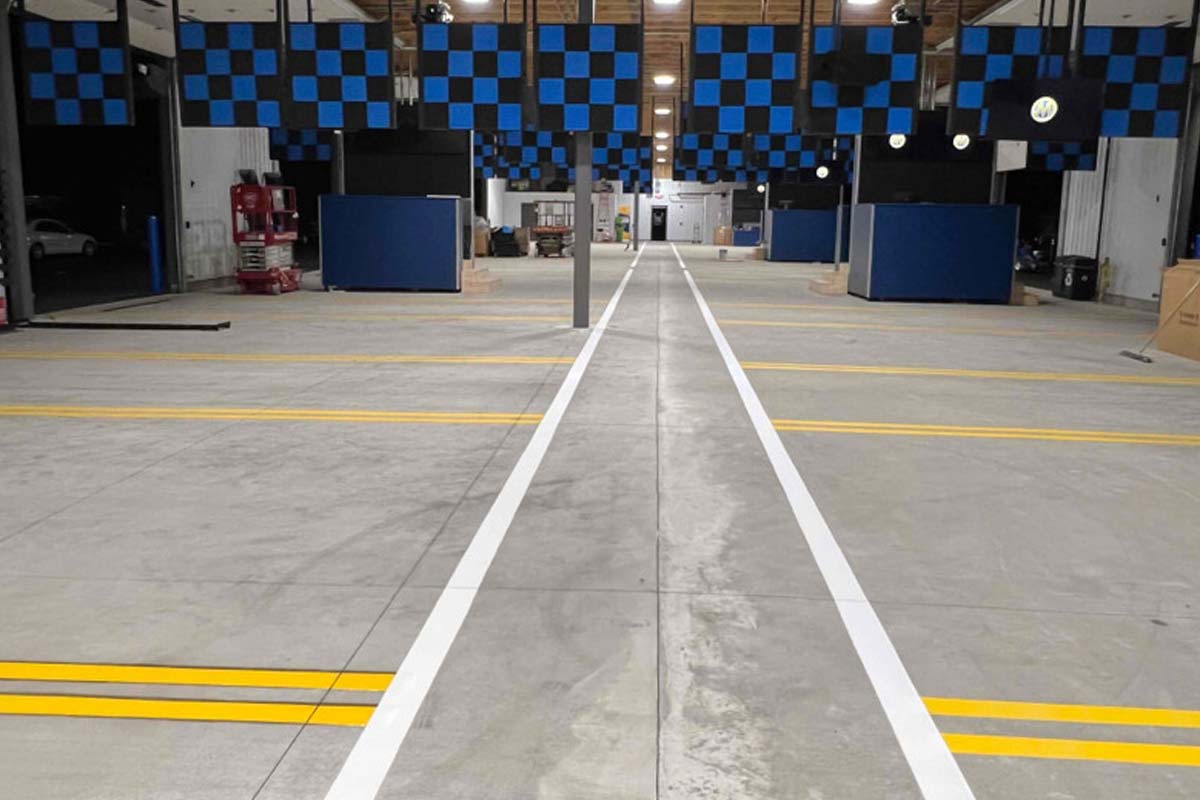
Warehouse and interior markings ensure clear traffic lanes, organized storage zones, and designated spaces designed to help your business operate safely and efficiently.
Benefits:
What OSHA Actually Requires — and What It Leaves to You
Most facility managers we meet are looking for the OSHA aisle-width number. There isn’t one.
The standard the Occupational Safety and Health Administration sets for aisle marking in a warehouse is 29 CFR 1910.176(a), and it is short. Where mechanical handling equipment is used, it requires that “sufficient safe clearances shall be allowed for aisles, at loading docks, through doorways and wherever turns or passage must be made,” that aisles and passageways be kept clear and in good repair, and then the sentence everything hangs on: “Permanent aisles and passageways shall be appropriately marked.”
Appropriately marked. Not four inches wide. Not yellow. The standard specifies no width, no color, and no line dimension at all. It is performance-based — OSHA has handed the specification to you and asks only that the outcome be safe for the equipment operating in your building.
That sounds like good news, and mostly it is. But the burden of judgment is now yours, and an inspector evaluates the result rather than your intent. A lane sized for a walkie stacker is not sized for a reach truck carrying a 48-inch load. A line ground to a shadow by steel wheels is not a marked aisle just because it used to be one.
So the useful question is not what width OSHA requires. It is what appropriately marked means in a building like yours — and in practice that comes down to four things. Width should follow the widest load that routinely travels the aisle, not the truck’s own footprint. Sightlines matter most where they are worst: blind corners, dock approaches, the mouth of a racking run. Contrast is what keeps a line readable on a slab ten years into oil and tire rubber, because a color that reads beautifully on new concrete can disappear on a stained floor. And consistency is what makes markings a system rather than decoration — one convention across every zone, written down, so a temp on their first shift reads the floor the same way you do.
Write your spec down. Since OSHA doesn’t publish one, the document proving you thought about it is your own.
Forklift Traffic Lanes, Pedestrian Walkways, and Safety Hazard Zones
Aisles are the part of the job people ask for. They are rarely the part that changes the building.
Forklift traffic lanes define where powered equipment belongs and, just as importantly, where it does not. In a busy distribution center the lane is doing crowd control between a five-ton machine and a person carrying a box at head height.
Pedestrian walkways are the other half of that sentence — and a walkway only works if it goes where people actually want to go: personnel door to break room, office to dock office, locker room to line. One that ignores the desire path gets ignored, and then you own a painted floor and the same near-miss you had before. Where a walkway crosses a forklift lane, that crossing is the highest-value marking in the building.
Safety hazard markings are the ones that get skipped and the ones an inspector notices: racking end caps and column bases that get clipped, dock edges and leveler pits, clearance around electrical panels, eyewash stations, exit routes, battery-charging areas.
Then there is the layer that has nothing to do with safety and everything to do with throughput — staging footprints, pallet drops, inbound and outbound lanes, quarantine and returns. Facilities running a 5S program are usually the ones who ask, because a footprint on the floor is the cheapest way to make “a place for everything” enforceable at a glance.
We will happily paint you a set of aisles. Ask us instead what should be marked, and the answer usually reshapes the drawing.
Epoxy vs. Traffic Paint: Which Lasts in a Distribution Center
There is no universally right coating; there is a right coating for how your floor gets used.
Traffic paint goes down fast, cures fast, and costs least to reapply. If your building can only surrender a floor for one shift, or the layout is still settling and you expect to move lanes again, fast-cure paint is often the honest choice — you are buying flexibility and a short shutdown, and accepting that you repaint sooner.
Epoxy is the harder, more abrasion-resistant film, and it earns its keep under punishment: steel-wheeled equipment, tight turns where trucks scrub the same square foot a hundred times a shift, floors washed on a schedule. It also asks more of you — more surface preparation, a longer cure window, and a slab genuinely clean and dry before anything is applied.
What decides it is wheel type, turn geometry, wash cadence, and how much downtime the building can give up. A cross-dock running sixteen hours a day and a low-turn storage annex under the same roof do not need the same product on the floor, and no rule says the whole building must get one.
Tell us how the floor gets used and we will give you our answer — including the zones where we would not bother.
Striping a Live Warehouse Without Stopping the Line
Almost nobody can hand over an empty building, and we do not need one.
Warehouse work is planned in zones. We take a section, mark it, let it cure, and hand it back before moving on, so the disruption rolls through the building instead of stopping it. Night and weekend work is normal here, because the quiet hours are when the floor is clear enough to prepare properly — and preparation is most of the outcome.
Two things drive the schedule. Cure time is a property of the coating and the conditions, not of how badly anyone wants the floor back. Surface preparation is the other: a line applied over dust, oil, or a damp slab fails early no matter what it cost, so cleaning is not an optional first step, it is the step that decides whether the rest was worth doing.
Walk the building with us. You will get a straight answer on what fits in a shift, what needs a weekend, and what should wait for a shutdown already on your calendar.
For a full list of our pavement marking services, visit our parking lot striping in North Indianapolis page.
Businesses We Serve




How it Works

GET A FREE ESTIMATE
Contact us today and we’ll have a quote to you in 24 hours

SCHEDULE A STRIPING
We’ll have your space restriped in less than 7 days, without affecting your business hours

GET A PARKING LOT THAT POPS
For a budget-friendly price, you’ll get a parking lot that looks like new
We proudly work with:


We proudly work with:

Frequently Asked Questions About Warehouse Line Painting in North Indianapolis, IN
Does OSHA require warehouse aisles to be marked?
Yes, where mechanical handling equipment is used. 29 CFR 1910.176(a) states that “permanent aisles and passageways shall be appropriately marked,” and it also requires sufficient safe clearances for aisles, at loading docks, through doorways, and wherever turns or passage must be made. If forklifts run in your building, marked permanent aisles are a requirement, not a best practice.
How wide does an OSHA aisle marking have to be?
There is no OSHA aisle width. This surprises people, and it is worth being precise: 1910.176(a) is performance-based, requiring “sufficient safe clearances” and aisles that are “appropriately marked.” It specifies no width, no color, and no line dimension. What should drive your width is the widest load that routinely travels the aisle, the sightlines at turns and dock approaches, and the equipment you run.
What color do forklift traffic lanes have to be?
OSHA does not specify a color for aisle markings. Because the standard is silent, the color is a decision you own — and the one that matters is contrast. A color that reads well on new concrete can vanish on a slab stained by ten years of oil and tire rubber. Facilities running a 5S program typically fix one convention across the whole building and document it, which is the approach we would recommend.
What gets marked in a distribution center besides the aisles?
Usually far more than the aisles. Forklift traffic lanes and pedestrian walkways with a defined crossing where they meet; safety hazard markings at racking end caps, column bases, dock edges, leveler pits, electrical panel clearance, eyewash stations, and exit routes; and the throughput layer — staging footprints, pallet drops, inbound and outbound lanes, quarantine and returns. Ask us what should be marked, not just what you want painted.
Should I use epoxy or traffic paint on a warehouse floor?
It depends on how the floor is used, not on which is better. Traffic paint applies and cures fast and costs least to redo, which suits a building that can only surrender a floor for one shift or a layout that is still changing. Epoxy is harder and more abrasion-resistant, and it earns its keep under steel wheels, tight scrubbing turns, and regular washing — but it demands more preparation and a longer cure window.
What does warehouse line painting cost?
We give you a figure after we have seen the floor, because the drivers vary enormously between buildings. What moves the number: total marked footage and how much of it is aisle versus detail work, the condition of the slab and how much cleaning or preparation it needs, the coating system, whether the building can be worked in shifts or has to be taken in zones around live operations, and whether the work runs in normal hours or overnight. Walk the floor with us and we will price it.