
Parking Lot Pressure Washing
In North Indianapolis, IN
Surface Prep Before Restriping
1-800-STRIPER provides professional parking lot pressure washing in North Indianapolis, IN — removing oil stains, tire marks, gum, and winter salt residue from asphalt and concrete surfaces, with wash water contained and recovered whenever detergents are used, as Indiana’s MS4 stormwater permit requires, for commercial properties across Hamilton and Boone counties.
1-800-STRIPER® of Indianapolis North PROVIDes Parking Lot Power Washing Services NEAR YOU
Need to blast away years of grime?
If your parking lot or parking garage looks dull and dirty, our professional crew can wash away grime, oil, stains, and slippery buildup to restore the appearance of your property.
Benefits:
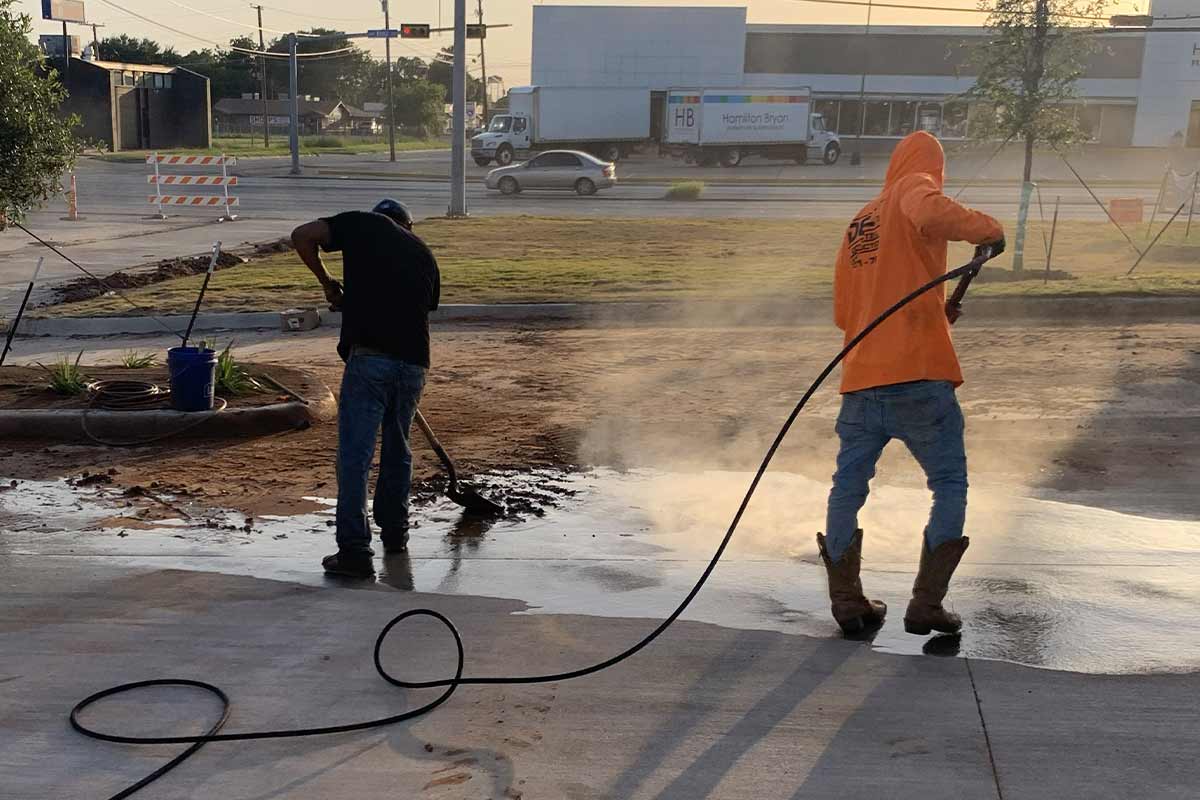
Oil, Rubber, Gum, and Winter Salt: What Actually Comes Off
A parking lot collects four different problems, and they do not all respond to the same thing.
Oil and transmission fluid soak in rather than sit on top, which is why a pressure washer alone often spreads the halo wider. Asphalt is porous and petroleum-based, so oil is chemically at home in it. Lifting a genuine drip stain means treating it, not simply blasting it.
Tire rubber is the black scuffing that builds at every turn, stop, and drive-through lane. It comes off, and the difference is usually the most visible thing about a cleaned lot.
Gum is the one nobody thinks about until they see the before-and-after outside an entrance, where it accumulates in a band a few feet deep.
Winter salt residue is the Indiana problem. De-icing chemicals leave a chalky film that dulls the surface and, more to the point, keeps working on your paint long after the snow has gone. Washing salt off in spring is not cosmetic — it is the cheapest thing you can do for the lines you already paid for.
One honest caveat: pressure washing cleans a surface, it does not resurface one. It will not fix a failing seal coat, close a crack, or bring back asphalt that has oxidized to gray. If that is what your lot needs, we will say so rather than sell you a wash that disappoints.
Wash Water and Stormwater Rules
This is the part most people never think about, and it is the part that can turn a cleaning job into a problem.
The water coming off a parking lot wash is not clean rainwater. It carries oil, detergent residue, rubber, sediment, and — in spring — de-icing chemicals. Letting it run straight into a storm drain sends all of that into the same system that discharges to local waterways.
That system is regulated — though not by the agency almost everyone names. Indiana is an authorized state, which means Indiana Department of Environmental Management MS4 stormwater permitting governs here, not the EPA’s, under the state’s MS4 general permit. And the permit is far more specific than the folklore around it.
It actually lists pavement wash water among the discharges a stormwater program need not chase — provided no spilled toxic or hazardous material is sitting there unremoved, and provided detergents are not used.
That second proviso is the whole rule, and it is the one that lands on your lot. A commercial wash uses detergent — the copy above says so, because the runoff carries detergent residue along with the oil and rubber it just lifted. The moment detergent is in the water, the exemption stops applying, and the local illicit-discharge ordinance your municipality is required to maintain takes over.
So the practical rule is simple, and now you know why it holds: once detergent is in the water, it gets contained, recovered, and disposed of properly — not sent down the nearest drain. That means blocking or protecting the inlets, capturing the runoff, and dealing with it correctly afterwards.
Ask any contractor quoting you a lot wash what they intend to do with the water. If the answer is a shrug, the saving they are offering you is not really a saving — it is a risk they have quietly transferred to the property owner.
Wash First, Stripe Second: Why Sequence Matters
If a lot is getting both a wash and fresh lines this year, the order is not a preference. It is the whole job.
Paint bonds to a surface, and it bonds to whatever is actually on that surface. Applied over oil film, rubber, salt residue, or dust, it grips the contamination rather than the pavement — and it fails early, no matter how good the paint was or what it cost. Paint that lets go in its first year has usually failed here, at the surface it was asked to stick to, rather than in the can.
So the sequence is: clean, let the surface dry, then stripe. Washing a lot after it is striped, on the other hand, is routine maintenance and does no harm when it is done sensibly.
The one that costs people money is booking the two jobs in the wrong order, or booking a wash with one company and striping with another who never asks whether the surface was cleaned. If we are doing both, we sequence them properly. If you are using someone else for one of them, ask the question anyway.
For a full list of our pavement marking services, visit our parking lot striping in North Indianapolis page.
Businesses We Serve




How it Works

GET A FREE ESTIMATE
Contact us today and we’ll have a quote to you in 24 hours

SCHEDULE AN INSTALLATION
We’ll have your installation scheduled in less than 7 days, without affecting your business hours

GET A PARKING LOT THAT POPS
For a budget-friendly price, you’ll get a parking lot that looks like new
We proudly work with:


We proudly work with:
Frequently Asked Questions About Parking Lot Pressure Washing in North Indianapolis, IN
How much do they charge to pressure wash a parking lot?
We quote after seeing the lot, and any figure quoted before that is a guess. What drives it: total square footage, how heavily soiled the surface is and with what — light dust cleans differently from years of embedded oil — how much of the area needs spot treatment rather than a general wash, what is involved in containing and disposing of the wash water on your particular site, water access, and whether the lot can be closed in sections or has to be worked overnight. Ask us for a free estimate.
How do you clean a big parking lot?
In sections, and in an order. A large lot is worked zone by zone so the property keeps operating — barriers move with the crew rather than closing the whole site. Heavy spot contamination such as oil drips and gum is treated before the general wash rather than during it. Storm drain inlets are protected before any water moves, and the runoff is captured rather than allowed to find the nearest grate. Large sites are usually done early, late, or over a weekend for exactly this reason.
What do I need to pressure wash a parking lot?
More than a pressure washer, which is the honest answer. You need enough water and the pressure to move embedded contamination without damaging the surface; you need a way to treat oil and gum, which do not blast away; and — the part that catches people — you need a plan for the wash water. Indiana’s MS4 permit treats pavement wash water as acceptable only where no spilled hazardous material remains and no detergents are used. A commercial wash uses detergent, so the runoff has to be contained and disposed of rather than run into a storm drain. That last piece is what makes this a commercial job rather than a rental-store one.
Can you pressure wash a lot before striping it?
Yes, and if you are doing both, that is the right order. Paint bonds to whatever is on the surface, so a line applied over oil film, rubber, or salt residue grips the contamination instead of the pavement and fails early. Clean first, let the surface dry, then stripe. Premature striping failure is far more often a preparation failure than a paint failure.
Where does the wash water go?
Not down the storm drain. Indiana’s MS4 stormwater permit — administered by IDEM, not the EPA — allows pavement wash water only where detergents are not used and no spilled hazardous material remains. A commercial wash uses detergent, so that exemption does not cover you, and your municipality’s illicit-discharge ordinance is what applies instead. The wash water is contained and recovered on site and disposed of properly, with drain inlets protected before any water starts moving. If a contractor cannot tell you what they will do with the water, that is worth knowing before they start.