Sports Court Striping
In North Indianapolis, IN
Multi-Sport Court Line Marking
1-800-STRIPER provides professional sports court striping in North Indianapolis, IN — laying out pickleball courts to USA Pickleball specifications, plus basketball courts, tennis courts, and playground game markings in durable acrylic court paint for schools, parks, and HOAs across Hamilton and Boone counties.
1-800-STRIPER® of Indianapolis North PROVIDes Sport Court and Playground Markings Services NEAR YOU
Want to get people to come out to play?
Brighten up your faded sport courts or turn your playground into a safe, colorful, and engaging space that entices people to come out and play.
Sport Court Specialties:
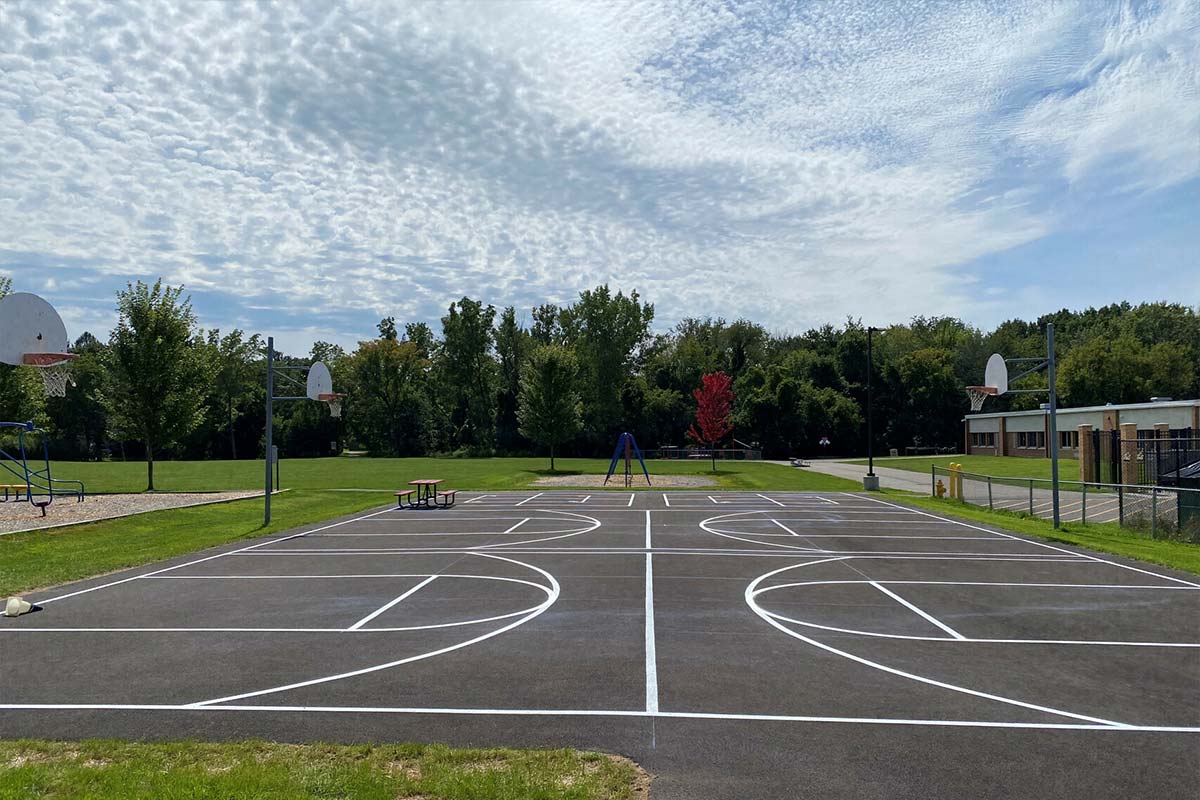
Pickleball, Basketball, and Tennis
Pickleball is why most people call now. Courts are going in on tennis courts, on unused basketball slabs, and on plain concrete pads at schools, parks, churches, and HOAs across the north side, and the layouts are laid out to the dimensions in the USA Pickleball Official Rulebook rather than to whatever fits.
The question that comes up every time is whether to convert a court or overlay it. Converting gives you a dedicated pickleball surface that reads cleanly and plays properly. Overlaying puts pickleball lines onto an existing tennis or basketball court, which gets far more play out of one slab — and asks players to read two sets of lines at once. Both are legitimate; which is right depends on who uses the court and how often they fight over it. Line color and contrast do most of the work of making a shared court readable, and that is a decision worth making deliberately rather than by default.
Basketball is the other half of most of these jobs — keys, three-point arcs, baselines, and center circles, full court or half.
Tennis courts are laid out to regulation dimensions, and in this area they are increasingly laid out with the pickleball question already asked.
Surfaces, Paint, and Why Court Paint Is Not Line Paint
A court is not a parking lot, and the coating is where that shows.
Court markings go down in acrylic court paint, which is built for a surface people run, pivot, and slide on, and which has to hold its color and its edge under a great deal more direct abuse than a parking stall ever sees. Line definition matters here in a way it does not on a lot: a fuzzy edge on a baseline is a genuinely contested call every time somebody hits it.
Surface condition governs the outcome, as always. Paint applied over a dirty, damp, or failing slab will not last, and a court that is cracking or holding water has a problem that new lines will not fix — we will tell you that rather than paint over it.
Then the layout itself has to be set out and measured before anything is applied, because a court that is a few inches out is wrong forever, and nobody discovers it until the first competitive game.
Playground Game Markings
The other half of the work at schools and parks — and the part that tends to get remembered.
Playground game markings are the painted games that turn an empty asphalt pad into somewhere children actually go: hopscotch, four square, foursquare grids, number lines and alphabet trails, running tracks around the perimeter, snakes and ladders, compass roses, and the map-and-maze layouts that teachers use as much as the kids do.
They go onto the same kind of asphalt or concrete pad that everything else here goes onto, in the same durable paint, and they cost a fraction of a piece of playground equipment. For a school with a bare blacktop and a small budget, playground game markings are usually the highest-value thing that can be done to it.
Schools, parks departments, churches, and HOAs across Hamilton and Boone counties are most of who asks — and the same visit that stripes the courts can mark the playground.
For a full list of our pavement marking services, visit our parking lot striping in North Indianapolis page.
Businesses We Serve




How it Works

GET A FREE ESTIMATE
Contact us today and we’ll have a quote to you in 24 hours

SCHEDULE AN INSTALLATION
We’ll have your play space restriped in less than 7 days, without affecting your playtime

GET A PARKING LOT THAT POPS
For a budget-friendly price, you’ll get a parking lot that looks like new
We proudly work with:


We proudly work with:

Frequently Asked Questions About Sports Court Striping in North Indianapolis, IN
Can you put pickleball lines on an existing tennis court?
Yes, and it is one of the most common requests we get. You have two choices: overlay pickleball lines onto the existing court, which gets far more use out of one slab but asks players to read two sets of lines, or convert the court to dedicated pickleball, which plays cleaner. Overlays live or die on line color and contrast — chosen well, a shared court reads easily; chosen badly, it is a permanent argument. We will walk through both with you.
What dimensions are pickleball courts?
We lay courts out to the dimensions published in the USA Pickleball Official Rulebook rather than to a figure quoted from memory, and we will confirm the current specification against the rulebook for your job. What we would flag before you plan: the playing area a court needs is meaningfully larger than the lines themselves, so the constraint on most sites is the run-off space around the court rather than the court itself. Measure the whole pad before you count courts.
Do you do playground game markings as well as courts?
Yes, and for a school with a bare blacktop it is often the better spend. Hopscotch, four square, number lines, alphabet trails, perimeter running tracks, snakes and ladders, compass roses, and map or maze layouts all go onto the same asphalt or concrete pad in durable paint, at a fraction of the cost of equipment. Schools, parks, churches, and HOAs are most of who asks — and one visit can cover the courts and the playground together.
What kind of paint is used on a sports court?
Acrylic court paint, not the traffic paint used on a parking lot. A court surface takes running, pivoting, and sliding, and the coating has to hold its color and — critically — a sharp line edge under that. Line definition matters more here than almost anywhere else, because a fuzzy baseline is a contested call every time someone hits it. As with any coating, the surface has to be clean and dry before anything is applied.
Can you stripe a court that is cracked or holding water?
We can, but not before saying we would rather not. New lines on a failing slab buy you appearance, not life — a court that is cracking or ponding has a surface problem, and paint does not fix surfaces. If the slab is sound and just dirty or faded, that is exactly the job. If it is not, you deserve to hear that before you spend the money, so we will look and tell you honestly.