Warehouse Line Painting
In Palm Beach, FL
Indoor Line Striping for Warehouses and Facilities
1-800-STRIPER provides professional warehouse line painting in Palm Beach, FL — OSHA-compliant aisle lines, pedestrian walkways, and safety zone markings per OSHA 1910.22 requirements using durable epoxy and traffic paint for distribution centers and industrial facilities across Palm Beach County, the Jupiter / Abacoa corridor, and the Treasure Coast (Port St. Lucie, Stuart).
1-800-STRIPER® of Palm Beach PROVIDes Warehouse Floor Markings Services NEAR YOU
Want your indoor space to operate more efficiently?
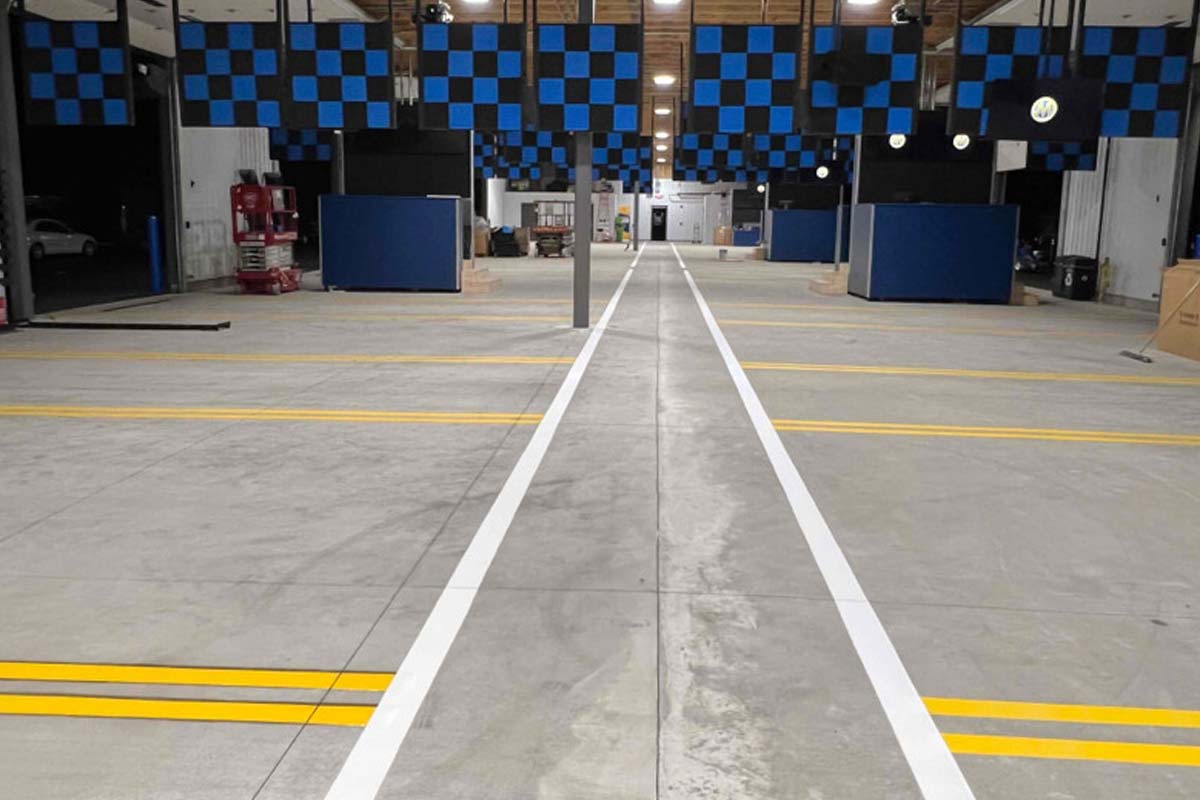
Warehouse and interior markings ensure clear traffic lanes, organized storage zones, and designated spaces designed to help your business operate safely and efficiently.
Benefits:
How It Works
Our warehouse line painting process:
- Floor inspection. We walk the facility with your operations team, mapping forklift aisles, pedestrian walkways, loading-dock zones, staging areas, hazardous-material storage boundaries, exit paths, and safety-zone perimeters around electrical panels, fire extinguishers, eye-wash stations, and emergency shut-offs.
- ANSI Z535 color plan. We propose a color-coding plan aligned with the widely adopted ANSI Z535 standard: yellow for caution zones, red for fire-protection and emergency equipment, green for safety stations, blue for information signs, black-and-white for no-go areas.
- Surface prep. We clean the slab of debris, loose paint, and chemical residue. For high-moisture coastal-humidity slabs (common in Palm Beach-area concrete), we test for moisture and apply moisture-tolerant primers where standard epoxy would fail to bond.
- Paint selection. Epoxy or methacrylate-based coatings on high-traffic forklift aisles and heavy-wear zones. Water-based traffic paint on lower-traffic pedestrian walkways and zone perimeters. We match the material to the expected wear cycle.
- Application. We apply during off-shift windows whenever possible — weekends, overnight shifts, planned maintenance days — so operations continue unaffected.
- Cure + documentation. Epoxy cures in 12-24 hours depending on product; water-based paint cures in 24 hours. We deliver a facility markings map for OSHA compliance records.
Palm Beach County & Treasure Coast Distribution-Hub Demand
The Palm Beach Park of Commerce in Jupiter and the Port St. Lucie Commerce Park on the Treasure Coast are two of the largest distribution-center concentrations in the broader South Florida region. Both contain a mix of logistics operators, last-mile delivery hubs, cross-dock terminals, cold-storage facilities, and general-merchandise distribution centers. OSHA 1910.22 compliance is active on every site. Forklift aisles marked with yellow caution lines, pedestrian walkways with contrasting color, dock-position numbers, loading-zone staging markings, and safety-zone perimeters around electrical gear and emergency equipment.
For coastal-exposed warehouses (those within one mile of the Atlantic or the Intracoastal), slab-moisture and humidity considerations drive the primer selection. High-RH concrete slabs — common in South Florida because of the year-round humidity — can cause standard epoxy to bubble or fail to bond. We test slab RH with a calibrated meter before epoxy work and specify moisture-tolerant systems when the RH exceeds the manufacturer’s threshold.
Hurricane-shelter-designated facilities add a preparation workflow. Before hurricane season, we refresh debris-staging zones, vehicle-turnaround markings, and post-storm cleanup paths so the facility can transition quickly from normal operations to shelter mode if needed.
ANSI Z535 Safety-Color Standards & OSHA 1910.22 Compliance
OSHA 1910.22(b) requires that aisles and passageways in workplaces be kept clear and that permanent markings be “visible and in good repair.” The standard doesn’t mandate specific colors, but the ANSI Z535 color-coding convention is what OSHA inspectors and most workforce-safety consultants expect to see. Yellow for caution (forklift aisles, pedestrian crossings, low-clearance areas). Red for fire-protection equipment, emergency stops, and hazards. Green for first-aid stations and safety equipment. Blue for information and operational signs. Black-and-white striping for no-go zones. Orange for dangerous conditions. Purple for radiation hazards.
Facilities managed by national logistics operators typically have a brand-standard color palette layered on top of the ANSI base, and we coordinate with corporate safety-compliance teams on any standardized markings before painting. Most Palm Beach-area warehouses follow ANSI Z535 closely because it matches what OSHA inspectors look for during routine compliance walks.
Why Choose Us
Our warehouse line painting crews schedule around your operational windows, not the other way around. Weekend mobilizations, overnight shifts, and phased section-by-section work for 24/7 facilities. We handle facility-wide re-marks and spot touch-ups on the same service agreement. Epoxy work is scheduled during dry-season months whenever possible (November-April) because humidity directly affects cure quality in unconditioned warehouse space. A written scope summary and facility map delivered after every visit for your OSHA compliance records.
For a full list of our pavement marking services, visit our all Palm Beach striping services page.
Businesses We Serve




How it Works

GET A FREE ESTIMATE
Contact us today and we’ll have a quote to you in 24 hours

SCHEDULE A STRIPING
We’ll have your space restriped in less than 7 days, without affecting your business hours

GET A PARKING LOT THAT POPS
For a budget-friendly price, you’ll get a parking lot that looks like new
We proudly work with:


We proudly work with:

Frequently Asked Questions About Warehouse Line Painting in Palm Beach, FL
What are the OSHA requirements for warehouse floor markings?
OSHA 29 CFR 1910.22(b) requires all permanent aisles and passageways in workplaces — including warehouses, distribution centers, and industrial facilities — to be marked. The markings must be distinguishable, durable under expected traffic, and maintained in visible condition. ANSI Z535 color-coding conventions (yellow for caution, red for emergency, green for safety, blue for information) are widely adopted alongside the OSHA requirement. 1-800-STRIPER of Palm Beach provides OSHA-compliant warehouse line painting across Palm Beach County, the Jupiter / Abacoa distribution corridor, and the Treasure Coast.
What warehouse markings does a distribution center in the Jupiter corridor need?
Most Palm Beach-area warehouses need a combination of forklift aisle lines, pedestrian walkways, loading dock zones, staging areas, hazardous-material storage boundaries, exit-path markings, and safety-zone demarcations around electrical panels, fire extinguishers, and emergency eye-wash stations. Distribution centers in the Palm Beach Park of Commerce (Jupiter) and Port St. Lucie Commerce Park also mark trailer parking positions and yard-traffic flow. 1-800-STRIPER of Palm Beach scopes the full marking set on site before application.
What paint lasts longest for warehouse floor markings in Florida?
Epoxy and methacrylate-based coatings hold up longest on warehouse floors because they resist forklift traffic, chemical spills, and the slab-moisture common to coastal South Florida concrete. Water-based traffic paint is cheaper but wears faster under constant forklift traffic. For humid Palm Beach-area facilities with high slab-moisture conditions near the coast, moisture-tolerant epoxy primers are used because standard epoxy can fail to bond to damp concrete. The right specification depends on forklift traffic volume, chemical exposure, slab condition, and coastal humidity exposure.
How often should warehouse floor markings be repainted?
Most Palm Beach-area warehouses repaint floor markings every 18 to 36 months, faster than the paint’s theoretical service life because forklift traffic, pallet-jack scraping, and occasional chemical spills wear the coating sooner. High-volume distribution centers in the Jupiter / Abacoa corridor may need annual touch-ups on the highest-traffic forklift aisles. A visual inspection of the primary aisles, dock lines, and pedestrian walkways once each quarter catches fading before it creates a workplace safety issue under OSHA 1910.22.
Can warehouse line painting be scheduled without shutting down operations?
Yes. Most warehouse line painting work in Palm Beach is scheduled during off-shift windows — weekends, overnight shifts, or planned maintenance days — so operations continue during normal business hours. Water-based traffic paint dries to light forklift traffic within two to three hours and fully cures in 24 hours; epoxy coatings need longer cure times and are typically scheduled around full shut-downs. For facilities that run 24/7, we phase the work section by section to avoid full-facility closure.
Does OSHA require specific colors for warehouse floor markings?
OSHA 1910.22(b) requires floor markings to be distinguishable and durable but does not mandate specific colors. The widely adopted ANSI Z535 color-coding convention assigns yellow to caution zones (forklift aisles, pedestrian crossings), red to fire-protection equipment and emergency stops, green to first-aid and safety equipment locations, blue to information signs, and black-and-white striping to no-go zones. Most Palm Beach-area distribution centers follow ANSI Z535 because it matches what their workforce and OSHA inspectors expect to see.