ADA Parking Lot Striping
In Palm Beach, FL
ADA Compliant Parking Spaces, Access Aisles, and Unloading Zones
1-800-STRIPER provides ADA-compliant parking lot striping in Palm Beach, FL — installing accessible spaces, van-accessible stalls, access aisles, ISA symbols, and required signage per the 2010 ADA Standards for Accessible Design and Florida Accessibility Code FAC Chapter 11 (stricter than federal slope and aisle-width requirements).
1-800-STRIPER® of Palm Beach PROVIDes ADA Compliance Services NEAR YOU
Need to make your property more accessible?
Upgrade your facility to become fully ADA compliant by partnering with us to create clear, accessible parking for all your visitors.
Our ADA Compliant line striping services include:
How It Works
Our ADA striping process is built around compliance verification, not just paint application:
- On-site measurement. We verify stall width, access-aisle width, and slope against current ADA limits. 8-foot stalls with 5-foot aisles for cars, 8-foot aisles or 11-foot stalls for vans, and running slope no steeper than 1:48 in any direction. Florida Accessibility Code FAC Chapter 11 requires the same or tighter tolerances.
- Accessible-route audit. We confirm the path from every accessible stall to the building entrance meets the clear-width and clear-path requirements, because a compliant stall that opens onto a non-compliant route is still a failure.
- Count verification. We confirm the total accessible space count against your lot size under the 2010 Standards table, and confirm that at least one of every six accessible spaces is designated van-accessible.
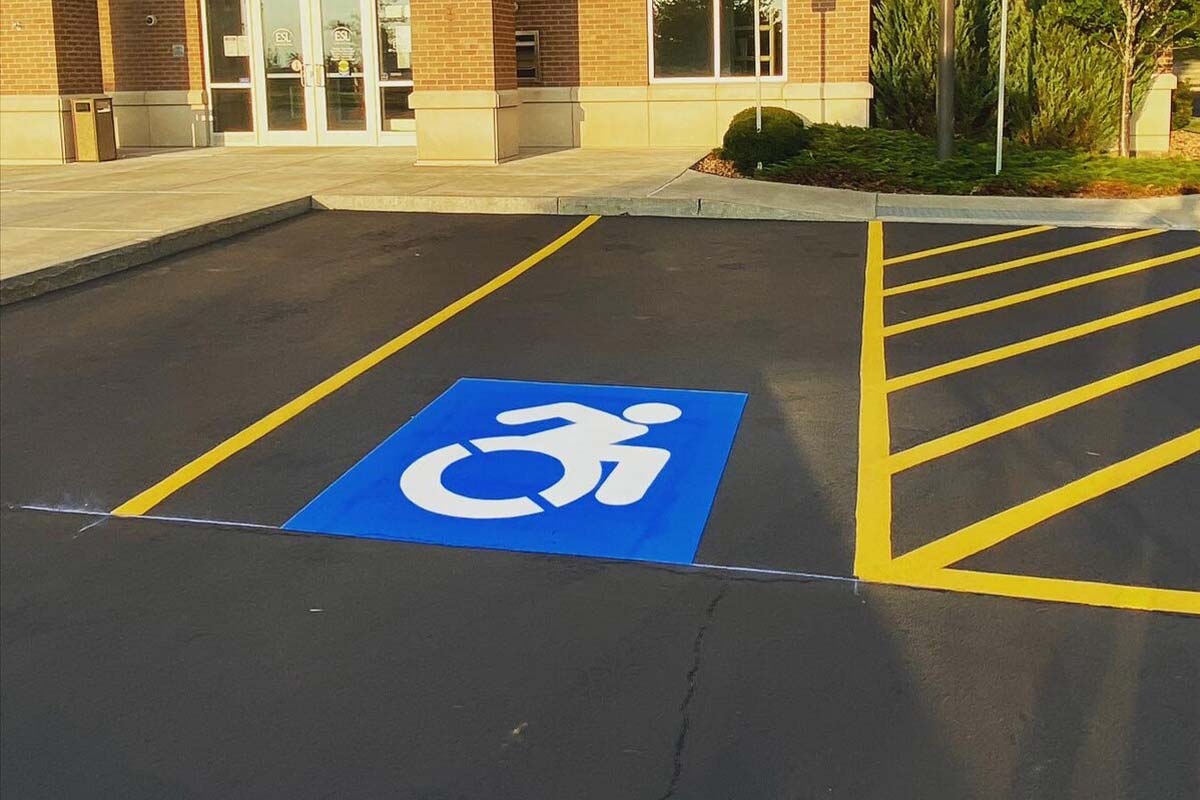
- Marking application. We stripe the diagonal-hatched access aisle in contrasting color, stencil the International Symbol of Accessibility in the stall, and repaint any worn border lines.
- Signage installation. We install the R7-8 sign at a minimum 60-inch mounting height with a Van Accessible plaque on van-designated stalls, anchored per Florida Building Code §1609 wind-load requirements for Zone 3 coastal exposure.
- Compliance sign-off. We leave a written scope summary identifying the markings applied and the ADA citation each one maps to, giving property managers documentation for any future inspection or audit.
Florida Accessibility Code — What FAC Chapter 11 Adds Beyond Federal ADA
Florida does not follow the 2010 ADA Standards alone. Florida Accessibility Code FAC Chapter 11 aligns with the federal baseline on most parking requirements but adds Florida-specific provisions that Palm Beach property owners must meet. FAC Chapter 11 enforces tighter slope tolerances in accessible stalls — the maximum running and cross slope is 1:48 in any direction, with no rounding tolerance. And requires signage mounting heights and visibility standards that align with but sometimes exceed the federal R7-8 specification. Enforcement in Florida flows through both the Department of Justice at the federal level and the Florida Commission on Human Relations at the state level, and private lawsuits under Florida-specific statutes run parallel to federal Title III actions.
A common gap on South Florida commercial properties is stall slope. Asphalt lots settle and crack over time, and slopes that met the tolerance when originally striped can drift out of compliance after a few summers of heat expansion and hurricane-driven rainfall runoff. An ADA walk-through before restriping catches these cases, because repainting over a non-compliant slope simply preserves the compliance gap under fresh paint.
Why Choose Us
South Florida weather is hard on ADA markings. Intense UV exposure, surface temperatures above 140°F in summer, coastal salt-air along A1A and US-1, and frequent afternoon thunderstorms wear the high-contrast blue and white paint and the reflective face of R7-8 signage faster than the 24-36 month refresh cycles common in cooler climates. Palm Beach lots typically need visual inspection before hurricane season (May) and re-striping every 12 to 18 months to maintain the clear-visibility standard the Department of Justice uses when assessing non-compliance. 1-800-STRIPER of Palm Beach schedules accessible-space refresh cycles during the stable morning windows in summer (June-August, before the afternoon storm cycle) and full-day windows November through April when humidity is lower and paint adhesion is strongest.
We also coordinate ADA work with your existing parking maintenance so accessible markings, general stalls, fire lanes, signage, and any pressure-wash prep happen on a single mobilization, saving operational disruption while closing the compliance gap end-to-end. For Palm Beach property owners who have not audited their accessible-parking scope in several years, we recommend a full walk-through before the next striping cycle: stall-count verification against current lot size, access-aisle width confirmation, slope verification under FAC Chapter 11, signage height and plaque check, and accessible-route validation from stall to building entrance. Catching a pre-existing compliance gap during maintenance scoping is far less disruptive than resolving one surfaced by a Department of Justice complaint or a Florida Commission on Human Relations action.
For a full list of our pavement marking services, visit our full Palm Beach service lineup page.
Businesses We Serve




How it Works

GET A FREE ESTIMATE
Contact us today and we’ll have a quote to you in 24 hours

SCHEDULE AN INSTALLATION
We’ll have your installation scheduled in less than 7 days, without affecting your business hours

GET A PARKING LOT THAT POPS
For a budget-friendly price, you’ll get a parking lot that looks like new!
We proudly work with:


We proudly work with:


Frequently Asked Questions About ADA Parking Lot Striping in Palm Beach, FL
What does ADA-compliant parking lot striping require in Florida?
ADA-compliant striping in Florida must meet the 2010 ADA Standards for Accessible Design, the ADA Accessibility Guidelines (ADAAG), and Florida Accessibility Code FAC Chapter 11, which incorporates and sometimes exceeds the federal standard. Requirements include properly dimensioned accessible stalls, striped access aisles with diagonal blue-and-white pattern, the International Symbol of Accessibility stencil in each stall, and code-compliant signage at the head of each space. 1-800-STRIPER of Palm Beach handles full compliance assessment and marking for Palm Beach County and Treasure Coast commercial properties.
How many ADA parking spaces does my Palm Beach parking lot need?
The required number depends on your total parking capacity per the 2010 ADA Standards. Lots with 1 to 25 total spaces need at least 1 accessible stall; 26 to 50 spaces need 2; and so on, scaling upward in a published table. Regardless of lot size, at least one of every six accessible spaces must be van-accessible. Palm Beach commercial properties serving the public — retail, medical, office, restaurants, HOA clubhouses, and tourist-corridor destinations on Palm Beach Island — must meet these counts to stay compliant with both federal ADA and FAC Chapter 11.
How is Florida Accessibility Code FAC Chapter 11 stricter than the federal 2010 ADA Standards?
Florida Accessibility Code FAC Chapter 11 aligns with the 2010 ADA Standards on most parking requirements but adds a tighter tolerance on running and cross slope in accessible stalls — Florida enforces a maximum of 1:48 in any direction — and requires compliant signage visible from within the accessible space at a minimum mounting height. FAC also cross-references the Florida Fire Prevention Code for accessible-route clearances. Palm Beach property owners must meet both the federal and state standards, with state enforcement flowing through the Florida Commission on Human Relations.
What is the difference between an ADA space and a van-accessible space?
A standard ADA accessible stall requires a 60-inch access aisle (5 feet) for wheelchair transfer. A van-accessible stall requires either a wider 96-inch access aisle (8 feet) or an 11-foot stall width with a 5-foot aisle to accommodate the side-deployed wheelchair lifts on accessible vans. Both types must be marked with the International Symbol of Accessibility, connect to an accessible route to the building entrance, and carry the required R7-8 and “Van Accessible” signage mounted at the compliant height.
How often should ADA striping be repainted in South Florida?
ADA markings in Palm Beach should be repainted every 12 to 18 months — faster than national guidance because South Florida UV exposure, frequent summer thunderstorms, and coastal salt-air wear the high-visibility blue and white paint faster than inland or cooler climates. A visual inspection before hurricane season (May) and another after the worst of the summer storm cycle (October) confirms whether the International Symbol of Accessibility, access-aisle diagonals, and border lines still meet the clear-visibility standard required for compliance.
Does ADA striping apply to gravel parking lots in Florida?
The ADA requires accessible spaces to have stable, firm, and slip-resistant surfaces. Gravel or unpaved lots must either pave or stabilize the designated accessible area — including the full stall, access aisle, and route to the building entrance — before compliant markings can be applied. In practice, ADA stall zones on predominantly gravel lots in Palm Beach County are typically paved with asphalt or concrete panels first, then striped with high-visibility ADA markings to meet both federal and Florida Accessibility Code requirements.