Thermoplastic Striping
In Palm Beach, FL
Thermoplastic Pavement Markings
1-800-STRIPER provides professional thermoplastic striping in Palm Beach, FL — long-service-life pavement markings for stop bars, crosswalks, directional arrows, and fire lanes applied at roughly 400°F per AASHTO M249 specifications for high-traffic commercial lots across Palm Beach County and the Treasure Coast.
1-800-STRIPER® of Palm Beach PROVIDes Thermoplastics Services NEAR YOU
Want to reduce the maintenance requirements for your parking lot?
Thermoplastic pavement markings are a durable, weather and vehicle-resistant striping option for your parking lot or facility.
You can utilize them for stop bars, ADA stalls, no-parking zones, directional arrows, crosswalks, or your entire parking lot.
Benefits:
How It Works
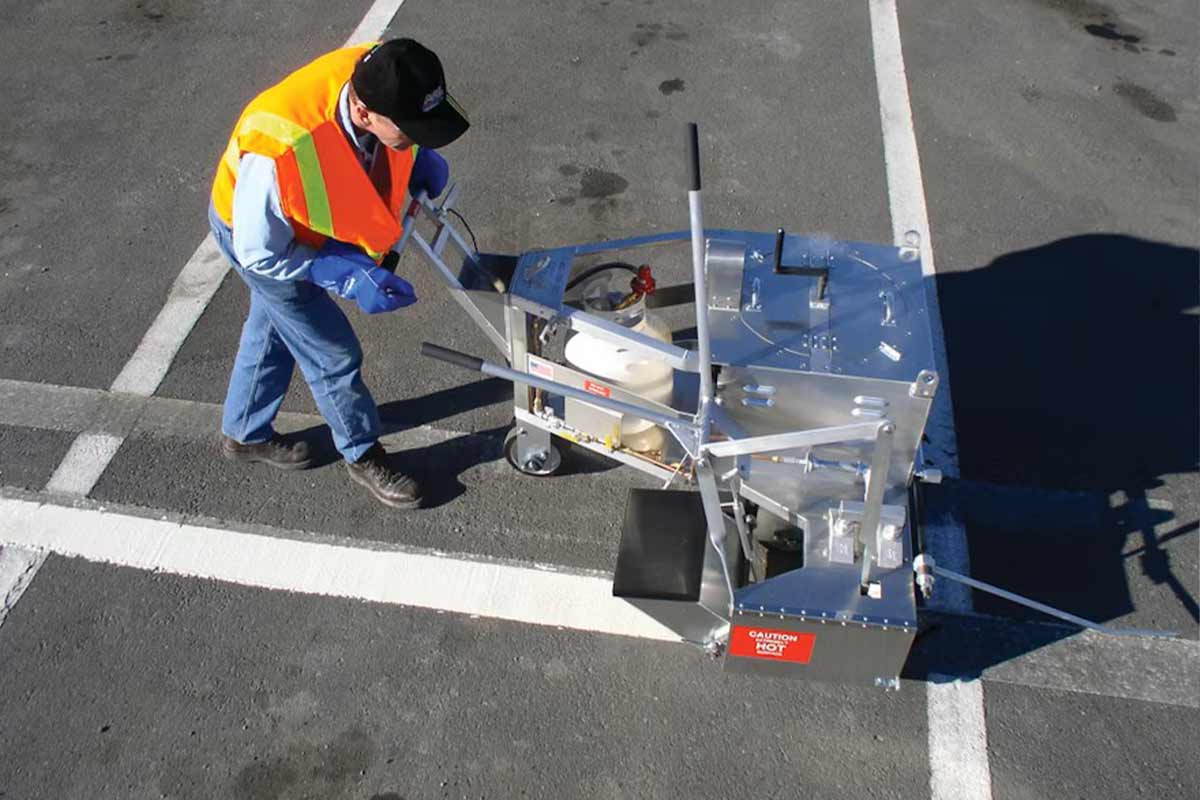
Our thermoplastic application process:
- Material selection. AASHTO M249-compliant white or yellow thermoplastic with reflective glass beads for night visibility. For high-contrast crosswalks, we specify higher-reflectivity formulations.
- Surface prep. The pavement must be clean, dry, and free of existing paint that’s flaking. Where old paint is bonded and sound, it serves as a base; where it’s failing, we remove it via shot-blasting or grinding.
- Primer. We apply a methacrylate or epoxy primer on concrete surfaces and on asphalt where additional adhesion is specified. Primer cures in 15-30 minutes under typical Palm Beach conditions.
- Thermoplastic application. We heat the material to approximately 400°F in a portable applicator and extrude or spray it at specified thickness (typically 90-120 mils). The material cools and bonds within 2-5 minutes.
- Glass-bead broadcast. For reflective markings, we broadcast additional glass beads into the still-warm thermoplastic surface to ensure adequate retroreflectivity for night visibility.
- Cure. The markings are ready for traffic within 15-30 minutes of application and reach full strength in 1-2 hours.
Thermoplastic vs. Traffic Paint — Cost-Benefit Comparison
| Factor | Water-based Traffic Paint | Thermoplastic |
|---|---|---|
| Initial cost per linear foot | Low | ~3-4x higher |
| Service life (South Florida commercial lot) | 12-18 months | 4-6 years |
| Application temperature | Ambient | ~400°F |
| Application speed | Fast | Slower (heating cycle) |
| Reflectivity (beads) | Good when new, fades with paint | High and durable |
| Skid resistance | Baseline | Higher (textured surface) |
| Best use | Full-lot restriping, stall lines, custom stencils | Primary drive-aisle centerlines, stop bars, crosswalks, fire lanes |
| Coastal salt-air durability | Degrades faster within 1 mi of coast | More resistant; still affected but holds longer |
Five-year total cost of ownership on primary markings typically favors thermoplastic because the two or three paint-refresh cycles required to match a single thermoplastic application add up to more than the thermoplastic premium. For standard parking-stall lines in low-to-moderate-traffic retail or office lots, traffic paint usually wins on cost because the lower-traffic lines don’t wear fast enough to justify thermoplastic.
Coastal Florida Application Window
Thermoplastic application requires specific surface conditions. Surface temperature above 50°F and below 130°F (roughly 70-95°F ambient works best). No moisture present — no dew, no recent rainfall, no wet paver joints. No imminent rainfall — the minimum dry window after application is 1 hour, but 4+ hours is preferred. Palm Beach has two reliable application windows:
- November through April dry season. Daily highs consistently below 85°F, humidity lower, afternoon thunderstorms rare. Full-day applications are typical. This is the preferred window.
- Summer morning-only windows. June through October, application starts at dawn and completes before 10 a.m. when surface temperatures start climbing toward the 130°F limit and thunderstorm risk rises. Feasible but scheduling is tighter.
Hurricane-watch windows (June 1 – November 30 when a named storm is within 72 hours) are avoided entirely because surface moisture and wind-borne debris compromise adhesion. For coastal-exposed properties within one mile of the Atlantic, salt-air adds a consideration: thermoplastic still outperforms paint, but the degradation cycle is about 30 percent faster than inland sites with the same traffic volume.
Why Choose Us
We apply AASHTO M249-compliant thermoplastic materials because the commercial-property insurance and municipal-inspection expectations in Palm Beach reference that standard. Our crews schedule thermoplastic work for the optimal November-April window whenever the project timeline allows, producing the longest-service-life application. We coordinate thermoplastic work with parking-stall restriping so high-wear primary markings are on a different refresh cycle than standard lines, matching maintenance budgets to material service lives.
For a full list of our pavement marking services, visit our full Palm Beach pavement marking services page.
Businesses We Serve



How it Works

GET A FREE ESTIMATE
Contact us today and we’ll have a quote to you in 24 hours

SCHEDULE AN INSTALLATION
We’ll have your installation scheduled restriped in less than 7 days, without affecting your business hours

GET A PARKING LOT THAT POPS
For a budget-friendly price, you’ll get a parking lot that looks like new
We proudly work with:


We proudly work with:

Frequently Asked Questions About Thermoplastic Striping in Palm Beach, FL
What is thermoplastic striping and how is it different from paint?
Thermoplastic striping is a durable pavement marking applied in molten form — heated to roughly 400°F — that bonds to asphalt or concrete as it cools. Compared to water-based or acrylic traffic paint, thermoplastic lasts 4 to 8 times longer, resists tire wear better on high-traffic areas, and retains a brighter white or yellow color longer. For Palm Beach commercial lots with heavy truck traffic in the Jupiter corridor and coastal-exposed properties along A1A, thermoplastic striping on primary traffic-flow lines is often worth the upfront investment.
Where is thermoplastic striping most effective?
Thermoplastic is most effective on high-traffic locations where markings wear fastest: primary drive-aisle centerlines, stop bars at exit points, directional arrows at intersections, crosswalks at major pedestrian routes, and fire lane boundaries on commercial lots with heavy truck or delivery-vehicle traffic. For standard parking-stall lines in low-to-moderate-traffic retail or office lots, traffic paint is usually the more cost-effective choice. 1-800-STRIPER of Palm Beach scopes each lot to identify which markings merit thermoplastic and which can use paint.
What AASHTO M249 spec applies to thermoplastic striping?
AASHTO M249 is the American Association of State Highway and Transportation Officials standard specification for white and yellow thermoplastic pavement marking material. It covers composition (aggregate, binder, pigment), application temperature (typically 400-420°F), reflectivity requirements, skid resistance, and durability under traffic. FDOT thermoplastic specifications reference and extend AASHTO M249. Professional applicators in Palm Beach use AASHTO M249-compliant materials because it’s the durability and reflectivity standard that commercial property insurers and municipal inspectors expect.
When is the optimal time to apply thermoplastic in Palm Beach?
The optimal application window in Palm Beach is November through April — when daily highs are consistently below 85°F, humidity is lower, and afternoon thunderstorms are less frequent. Thermoplastic needs a dry, warm-but-not-hot surface for proper adhesion, which South Florida’s mild dry-season mornings provide consistently. Summer applications are possible in early-morning windows before surface temperatures climb, but scheduling is tighter because of the afternoon storm cycle. Hurricane-season scheduling (June-November) is avoided for any named-storm-watch window.
How long does thermoplastic striping last in Palm Beach?
Thermoplastic striping on Palm Beach commercial lots typically lasts 4 to 6 years before a noticeable fade or wear pattern develops — compared to 12 to 18 months for water-based traffic paint. South Florida UV exposure, coastal salt-air, and surface temperatures above 140°F in summer shorten this slightly compared to cooler or inland markets, but thermoplastic still dramatically outlasts paint in equivalent conditions. Primary drive aisles, stop bars, and high-pedestrian crosswalks retain visible shape and reflectivity through multiple paint-refresh cycles on surrounding stall lines.
Can thermoplastic be applied over existing faded paint?
Thermoplastic can be applied over existing traffic paint if the underlying paint is sound and tightly bonded to the pavement — in that case, the old paint serves as a bonding layer. If the existing paint is flaking, chalking, or cracking, it must be removed first via shot-blasting, grinding, or chemical stripping so the thermoplastic bonds directly to the pavement. A pre-application inspection identifies which approach is needed, because thermoplastic applied over failing paint will debond and peel regardless of temperature or thickness.