
Bollard Installation
In Palm Beach, FL
Bollard Installation Services
1-800-STRIPER provides professional bollard installation in Palm Beach, FL — setting steel, concrete-filled, and decorative protective posts per ASTM F3016 vehicle-impact resistance and ADA clearance standards to protect storefronts, utility meters, fire-suppression infrastructure, and pedestrian zones for commercial properties across Palm Beach County, the Jupiter corridor, and the Treasure Coast.
1-800-STRIPER® of Palm Beach PROVIDes Bollard Installation Services NEAR YOU
Want to prevent accidents and protect your property?
Bollards provide physical protection for your customers and your property.
Safety and security:
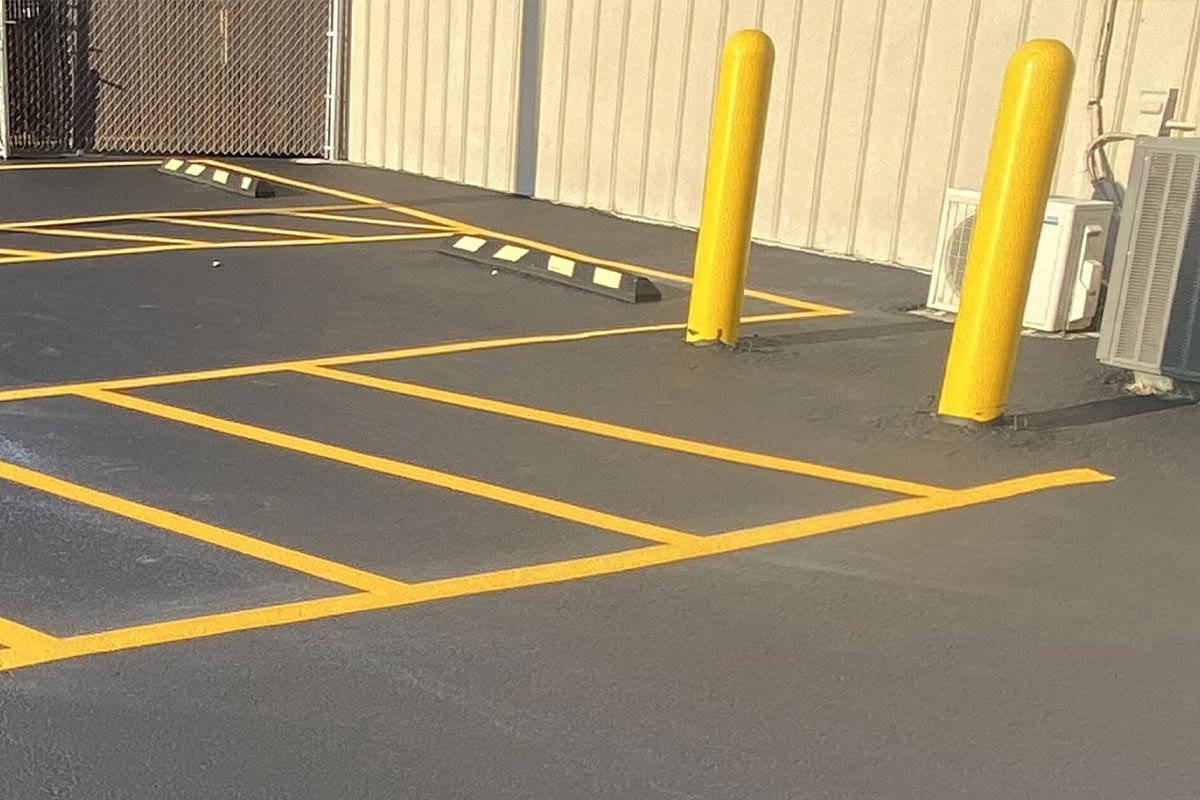
Bollards create a physical barrier between vehicles and pedestrians, protecting people in walking areas from accidental or intentional vehicle intrusions.
Bollards act as a protective barrier around storefronts, gas stations, and other vulnerable areas, minimizing the risk of costly damage from vehicle impacts.
Strategic Placement Locations:
How It Works
Our bollard installation process:
- Threat and risk assessment. We walk the site with the property manager, identifying zones where a vehicle impact — from low-speed drift to higher-speed pedal-confusion — could damage storefronts, utility meters, FDC connections, natural-gas meters, electrical panels, or pedestrian pathways.
- ASTM F3016 rating selection. We match the bollard impact rating to the threat level. 30-mph rating for storefronts and pedestrian-heavy zones, 20-mph rating for drive-thru lanes and ATM islands, 10-mph rating for low-speed parking-lot drift scenarios.
- Anchor depth calculation. Impact rating and ASCE 7 wind-load exposure (Category C or D for Palm Beach) drive the concrete footing depth. Typical 6-inch steel pipe bollard installations use a 24-to-48-inch deep concrete footing, 18-to-24-inch footing diameter, with the steel pipe extending into the footing and filled with additional concrete.
- Footing excavation and pour. We auger the footing to design depth, set the bollard plumb, and pour high-strength concrete. Cure time 24-48 hours before the bollard is considered at service strength.
- Surface finish. Painted steel in safety yellow or black for industrial sites; powder-coated or stainless-clad for aesthetic sites like Worth Avenue retail, Mizner Park, or hospitality properties along A1A. Decorative cast-iron or stainless covers available for upscale installations.
- Documentation. Site map identifying every bollard, its impact rating, anchor specification, and finish.
ASTM F3016 Impact Ratings Explained
| Rating | Test Vehicle | Test Speed | Best For |
|---|---|---|---|
| P10 | 5,000 lb pickup | 10 mph | Low-speed parking-lot drift |
| P20 | 5,000 lb pickup | 20 mph | Drive-thru lanes, ATM kiosks |
| P30 | 5,000 lb pickup | 30 mph | Storefronts, pedestrian zones |
| K4 / K8 / K12 | Higher (federal security) | Higher | Government / federal facilities |
Most Palm Beach commercial installations use P20 or P30 rated bollards. Storefront protection at retail centers, country clubs, and hospitality properties defaults to P30. Drive-thru and ATM installations use P20. P10 is typical for low-speed parking lot drift scenarios, like the concrete-filled bollards placed around fire hydrants or grease-trap access points in restaurant lots.
Coastal Florida Hurricane-Resilience — Storm Surge & Wind Protection
Bollards installed in Palm Beach Zone 3 wind-load areas serve a dual purpose: vehicle-impact protection and hurricane-resilience protection. During a named storm event, wind-borne debris can strike storefronts, utility infrastructure, and fire-suppression connections at velocities that meet or exceed the bollard’s vehicle-impact rating. A P30-rated bollard that stops a 5,000-lb pickup at 30 mph also stops a wind-driven piece of debris at equivalent energy. Post-storm, intact bollards also serve as anchoring points for temporary barricades, staging, and emergency-vehicle routing.
For coastal-exposed installations along A1A, Palm Beach Island, and Jupiter Inlet, salt-air corrosion adds a consideration. Hot-dip galvanized steel or stainless-clad finish on every component (bollard, anchor hardware, fasteners) extends service life compared to standard painted steel. A 2-to-3-year cleaning and re-paint cycle on painted coastal installations prevents rust accumulation from compromising the bollard’s integrity.
Why Choose Us
We rate every bollard installation to the actual impact threat at the site, not a one-size-fits-all default. Coastal-exposed installations get hot-dip galvanized or stainless hardware as standard. Every installation documented with a site map, impact rating, and anchor specification for property-management records. We coordinate bollard installation with striping, signage, or layout-design work on a single mobilization whenever the scope aligns. Aesthetic bollard finishes matched to Palm Beach Island architectural standards and HOA / country-club review-committee requirements.
For a full list of our pavement marking services, visit our back to 1-800-STRIPER of Palm Beach services page.
Businesses We Serve




How it Works

GET A FREE ESTIMATE
Contact us today and we’ll have a quote to you in 24 hours

SCHEDULE AN INSTALLATION
We’ll have your installation scheduled in less than 7 days, without affecting your business hours

GET A PARKING LOT THAT POPS
For a budget-friendly price, you’ll get a parking lot that looks like new
We proudly work with:


We proudly work with:


Frequently Asked Questions About Bollard Installation in Palm Beach, FL
What is a bollard and where are they installed on commercial properties?
A bollard is a sturdy vertical post installed to protect storefronts, utility meters, fire-suppression infrastructure, pedestrian zones, drive-thru lanes, and building corners from vehicle impact. 1-800-STRIPER of Palm Beach installs steel, concrete-filled, and decorative protective posts for commercial properties throughout Palm Beach, St. Lucie, and Martin counties. Common placements include storefront protection along Worth Avenue and CityPlace, ATM and drive-thru lanes, gas station pump islands, warehouse loading docks, and any point where a drifting or runaway vehicle could damage critical infrastructure.
How does ASTM F3016 rate bollard impact resistance?
ASTM F3016 is the standard test method that rates bollard performance against specified vehicle-impact scenarios. The standard covers impact from a 5,000-pound test vehicle at speeds of 10, 20, and 30 mph. Bollards passing the 30-mph test are appropriate for storefronts and pedestrian-heavy zones; 20-mph-rated bollards protect low-speed drive-thru lanes and ATM kiosks; 10-mph ratings cover low-speed parking-lot drift scenarios. 1-800-STRIPER of Palm Beach matches the bollard rating to the risk level at each installation point.
What types of bollards are appropriate for South Florida commercial properties?
Steel pipe bollards filled with concrete are the most common and provide durable impact resistance for most commercial scenarios. Decorative cast-iron or stainless-steel bollard covers add an aesthetic option for hospitality properties along Palm Beach Island, Worth Avenue, and Mizner Park. Removable bollards — used to close off drive lanes at night or during events — are installed with keyed or padlocked mounting sleeves. Hurricane-resistance is a Palm Beach consideration: deeper concrete footings anchor bollards against wind-borne debris impact during named storms in Zone 3 wind-load areas.
How are bollards anchored in parking lots?
Most commercial bollards are anchored with a concrete footing poured 24 to 48 inches into the pavement or sub-base, depending on the impact rating required. Steel bollards are set in the wet concrete and filled with additional concrete up the interior of the pipe to increase mass. Surface-mount bollards — rated for lower-impact scenarios — use large-diameter anchor bolts into an existing concrete slab. For Palm Beach installations in coastal-exposed Zone 3 wind areas, anchor depth and concrete mass are driven by hurricane wind-load and impact rating.
Do bollards need to meet ADA clearance requirements?
Yes, where they’re installed along accessible routes. The 2010 ADA Standards for Accessible Design and Florida Accessibility Code FAC Chapter 11 require accessible routes to have a minimum 36-inch clear width, unobstructed from floor level up to 80 inches high. Bollards installed along these routes must be spaced at least 36 inches apart to preserve the clear path. Bollards also must be detectable by cane (a vertical edge at or below 27 inches) so they’re identifiable by pedestrians with visual impairments.
How long do steel bollards last in Palm Beach?
Steel bollards installed in South Florida typically last 10 to 20 years before the protective paint and rust management needed to prevent corrosion begin to require more than routine maintenance. Coastal proximity and salt-air conditions along A1A, Palm Beach Island, and Jupiter Inlet accelerate corrosion compared to inland Palm Beach County. A simple cleaning and re-paint cycle every 2 to 3 years on coastal-exposed sites — and every 3 to 5 years on inland installations — extends bollard service life by a decade or more under South Florida conditions.