Wheel Stop Installation
In North Hartford, CT
Concrete and Rubber Parking Stops
1-800-STRIPER provides professional wheel stop installation in North Hartford, CT — anchoring concrete and recycled-rubber wheel stops at stall heads to protect sidewalks, storefronts, and accessible routes for commercial properties across Hartford and Tolland counties.
1-800-STRIPER® of North Hartford PROVIDes Wheel Stops Services NEAR YOU
Need to protect vehicles or walls from accidental damage?
Wheel stops (also called parking blocks) protect your property, enhance safety, and improve parking lot organization.
Benefits:
Wheel stops prevent vehicles from parking too far into a space or overextending into other spots, pedestrian walkways, and other areas, while also helping with vehicle alignment. They can prevent damage to buildings, curbs, or landscaping. Wheel stops also serve as clear visual cues for proper parking and are sometimes used on slopes to prevent cars from rolling.
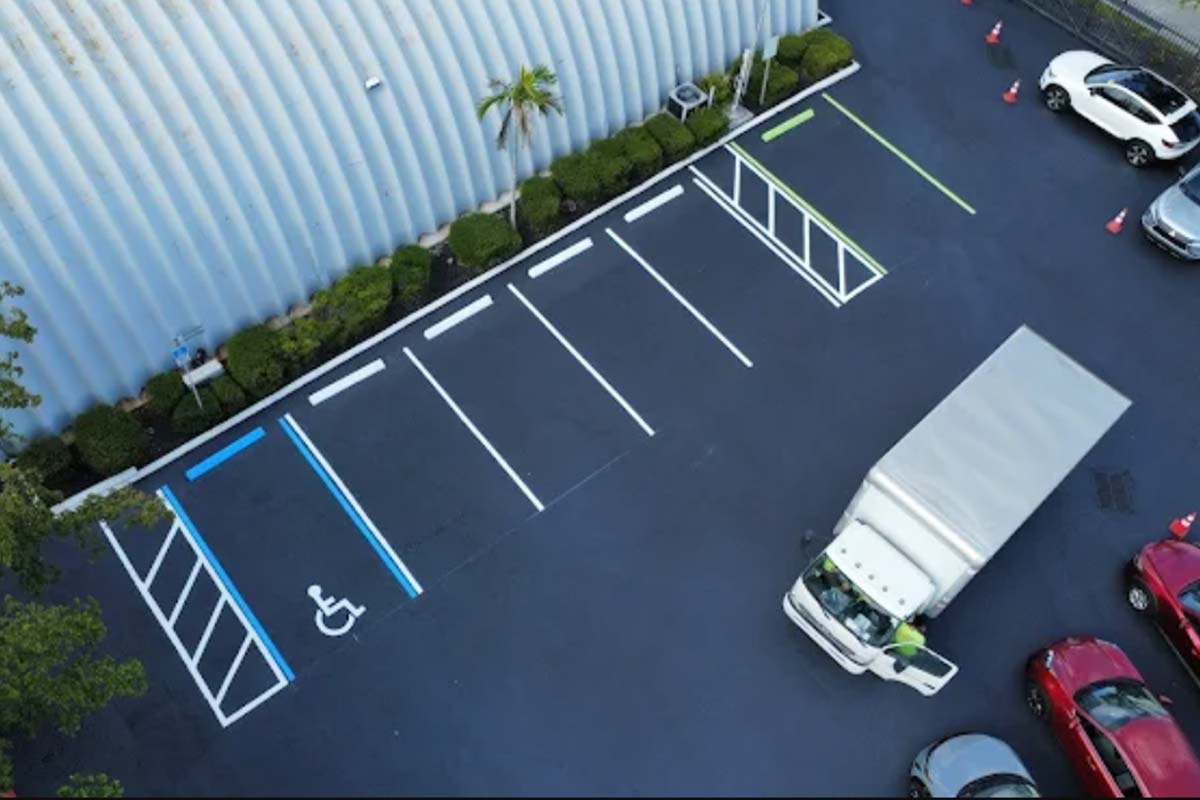
Wheel Stop Installation in North Hartford, CT
A wheel stop is the low barrier at the head of a parking stall that keeps a vehicle from rolling forward into whatever is on the other side of the line — a sidewalk, a storefront, a light pole, landscaping, or an accessible route. We install concrete and recycled-rubber wheel stops on commercial properties across Hartford and Tolland counties, anchored into asphalt or concrete pavement.
Wheel stops come up in three situations. A new or newly repaved lot that needs them set from scratch. An existing lot where the stops are cracked, loose, or have been shoved out of line by a plow. Or an accessibility review, where the question is whether parked vehicles are encroaching on a route they should be kept off.
We do the stop layout together with the striping, so the stops land where the stalls are rather than where an old plan says they used to be. On a re-striped lot that is the difference between a stop on the line and a stop sitting at an angle across it.
Call (860) 815-7337 for a free estimate — estimates come back within 24 hours.
Concrete vs Recycled-Rubber Wheel Stops
Both materials do the same job. What separates them is how they behave in a Connecticut winter, how they are handled, and how they age. Windsor Locks records 124.9 days a year with a minimum at or below 32 °F and 40.5 inches of snow in an average year, so freeze-thaw cycling and plow contact are the two forces that decide how long a wheel stop lasts on a lot in this market.
| Concrete | Recycled rubber | |
|---|---|---|
| Weight and handling | Heavy. Set with equipment, and not repositioned casually once it is down. | Light enough to handle and reposition, which makes a re-striped or re-laid-out lot simpler to work. |
| Freeze-thaw resistance | Rigid. Water that gets into a chip or crack expands as it freezes, so damage tends to grow across the 124.9 freeze days Windsor Locks averages each year. | Flexible. Absorbs freeze-thaw movement rather than fracturing along it. |
| Plow and impact contact | Can chip or break where a blade or a bumper catches it. | Flexes under impact instead of fracturing. |
| Replacement and repair | Generally replaced as a whole unit once it breaks. | Generally unbolted and swapped, or simply re-anchored if a fastener works loose. |
| Appearance over time | Bare gray unless painted, and painted concrete needs repainting as the coating wears. | Supplied in a finished color, so it holds its appearance without repainting. |
Which one belongs on your lot depends on the lot. Concrete is the traditional choice and reads as permanent. Recycled rubber takes the freeze-thaw and the plow contact that shorten a concrete stop’s life here, and it comes back out cleanly when a lot is re-striped to a new layout. We walk the property, look at the pavement, the plow paths, and the traffic, and tell you which one we would set and why.
Wheel Stops and Accessible Routes
Start with what the federal standard requires. Section 502.7 of the 2010 ADA Standards for Accessible Design imposes an outcome: a parked vehicle must not obstruct the required clear width of the accessible route next to it. That duty is real, and it is not optional. What the section does not do is tell you how to achieve it — §502.7 is agnostic as to means.
Wheel stops appear only in the Advisory to that section, described as “an effective way” of keeping vehicles from encroaching, and they sit there as one of several accepted solutions alongside deeper stalls, relocating the route, and curbs. So the accurate statement is this: a wheel stop is not a required object. It is one accepted way to satisfy §502.7, and the designer chooses the means. Where an accessible route runs across the head of a stall, a wheel stop is one of the ways that gets solved.
Now the part that catches property managers: a wheel stop can also create a violation. Set inside an access aisle, it takes away the space that aisle exists to provide. Connecticut protects that space by statute — under Connecticut General Statutes §14-253a a car space must be fifteen feet wide including five feet of cross hatch, a van space sixteen feet including eight feet of cross hatch, and subsection (f) puts the cross hatch off limits to vehicles without a plate or placard. Set a stop where it narrows a pedestrian route below the clear width that route needs, and the stop itself becomes the obstruction §502.7 was written to prevent.
So the honest answer to “do I need wheel stops” is that you need the outcome. Whether a wheel stop is how you get there is a design decision. We will not tell you a stop is required when it is not — or leave one sitting where it creates the problem it was meant to solve. The standard is published in full as the 2010 ADA Standards for Accessible Design.
Anchoring and Placement
A wheel stop only works if it is anchored, and how it is anchored depends on the pavement under it. On asphalt we drill through the stop and drive steel pins down into the pavement. On concrete we drill and set anchor bolts. Either way the stop is fastened through into the surface below, because a stop that merely rests on the pavement will move — and a wheel stop that moves is a trip hazard rather than a barrier.
Placement is the other half of the job, and it is the half that gets skipped. The stop goes at the head of the stall, square to the stall, and set so the tire meets it before the vehicle’s front overhang reaches whatever is being protected. Get that relationship wrong and a pickup’s bumper still lands on the sidewalk with its tire pressed hard against a perfectly installed stop.
Three placement rules we do not bend. A wheel stop never goes inside an access aisle. A wheel stop never narrows a pedestrian route below the clear width that route needs. And a wheel stop never sits in a drainage flow line where it will dam water — Windsor Locks averages 45.85 inches of precipitation a year, and water that ponds against a stop is water that freezes there across 124.9 days at or below 32 °F.
Plows are the fourth consideration, and the one most likely to undo the other three. With 40.5 inches of snow in an average year, stops set where a blade runs are the stops that come loose. We set them with the plow paths in mind, and on an existing lot we re-anchor or replace whatever the winter has moved.
How It Works
- Free estimate. Call (860) 815-7337 with the lot’s address and how many stalls you are working with. Estimates come back within 24 hours.
- Walkthrough. We look at the pavement type, the drainage, the plow paths, and where the accessible routes run relative to the stalls.
- Material. We recommend concrete or recycled rubber for your lot, and we tell you what the recommendation is based on.
- Layout. Stops are marked at the stall heads and checked against the accessible route before anything is drilled — no stop inside an access aisle, no stop narrowing a route.
- Install. Stops are drilled and pinned into asphalt or bolted into concrete, square to the stall and set to the marked layout.
- Walkthrough. We check every stop for movement and hand the lot back to you.
If your lot is being re-striped, that is the moment to deal with the stops. The layout is fresh, the stall lines are where they are going to stay, and every stop lands on its line instead of near it.
For a full list of our pavement marking services, visit our parking lot striping in North Hartford page.
Businesses We Serve




How it Works

GET A FREE ESTIMATE
Contact us today and we’ll have a quote to you in 24 hours

SCHEDULE AN INSTALLATION
We’ll have your installation scheduled restriped in less than 7 days, without affecting your business hours

GET A PARKING LOT THAT POPS
For a budget-friendly price, you’ll get a parking lot that looks like new
We proudly work with:


We proudly work with:


Frequently Asked Questions About Wheel Stop Installation in North Hartford, CT
Are wheel stops required by the ADA?
Not as an object. Section 502.7 of the 2010 ADA Standards imposes an outcome: a parked vehicle must not obstruct the required clear width of the adjacent accessible route. The section is agnostic as to means. Wheel stops appear in the Advisory as “an effective way” to achieve that, one of several accepted solutions alongside deeper stalls, relocating the route, and curbs. The duty is not optional; the method is the designer’s choice. Where a route runs across the head of a stall, a wheel stop is one accepted way to hold it clear.
Concrete or rubber wheel stops — which is better?
Neither one is better everywhere. Concrete is rigid and reads as permanent, but it is heavy to handle, and chips and cracks in it tend to grow through freeze-thaw — Windsor Locks averages 124.9 days a year at or below 32 °F. Recycled rubber flexes under plow contact and impact instead of fracturing, and it unbolts cleanly when a lot is re-striped to a new layout. We walk your lot, look at the pavement, the plow paths, and the traffic, and tell you which one we would set.
How are wheel stops anchored?
Through the stop and into the pavement. On asphalt we drill through the stop and drive steel pins; on concrete we drill and set anchor bolts. A stop that only rests on the surface will shift under a bumper or a plow blade, and at that point it is a trip hazard rather than a barrier. Anchoring is also what lets a stop be pulled and reset cleanly if the lot is ever re-striped to a different layout. Every stop gets checked for movement before we leave the site.
Can a wheel stop create an ADA problem?
Yes. A wheel stop set inside an access aisle takes away the space that aisle exists to provide — in Connecticut the cross hatch is protected by statute, and Connecticut General Statutes §14-253a requires a car space fifteen feet wide including five feet of cross hatch. A stop set where it narrows a pedestrian route below the clear width that route needs becomes the obstruction §502.7 exists to prevent. That is why placement is checked against the accessible route before anything is drilled.
Do wheel stops crack in Connecticut winters?
Concrete can. Windsor Locks records 124.9 days a year with a minimum at or below 32 °F and 40.5 inches of snow in an average year, so wheel stops here take freeze-thaw cycling and plow contact every single season. Water gets into a chip, freezes, expands, and the chip grows. Recycled rubber flexes rather than fracturing, which is why it is often the stronger choice on a lot that gets plowed hard. Anchoring matters too — a loose stop is the one a blade catches.