Parking Lot Restriping
In North Hartford, CT
Restripe Existing Lines and Markings
1-800-STRIPER provides professional parking lot restriping in North Hartford, CT — refreshing faded stalls, accessible spaces, fire lanes, and directional arrows with waterborne traffic paint during Connecticut’s early-May-to-early-October striping season for commercial properties across Hartford and Tolland counties.
1-800-STRIPER of North Hartford PROVIDes Restriping Services NEAR YOU
Need to brighten up your faded parking lot?
Keep your parking lot safe and attractive by restriping annually to freshen up lines and symbols that have faded from the sun, weather, and traffic. Nothing beats a fresh coat of paint!
Benefits:
Parking Lot Restriping in North Hartford, CT
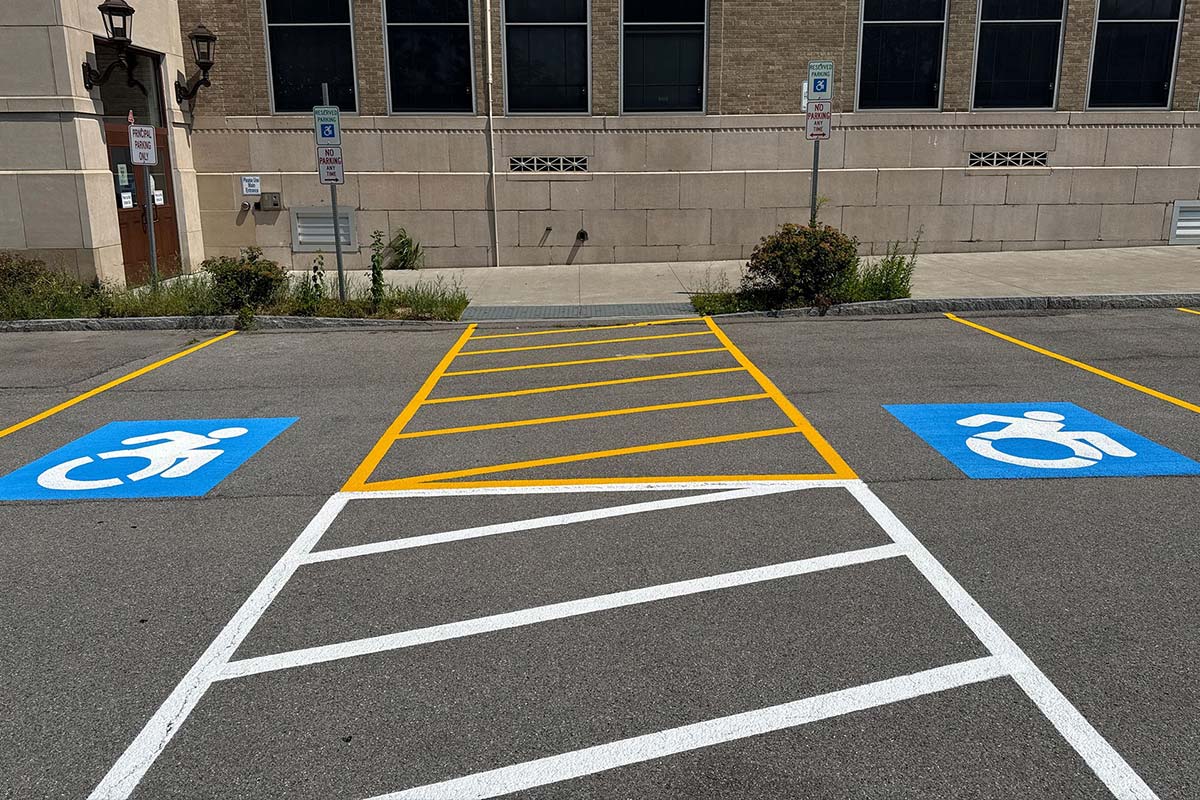
Restriping refreshes the layout you already have — faded stalls, accessible spaces and the cross hatch beside them, fire lane markings, directional arrows, stop bars, and no-parking zones, using waterborne traffic paint. 1-800-STRIPER of North Hartford does this work for commercial properties across Hartford and Tolland counties, including Manchester, Windsor, South Windsor, East Hartford, West Hartford, Glastonbury, Simsbury, Ellington, Vernon Rockville, and Windsor Locks.
Most restripes keep the existing plan. We measure what is on the ground, confirm stall counts and accessible-space dimensions with you, then repaint to that plan. When the layout does need to change — a new tenant, a redesigned entrance, added accessible spaces — we lay the new plan out and mark it on the ground before any paint goes down.
Fire lane markings are part of most restripes, and they carry one condition. Your fire lanes must be marked, but Connecticut publishes no uniform paint specification for them — the width, the color, and the lettering are set by your local fire marshal as the authority having jurisdiction. We get that spec in writing before we stripe.
When to Restripe: Connecticut’s Freeze-Thaw and Salt Cycle
Restripe when the markings stop doing their job — when stall lines are hard to read from a moving car, when the cross hatch beside an accessible space has faded out, or when arrows and stop bars no longer direct traffic. Connecticut’s winter is what sets that pace. At Bradley International Airport in Windsor Locks, the NOAA climate station for the Hartford area, the 1991–2020 normals record 124.9 days a year with a low at or below 32 °F, 40.5 inches of mean annual snowfall, and 45.85 inches of mean annual precipitation.
Those three numbers describe what a painted line lives through here. Snow that falls has to be plowed, and a plow blade passes directly over your stall lines. De-icing material is spread on top of them and then ground into the surface by tires. And air temperatures drop to freezing or below on roughly 125 days in an average year, so the pavement under the paint cycles through that again and again.
The regional climate record is published by the NOAA National Centers for Environmental Information, which describes Connecticut as a state of “cold, snowy winters and warm, humid summers.” What none of the sources we checked gives you — not Connecticut General Statutes chapter 248, not ConnDOT’s § 12.09 waterborne-paint specification, not the Bradley climate normals — is a repaint interval. We are not going to invent one, and we are not going to quote you a number we cannot stand behind. We work from the condition of your lot rather than a calendar, and we will tell you when a lot still has a season left in it.
The Striping Season at Bradley Field: Early May to Early October
In the Hartford area, the practical striping season runs roughly early May to early October. Treat that as a rule of thumb, not a specification. It is derived from the 1991–2020 climate normals at one NOAA station — USW00014740, Bradley International Airport in Windsor Locks, and it describes that station’s record, not a rule any agency publishes. At Bradley, the average last spring freeze falls on April 24 and the average first fall freeze on October 13, a 170-day freeze-free season.
Elevation shortens the shoulders. Hill towns such as Simsbury, Ellington, and Vernon run narrower windows at both ends of the season than the valley floor at Windsor Locks does, so an early-May or early-October date that works at Bradley is not automatically a date that works in Simsbury.
The Connecticut Department of Transportation publishes two pavement-marking specifications, and they are not interchangeable. Section 12.10 covers epoxy for highway work. Section 12.09 covers waterborne paint — the material class that goes on parking lots. ConnDOT’s road-surface temperature floor, its retroreflectivity values, and its line-width tolerance all sit in the epoxy section, not in § 12.09. We checked § 12.09; we did not audit every general provision and materials spec in Form 819, and we are not telling you paint can go down in any conditions — it cannot. What we will not do is quote you an epoxy number and call it a paint number. We schedule on dry pavement, the forecast, and the product’s own data sheet.
What § 12.09 does say is concrete. The surface must be dry and cleaned of sand and road debris for an acceptable bond. Paint goes down at 100 to 115 square feet per gallon, glass beads at 6 pounds per gallon, with a no-pick-up dry time of 15 minutes or less under ASTM D711. The current book is Form 819 — the 2024 base with January 2026 supplements; Form 818 is superseded. These specifications are written for state highway work, so we use § 12.09 as a workmanship reference, not as a legal requirement on private property.
Older Lots and Today’s Accessible-Stall Dimensions
Connecticut’s accessible-stall dimensions changed, and the change is in the cross hatch. Under Connecticut General Statutes § 14-253a, a car stall striped on or after October 1, 1979 and before October 1, 2004 was built fifteen feet wide including three feet of cross hatch. The current requirement, on and after October 1, 2017, is a car stall fifteen feet wide including five feet of cross hatch, and a van space sixteen feet wide including eight feet of cross hatch. The overall fifteen-foot stall did not get wider — the striped cross hatch beside it did, by two feet.
That is worth knowing in North Hartford, because plenty of lots here were laid out inside that older window and have never been re-measured. It is also worth knowing that Connecticut’s fifteen-foot car stall is already two feet wider than the federal figure: the 2010 ADA Standards set a 96-inch car space plus a 60-inch access aisle, or thirteen feet. And the cross hatch is not spare pavement — under § 14-253a(f), a vehicle without a plate or placard may not park in it.
Here is what we will not tell you: that restriping your lot legally forces you to re-cut that cross hatch to five feet. Whether a repaint counts as routine maintenance or as an alteration that triggers current standards is a determination for your local building official — not for your striping contractor, and least of all for a contractor who would be selling you the bigger job on the strength of it. We measure what you have, show you both layouts side by side, and stripe whatever your building official confirms.
How It Works
- Free estimate. Call (860) 815-7337 or request an estimate online. We measure the lot and count what is on the ground, and estimates come back within 24 hours.
- Layout review. We confirm stall count, accessible spaces and cross hatch, fire lane markings, and traffic flow — and flag anything you should take to your building official or local fire marshal before we paint, not after.
- Scheduling. Most restripes run overnight or on a weekend so the lot stays usable in business hours, and we book against the forecast rather than a fixed date.
- Surface prep. The marking path is cleaned of sand and road debris, and the surface must be dry before paint goes down — the bond condition ConnDOT § 12.09 sets for waterborne paint.
- Layout and paint. We chalk the plan, you confirm it, then we spray waterborne traffic paint and apply glass beads where the plan calls for them.
- Walkthrough. We walk the finished lot with you before we leave, so anything you want adjusted gets adjusted while we are on site.
For a full list of our pavement marking services, visit our parking lot striping in North Hartford page.
Businesses We Serve




How it Works

GET A FREE ESTIMATE
Contact us today and we’ll have a quote to you in 24 hours

SCHEDULE AN INSTALLATION
We’ll have your installation scheduled in less than 7 days, without affecting your business hours

GET A PARKING LOT THAT POPS
For a budget-friendly price, you’ll get a parking lot that looks like new
We proudly work with:


We proudly work with:


Frequently Asked Questions About Parking Lot Restriping in North Hartford, CT
How often should a parking lot be restriped?
There is no published repaint interval for Connecticut — no state code and no climate source sets one, and we will not invent a number to fill the gap. Restripe on condition: when stall lines are hard to read from a moving car, when the cross hatch beside an accessible space has faded, or when arrows and stop bars stop directing traffic. Connecticut’s winter is hard on a painted line, with 124.9 days a year at or below 32 °F and 40.5 inches of average snowfall. We inspect your lot and tell you what we see.
When can you restripe in Connecticut?
Roughly early May to early October in the Hartford area — a rule of thumb, not a specification. It comes from the NOAA 1991–2020 normals at Bradley International Airport in Windsor Locks (station USW00014740), where the average last spring freeze is April 24 and the average first fall freeze is October 13. Hill towns such as Simsbury, Ellington, and Vernon run shorter shoulder seasons than the valley floor. We schedule parking lot restriping in North Hartford, CT off dry pavement and the forecast, not off a fixed calendar date.
What takes the paint off a Connecticut parking lot?
Winter does, and the Hartford area gets a lot of it. In an average year the region records 124.9 days at or below 32 °F, 40.5 inches of snowfall, and 45.85 inches of precipitation. Snow gets plowed, and the blade passes directly over your stall lines. De-icing material is spread on top of them and ground in by tires all season. Sun and traffic finish the job the rest of the year. We will not quote you a fade rate we cannot source — but we will walk your lot and tell you honestly how far gone the lines are.
Do you need to clean the lot before restriping?
Yes. The Connecticut Department of Transportation’s waterborne paint specification, § 12.09, requires the surface to be dry and cleaned of sand and road debris for an acceptable bond. In Connecticut that matters more than it sounds: winter sand sits on lots well into spring, and paint sprayed over sand bonds to the sand rather than to the pavement. We clean the marking path and confirm the surface is dry before any paint goes down. That specification governs state highway work; we use it as our workmanship reference on private lots.
My lot was striped before 2004 — what happens to the accessible spaces when I restripe?
First the facts. A car stall striped on or after October 1, 1979 and before October 1, 2004 was built fifteen feet wide including three feet of cross hatch. Connecticut’s current standard, on and after October 1, 2017, is fifteen feet wide including five feet of cross hatch. What we will not do is tell you the law forces you to re-cut it. Whether a repaint is maintenance or an alteration that triggers current standards is a call for your local building official. Ask them, tell us what they say, and we will stripe to it.
Can you restripe over the existing lines?
Usually yes — when the layout is right and the surface is sound. Most restripes repaint the plan already on the ground, the least disruptive route for a working lot. Two things change that. If the existing layout is wrong — accessible spaces that do not match Connecticut’s current dimensions, a fire lane your fire marshal wants marked differently, repainting only makes the wrong layout brighter. And the surface still has to be dry and cleaned of sand and road debris for the paint to bond. We will tell you which case you are in.