
Warehouse Line Painting
In North Hartford, CT
OSHA-Compliant Safety Markings
1-800-STRIPER provides professional warehouse line painting in North Hartford, CT — marking permanent aisles, pedestrian walkways, and safety zones per the OSHA aisle-marking requirement at 29 CFR 1910.176(a) for industrial and distribution facilities across Hartford and Tolland counties.
1-800-STRIPER® of North Hartford PROVIDes Warehouse Floor Markings Services NEAR YOU
Want your indoor space to operate more efficiently?
Warehouse and interior markings ensure clear traffic lanes, organized storage zones, and designated spaces designed to help your business operate safely and efficiently.
Benefits:
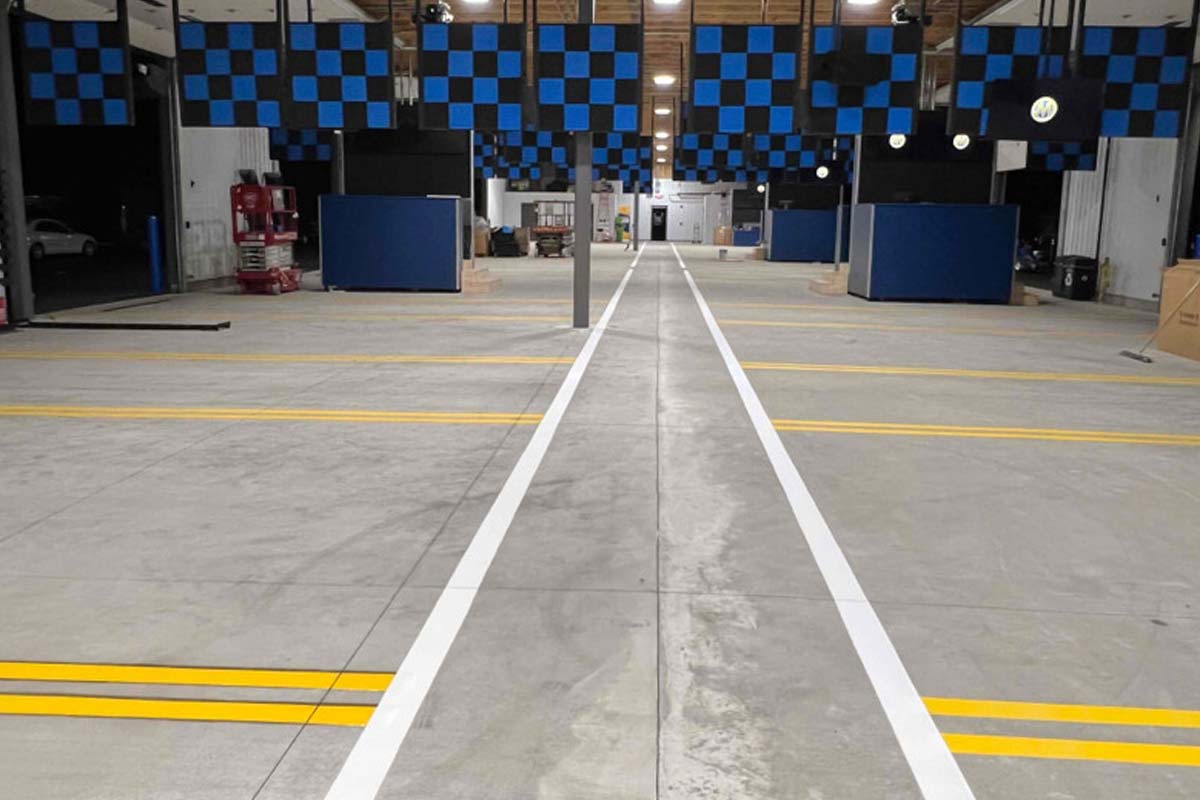
Warehouse Line Painting in North Hartford, CT
OSHA requires your permanent aisles to be marked — and it does not tell you what color to use, how wide to make the line, or what number to hit on aisle width. It does require the aisle to be wide enough to be safe. It just never says how wide. That combination surprises most facility managers, and it is why so much bad information circulates about warehouse floor marking.
We mark aisles, pedestrian walkways, safety zones, dock areas, and equipment footprints for distribution centers, manufacturing floors, and industrial facilities across Hartford and Tolland counties.
Because there is no federal color chart to hand you, the marking plan matters more here than on almost any other surface we stripe. We build it with you, and then we paint to it.
What OSHA Requires: Permanent Aisles Must Be Marked
The requirement lives in 29 CFR 1910.176(a), and it is short enough to quote:
Three duties sit in that paragraph. Allow sufficient safe clearances. Keep the aisles clear and in good repair. And mark the permanent ones.
One clarification worth making, because the wrong citation is everywhere in this industry: 29 CFR 1910.22 is not the aisle-marking rule. It is the general walking-working-surfaces standard, and it covers housekeeping — surfaces kept clean, orderly, and free of hazards. We read it. It contains no aisle-marking requirement. If a contractor quotes 1910.22 at you as the reason your aisles need striping, they are citing a provision that does not say what they think it says.
“Appropriately marked” is a live standard, not a loophole. A faded, patchy, or inconsistent aisle line is a marked aisle in name only, and it is exactly what an inspector notices.
What 29 CFR 1910.176 and 1910.144 Leave to You
We read both sections in full. Here is what they do and do not specify.
| Question — *as answered by 29 CFR 1910.176 and 1910.144 only* | What those sections say |
|---|---|
| Must permanent aisles be marked, where mechanical handling equipment is used? | Yes — 1910.176(a), “appropriately marked” |
| Does 1910.176(a) impose an aisle-clearance duty? | Yes — it requires “sufficient safe clearances” |
| Does 1910.176 give a *numeric* aisle width? | No number appears in that section |
| Does 1910.176 give a line width? | No number appears in that section |
| Do 1910.176 or 1910.144 specify an aisle *color*? | No — neither section mentions aisles in a color rule |
Read that table carefully, because the two rows people misread are the aisle-width rows. 1910.176(a) does impose an aisle-width duty — “sufficient safe clearances” is a real, enforceable requirement. What it does not do is give you a number. It is a performance standard: the clearance has to be sufficient for the equipment you run, and you have to be able to defend that judgment.
So the accurate statement is that these sections set no numeric aisle width — not that OSHA has no aisle-width requirement. Anyone telling you the second thing is handing you a citation.
A note on scope, because it matters: we read 1910.176, 1910.144, and 1910.22. We are describing what those three sections say, not making a claim about all of Title 29.
OSHA Safety Colors and What They Mean
29 CFR 1910.144 assigns meanings to safety colors. Red is the basic color for identifying certain hazards and equipment; yellow is the basic color for identifying others. It is a vocabulary, not an aisle specification — the section contains no reference to aisles at all.
This is where the most common myth in warehouse marking lives: *OSHA requires yellow aisle lines.* It does not. Neither 1910.176 nor 1910.144 tells you to paint an aisle yellow.
But — and this is the part that gets left out — yellow may well be required of you anyway, just not by these OSHA sections. Your insurer’s loss-control specification may require it. Your corporate EHS standard may set it. If you lease the building, your tenant obligations may dictate it. And if your facility already runs a color convention, consistency is a genuine safety argument in its own right.
So the practical answer is not “paint whatever you like.” It is: find out what binds your facility, write it into a marking plan, and mark to the plan. We will help you build that plan and then execute it exactly.
Markings We Install
- Aisle and passageway lines — the permanent routes 1910.176(a) requires you to mark
- Pedestrian walkways — separating foot traffic from powered equipment
- Safety and hazard zones — around panels, eyewash stations, and equipment
- Dock and staging areas — receiving, outbound, and hold zones
- Equipment footprints — racking, machinery, and battery-charging areas
- Directional arrows and floor legends
We use durable traffic and epoxy coatings appropriate to a floor that takes forklift traffic, and we sequence the work so your operation keeps running.
How It Works
- Walk the floor. We map your traffic flows — where equipment turns, where people cross, where the pinch points are.
- Find out what binds you. OSHA sets the marking duty; your insurer, EHS standard, or lease may set the colors. We ask before we assume.
- Build the marking plan. You approve a layout and a color convention before any paint is applied.
- Prep the substrate. Concrete gets cleaned so the coating bonds.
- Lay out and paint. We chalk first, you confirm, then we mark.
- Phase around production. Nights, weekends, or zone by zone — whatever keeps you running.
Read the marking requirement yourself at the Occupational Safety and Health Administration, and the safety color code at the Occupational Safety and Health Administration.
Call (860) 815-7337 for a free estimate — we will get it back to you within 24 hours.
For a full list of our pavement marking services, visit our parking lot striping in North Hartford page.
Businesses We Serve




How it Works

GET A FREE ESTIMATE
Contact us today and we’ll have a quote to you in 24 hours

SCHEDULE A STRIPING
We’ll have your space restriped in less than 7 days, without affecting your business hours

GET A PARKING LOT THAT POPS
For a budget-friendly price, you’ll get a parking lot that looks like new
We proudly work with:


We proudly work with:

Frequently Asked Questions About Warehouse Line Painting in North Hartford, CT
Does OSHA require aisle markings in a warehouse?
Yes. 29 CFR 1910.176(a) states that “permanent aisles and passageways shall be appropriately marked.” The same paragraph requires sufficient safe clearances for aisles and requires that aisles be kept clear and in good repair. Note that this duty lives in 1910.176, not in 1910.22 — 1910.22 is the general walking-working-surfaces housekeeping standard and contains no aisle-marking requirement at all, despite being cited constantly for exactly that purpose.
Does 29 CFR 1910.144 require aisle lines to be yellow?
No. We read 1910.144 in full: it assigns basic meanings to safety colors — red for identifying certain hazards, yellow for others, and it never mentions aisles. Neither does 1910.176. So there is no federal aisle-color mandate. That said, yellow is frequently required anyway by something other than OSHA: your insurer’s loss-control spec, your corporate EHS standard, or your lease. Find out what binds your facility, then mark to it consistently.
Does 1910.176 set a line width?
No number appears in the section. 1910.176(a) requires that permanent aisles be “appropriately marked” without specifying how wide the line must be. Widely circulated figures of two to six inches trace back to a 1972 OSHA Standard Interpretation that OSHA now publishes with an archive banner stating it may no longer represent OSHA policy. We do not treat archived guidance as a requirement. In practice we mark to a width that is clearly visible under your lighting and traffic conditions.
How wide does the aisle itself have to be?
There is an aisle-width duty, and there is no aisle-width number. 1910.176(a) requires “sufficient safe clearances” for aisles, at loading docks, through doorways, and wherever turns or passage must be made — that is a real, enforceable requirement. But the section states no figure. It is a performance standard: the clearance has to be genuinely sufficient for the equipment you run, and you need to be able to justify it. Anyone who tells you OSHA has no aisle-width requirement is misreading the section.
What do the OSHA safety colors mean?
29 CFR 1910.144 establishes a color vocabulary: red is the basic color for identifying certain hazards and equipment, and yellow is the basic color for identifying others. It is about communicating meaning consistently, so that anyone walking your floor reads a color the same way. It does not tell you to paint your aisles a particular color, and it does not mention aisles. We use it as the foundation of a marking plan, alongside whatever your insurer or EHS standard requires.
What kind of paint holds up to forklift traffic?
A warehouse floor is one of the hardest surfaces to keep marked, because a loaded forklift scrubs a painted line every time it turns. We use durable traffic and epoxy coatings selected for the substrate and the traffic load rather than a single product for every floor. Surface preparation matters as much as the coating — concrete that is not properly cleaned will not bond, and a line that will not bond will not last through a season of turns.
Can you paint while the warehouse is operating?
Usually, yes. We phase the work zone by zone, or run nights and weekends, so your operation keeps moving. Aisle marking is naturally sectional — we can close one route, mark it, let it cure, and reopen it before moving to the next. Tell us your production schedule when you call (860) 815-7337 and we will build the sequence around it rather than asking you to shut down.