ADA Parking Lot Striping
In North Hartford, CT
ADA-Compliant Accessible Parking
1-800-STRIPER provides ADA-compliant parking lot striping in North Hartford, CT — installing accessible car and van stalls, cross-hatched access aisles, and blue-and-white permit signage per the 2010 ADA Standards for Accessible Design and Connecticut General Statutes § 14-253a.
1-800-STRIPER® of North Hartford PROVIDes ADA Compliance Services NEAR YOU
Need to make your property more accessible?
Upgrade your facility to become fully ADA compliant by partnering with us to create clear, accessible parking for all your visitors.
Our ADA Compliant line striping services include:
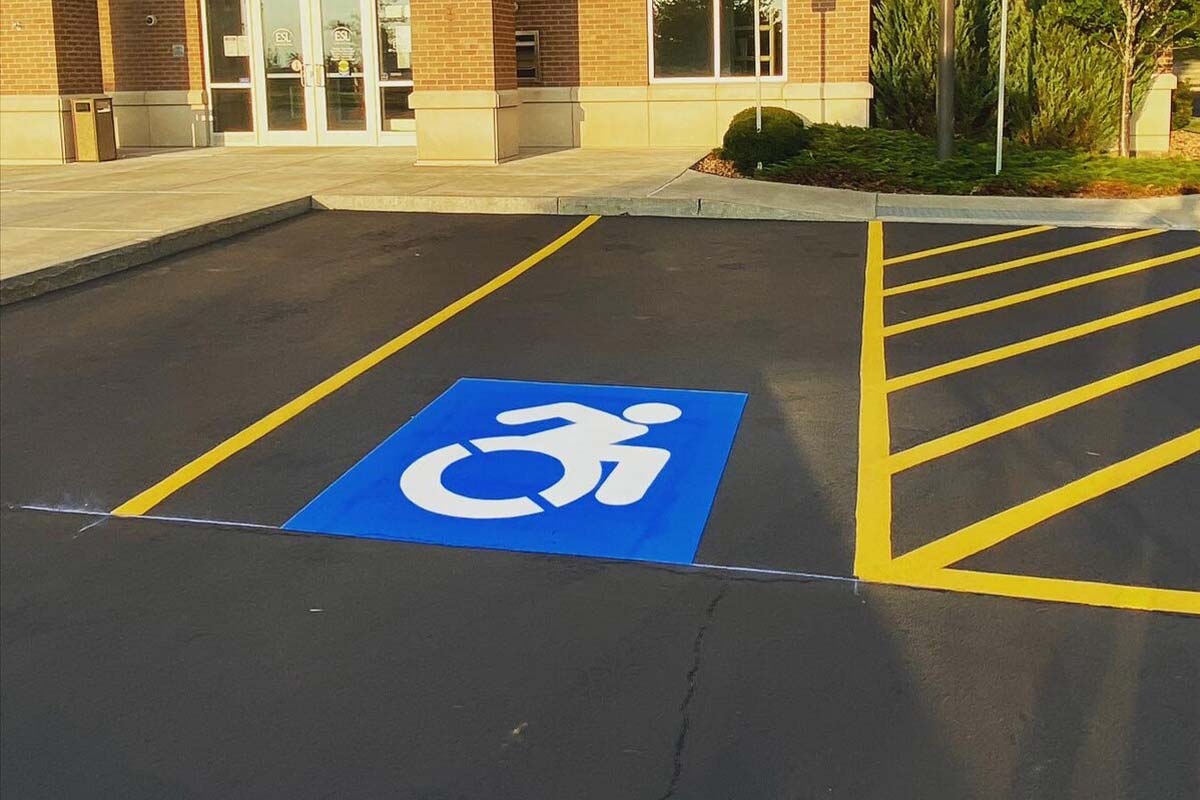
ADA Parking Lot Striping in North Hartford, CT
An accessible stall in this state has to clear two rule books at the same time: the federal 2010 ADA Standards for Accessible Design and Connecticut General Statutes § 14-253a. Connecticut’s car stall is wider than the federal floor, and so is its van access aisle — and the federal standards do not go away when the state adds to them, so every accessible space we lay out is measured against both.
Our ADA work covers the whole accessible space, not just the paint. That means the car stall, the van stall, the cross-hatched access aisle beside it, and the above-grade permit sign the state requires. Under § 502.7 of the 2010 ADA Standards, a parked vehicle must not obstruct the clear width of the accessible route next to it. That section sets an outcome and is deliberately agnostic about method — wheel stops appear only in the Advisory, as one effective way among several. We pick the method that suits your lot and tell you why.
We stripe commercial properties across Hartford County and Tolland County, including Manchester, Vernon Rockville, Glastonbury, South Windsor, Windsor, Simsbury, East Hartford and West Hartford. Call (860) 815-7337 for a free estimate — estimates come back within 24 hours.
Connecticut Requires a Wider Accessible Stall Than Federal ADA
Connecticut’s accessible car stall is fifteen feet wide, including five feet of cross hatch. The federal floor in the 2010 ADA Standards for Accessible Design is an eight-foot space plus a five-foot access aisle — thirteen feet. Connecticut is two feet wider, and that has been the requirement on and after October 1, 2017 under Connecticut General Statutes § 14-253a.
Vans are where this gets sharp, and it is worth being precise, because most write-ups get it backwards. Federal law gives you two ways to build a van stall. Section 502.2 sets a van space at 132 inches — eleven feet — beside a five-foot aisle, and permits an eight-foot van space instead where the access aisle is widened to eight feet. Both add up to sixteen feet.
Connecticut’s van stall is also sixteen feet — but the statute says *including eight feet of cross hatch*, and that wording quietly closes one of the two federal doors. A van space built the federal way, eleven feet wide with a five-foot aisle, is sixteen feet wide, fully compliant under federal law, and non-compliant in Connecticut. The state requires the eight-foot cross hatch.
So Connecticut is stricter than the federal floor in two different places: a wider car space, and a wider van access aisle. The federal standards add one dimension the state statute leaves alone — § 502.5 requires 98 inches of vertical clearance along van-accessible routes, which is what catches canopies, parking decks and overhangs.
Both codes apply. The state statute does not replace the federal standard — it stacks on top of it, and the federal minimum stays in force underneath. Where the two speak to the same dimension, we build to whichever code is stricter on that dimension — in Connecticut, the state’s fifteen-foot car stall and its eight-foot van cross hatch.
Federal § 502.3.3 requires that “access aisles shall be marked so as to discourage parking in them,” and its Advisory expressly declines to specify a method or a color, noting that the question “may be addressed by State or local laws.” Connecticut’s statute is exactly that kind of state law, and it answers the width question at five feet for cars and eight feet for vans. One more measurement rule matters at layout time: § 502.1 measures space width centerline to centerline, so that is how we lay the lot out and how we paint it.
How Many Accessible Spaces Your Lot Needs
The count is federal, and it starts at one. Section 208.2 of the 2010 ADA Standards sets a minimum number of accessible spaces based on the total number of spaces in the lot — a lot with 1 to 25 spaces needs at least one accessible space, and the minimum scales with lot size, reaching 2% of the total for lots of 501 to 1,000 spaces.
| Total spaces in the lot | Minimum accessible spaces (ADA § 208.2) |
|---|---|
| 1–25 | 1 |
| 26–50 | 2 |
| 51–75 | 3 |
| 76–100 | 4 |
| 101–150 | 5 |
| 151–200 | 6 |
| 201–300 | 7 |
| 301–400 | 8 |
| 401–500 | 9 |
| 501–1,000 | 2% of the total |
| 1,001 and over | 20, plus 1 for each 100 (or fraction thereof) over 1,000 |
Van spaces come out of that number rather than sitting on top of it — and here is the part that surprises most small-lot owners. Section 208.2.4 requires a van-accessible space “for every six or fraction of six” accessible spaces. One is a fraction of six. So if your lot has 1 to 25 spaces, it needs one accessible space, and that space has to be van-accessible. For a lot serving the public, there is no size small enough to skip the van stall. (Section 208.1 does carve out spaces used exclusively for buses, trucks, delivery vehicles, law enforcement or vehicular impound — a depot or a fleet yard is a different question, and we will tell you if yours is one.)
One point of confusion is worth clearing up. Connecticut General Statutes § 14-253a(g) contains a schedule that refers to private lots of 200 or more cars — that clause is about permit plates and placards. It is not an exemption from accessible parking, and no small lot should be read as excused by it. Federal § 208.2 governs from a single space upward.
Connecticut’s Accessible Parking Sign Requirements
Every accessible space in Connecticut needs an above-grade sign, and the statute says what goes on it. Under Connecticut General Statutes § 14-253a(h), the sign carries white lettering against a blue background, bears the words “handicapped parking permit required” and “violators will be fined,” and displays the International Symbol of Access. Replacement signs read “reserved parking permit required.”
“Above grade” is the part property owners miss, and the federal standards put a number on it that the state statute does not. ADA § 502.6 requires the sign to stand 60 inches minimum above the finish floor or ground, measured to the bottom of the sign — high enough to clear the hood of the vehicle parked in the space. The same section requires that signs identifying van spaces carry the designation “van accessible.” So a van stall in Connecticut ends up with both: the state’s blue-and-white permit sign, and the federal van designation.
Connecticut puts the International Symbol of Access on that sign. If your property manager or your town also wants a symbol laid into the stall itself, we paint it — but it is an addition to the sign, never a substitute for it. The statute is specific that the symbol belongs on the sign.
We install signs and stalls together, because in practice they are one requirement. A perfectly striped fifteen-foot stall with no sign above it is not a finished accessible space, and neither is a sign standing over a stall that measures short.
How It Works
We put the code work up front, before anyone opens a can of paint.
- Call for a free estimate. Reach us at (860) 815-7337. We come out, measure the lot, and count your total spaces — that count drives everything downstream.
- Pull the accessible count. We take the minimum from the § 208.2 schedule and apply the one-van-per-six ratio in § 208.2.4.
- Size the stalls to Connecticut. Car stalls at fifteen feet including five feet of cross hatch; van stalls at sixteen feet including eight feet; measured centerline to centerline.
- Confirm the signage. Above-grade signs, white lettering on blue, the statutory wording, and the International Symbol of Access.
- Prepare the surface. We stripe on a dry, swept surface — sand and road debris keep paint from bonding.
- Stripe, sign, and walk the lot with you. You get the finished layout and the dimensions we hit, in writing.
Estimates come back within 24 hours.
For a full list of our pavement marking services, visit our parking lot striping in North Hartford page.
Businesses We Serve




How it Works

GET A FREE ESTIMATE
Contact us today and we’ll have a quote to you in 24 hours

SCHEDULE AN INSTALLATION
We’ll have your installation scheduled in less than 7 days, without affecting your business hours

GET A PARKING LOT THAT POPS
For a budget-friendly price, you’ll get a parking lot that looks like new!
We proudly work with:


We proudly work with:


Frequently Asked Questions About ADA Parking Lot Striping in North Hartford, CT
How wide does an accessible parking space have to be in Connecticut?
Fifteen feet for a car stall, including five feet of cross hatch, on and after October 1, 2017 under Connecticut General Statutes § 14-253a. A van stall is sixteen feet wide, including eight feet of cross hatch. The federal floor is narrower — an eight-foot space plus a five-foot access aisle, or thirteen feet, so Connecticut runs two feet wider on a car stall. Both codes apply, and our ADA parking lot striping in North Hartford, CT is laid out to the wider state dimension.
How many accessible spaces does my lot need?
Section 208.2 of the 2010 ADA Standards sets the minimum from the total number of spaces in your lot. A lot of 1 to 25 spaces needs at least one accessible space, and the minimum scales upward with lot size, reaching 2% of the total for lots of 501 to 1,000 spaces. The reference in Connecticut General Statutes § 14-253a(g) to private lots of 200 or more cars deals with permit plates and placards — it is not an exemption. The federal count applies from a single space upward.
Do I need a van-accessible space?
Almost certainly yes — and if your lot is small, definitely yes. Section 208.2.4 of the 2010 ADA Standards requires one van-accessible space for every six “or fraction of six” accessible spaces your lot requires. One is a fraction of six, so a lot with 1 to 25 total spaces needs one accessible space and that space must be van-accessible. There is no lot too small for a van stall. Connecticut sizes it at sixteen feet including eight feet of cross hatch, which is the same total the federal standard requires, arrived at differently.
What does Connecticut require on an accessible parking sign?
Connecticut General Statutes § 14-253a(h) requires an above-grade sign with white lettering against a blue background. It bears the words “handicapped parking permit required” and “violators will be fined,” and it displays the International Symbol of Access. Replacement signs read “reserved parking permit required.” The requirement is a sign requirement — the symbol goes on the sign above the stall, where a driver can read it from the seat. We install the signs at the same time we stripe the stalls.
Can someone park in the cross-hatched area next to an accessible space?
No. The cross hatch is not a parking space, and Connecticut protects it: under Connecticut General Statutes § 14-253a(f), a vehicle without a plate or placard may not use it. Federal § 502.3.3 backs that up, requiring that access aisles “shall be marked so as to discourage parking in them,” and § 502.7 requires that parked vehicles not obstruct the clear width of the adjacent accessible route. A faded cross hatch invites exactly this problem, which is why we restripe it.
My lot was striped years ago — is it still compliant?
It depends on when the lot was laid out. Lots striped on or after October 1, 1979 and before October 1, 2004 were built to a fifteen-foot stall with a three-foot cross hatch. On and after October 1, 2017, Connecticut General Statutes § 14-253a puts the cross hatch at five feet for cars and eight feet for vans. Those older layouts carry three feet — two feet short of today’s car requirement, and five feet short of today’s van requirement. Whether a restripe obligates you to re-widen is a question for your local building official. We measure your lot, show you both dimensions, and stripe to what they confirm.