
Bollard Installation
In North Denver, CO
Safety and Security Bollards
1-800-STRIPER provides professional bollard installation in North Denver, CO — installing fixed, removable, and impact-rated safety bollards to protect storefronts, pedestrian walkways, and equipment per ASTM F3016 and ASTM F2656 crash-rating standards for commercial properties across the north Denver metro.
1-800-STRIPER® of North Denver PROVIDes Bollard Installation Services NEAR YOU
Want to prevent accidents and protect your property?
Bollards provide physical protection for your customers and your property.
Safety and security:
Bollards create a physical barrier between vehicles and pedestrians, protecting people in walking areas from accidental or intentional vehicle intrusions.
Bollards act as a protective barrier around storefronts, gas stations, and other vulnerable areas, minimizing the risk of costly damage from vehicle impacts.
Strategic Placement Locations:
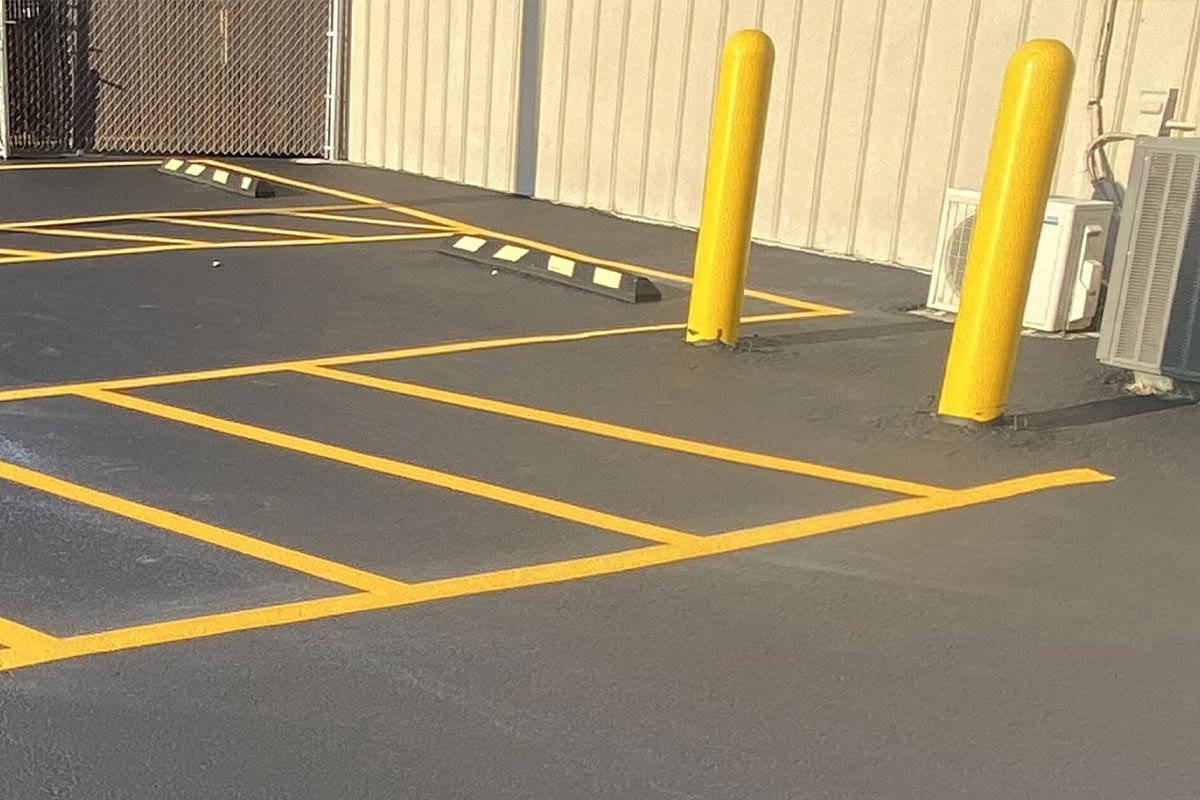
Bollard Installation in North Denver, CO
Bollards are short, sturdy posts set into the ground to stop or steer vehicles. On a commercial property they do four jobs at once. First, they protect the building — a row of bollards in front of a storefront keeps a driver who mistakes the gas pedal for the brake from ending up in the lobby. Second, they keep people safe by shielding walkways, entrances, and outdoor seating where foot traffic and moving cars share space. Third, they guide traffic, holding drive lanes, defining loading zones, and keeping cars off islands and sidewalks. Fourth, they guard assets and utilities — fuel dispensers, EV chargers, electrical cabinets, fire risers, air-and-vacuum stations, and dock equipment that would cost a fortune to replace after a strike.
We install bollards for retail centers, warehouses, medical offices, gas stations, and industrial yards across North Denver. Every layout starts with the same question: what are we protecting, and from what direction is the risk coming? Get that right and the rest of the job — type, rating, spacing, and depth — follows. Call for a free estimate and we will walk the site with you.
Bollard Types
Not every hazard needs the same post. We install four common types and match them to how the space gets used.
Fixed bollards are permanently set in a concrete footing. They are the workhorse — highest strength for the dollar, nothing to maintain, and the right call anywhere access never changes: storefront fronts, corners of buildings, ends of walkways, and around fixed equipment.
Removable bollards drop into a below-grade socket and lock in place, then lift out with a key when you need the opening clear. They fit fire lanes, service gates, delivery corridors, and event spaces where the barrier has to disappear on occasion and stand firm the rest of the time.
Retractable bollards telescope or drop below grade at the same spot, so nobody has to carry a post to storage. They suit controlled entries and gated drives that open and close on a regular cycle, where a removable unit would be handled too often to be practical.
Decorative and architectural bollards are covers — cast, painted, or stainless sleeves — that slip over a structural steel pipe. The pipe and footing do the protecting; the cover does the looking-good. These fit hospitality, mixed-use, and higher-end retail where a bare yellow post would clash with the storefront. The protection is identical; only the finish changes.
When you are unsure which type a spot needs, we will recommend one based on how often the opening has to move and how hard it may get hit.
Impact-Rated Safety Bollards
A bollard’s strength is not a guess — it comes from a crash test. Two standards cover almost every commercial job in North Denver.
| Standard | Rating | Meaning |
|---|---|---|
| ASTM F3016 | S10 / S20 / S30 | Low-speed impact test at 10 / 20 / 30 mph (storefront & pedestrian protection) |
| ASTM F2656 | M30 / M40 / M50 | Vehicle-barrier crash test at 30 / 40 / 50 mph (high-security applications) |
ASTM F3016 is the standard written for storefronts and parking lots. It tests a bollard against a passenger vehicle at 10, 20, or 30 mph — the speeds a car actually reaches crossing a lot or rolling out of a parking stall. The rating also reports penetration: how far past the bollard the vehicle’s front continues after impact. A lower penetration class means the car stops sooner and closer to the post, which is what you want in front of a doorway. For the vast majority of retail, restaurant, and fuel sites, an F3016 low-speed rating is the correct, cost-sensible spec.
ASTM F2656 is the high-security standard. It tests larger vehicles at 30, 40, and 50 mph and reports M-ratings (the modern replacement for the older K-rating system) along with penetration distance. F2656 belongs at government buildings, data centers, utility yards, and any perimeter where the threat is a deliberate ram at speed. It is heavier, deeper, and more expensive — overkill for a storefront, essential for a secure perimeter. We help you land on the right standard so you are not underprotected or overbuilt.
Storefront & Pedestrian Protection
Most vehicle-into-building incidents are accidents — a wrong pedal, a slick surface, a car left in drive. The fix is a line of bollards between the parking and the people. At building fronts we set posts to shield entry doors, glass storefronts, and the walkway strip customers use to reach the door. At drive-up windows and pickup lanes, bollards keep a mis-aimed car from riding up onto the pad where staff and customers stand.
Fuel and EV equipment take priority. Dispensers, charging pedestals, and their bases sit right in the drive path and are expensive and slow to replace, so we ring them with impact-rated posts sized to the traffic around them. The same logic applies to air-and-water stations, propane cages, and vending corrals.
Cart-corral areas need attention too. A corral in the middle of a lot invites backing and turning traffic, so bollards at the corral ends and along its approach protect both the equipment and the people loading their cars. Wherever a person stands still while vehicles move nearby — an ATM lane, an order window, an outdoor patio edge — a bollard turns a potential collision into a scrape on a steel post. We plan these lines during the site walk so the protection lands where the risk actually is, not just where it is convenient to dig.
Bollard Placement & Spacing
Spacing decides whether a barrier works. Set posts too far apart and a car slips between them; set them too tight and you block carts, wheelchairs, and hand trucks. The common rule is roughly 4 to 5 feet on center, tightened where the threat is a full-size vehicle and opened up where the job is mostly guidance. Along any route people walk, we hold ADA pedestrian clearance so wheelchairs and strollers pass cleanly — protection and accessibility have to coexist, and spacing is where that balance lives.
What is below grade matters as much as what is above it. A bollard is only as strong as its footing, so each post is embedded in a concrete foundation — commonly around 18 to 36 inches deep depending on pipe diameter and the impact rating it has to meet. A light guidance post sits shallower; an impact-rated storefront bollard sits deeper with a wider footing to resist and transfer the load.
Frost depth is a real factor here. North Denver’s freeze-thaw cycles can heave a shallow footing over a few winters, loosening a post that looked solid the day it was set. We set footings deep enough to stay stable through the seasons and detail the concrete so water is not trapped against the pipe. Getting embedment and drainage right is the difference between a bollard that holds for years and one that leans by spring.
Our Bollard Installation Process
We keep installs predictable with the same five steps on every site.
- Assess risk and plan the layout. We walk the property, note traffic direction, speeds, and what needs protecting, then mark a layout that stops vehicles while keeping pedestrian and ADA clearance.
- Locate utilities and mark cores. Before anything gets cut, we arrange utility locates and mark each core or dig point, so we are not drilling into a gas line, conduit, or water service hidden under the slab.
- Core or excavate and set footings. We core through existing concrete or excavate in soil, then form and pour footings to the depth and diameter the pipe size and rating call for.
- Set the pipe, fill, concrete, and cap or sleeve. We plumb each post, fill the pipe where specified, place the concrete, and finish with a cap on a fixed post or a socket and sleeve on a removable or retractable one.
- Paint, finish, and inspect. We coat or install decorative covers, add reflective banding where visibility helps, then check plumb, alignment, spacing, and clearance before we call it done.
You get a clean layout, a documented install, and posts that do their job. Call for a free estimate to get on the schedule.
For a full list of our pavement marking services, visit our parking lot striping in North Denver page.
Businesses We Serve




How it Works

GET A FREE ESTIMATE
Contact us today and we’ll have a quote to you in 24 hours

SCHEDULE AN INSTALLATION
We’ll have your installation scheduled in less than 7 days, without affecting your business hours

GET A PARKING LOT THAT POPS
For a budget-friendly price, you’ll get a parking lot that looks like new
We proudly work with:


We proudly work with:

Frequently Asked Questions About Bollard Installation in North Denver, CO
What is the difference between fixed, removable, and retractable bollards?
Fixed bollards are set permanently in concrete and offer the most strength for the money — use them wherever access never changes. Removable bollards lock into a below-grade socket and lift out with a key, so an opening can be cleared for fire lanes, deliveries, or events. Retractable bollards drop below grade at the same spot, ideal for entries that open and close on a regular cycle. We match the type to how often the opening has to move and how hard it might be struck.
What is an impact or crash rating, and what do F3016 and F2656 mean?
A crash rating is a tested measure of how a bollard holds up when a vehicle hits it. ASTM F3016 tests low-speed impacts at 10, 20, or 30 mph (S10/S20/S30) and fits storefronts and parking lots. ASTM F2656 tests higher speeds at 30, 40, or 50 mph (M30/M40/M50, the modern K-rating replacement) for high-security perimeters. Both report penetration — how far the vehicle continues past the post. Most storefronts use F3016; secure sites use F2656.
How deep are bollards set in the ground?
Bollards are embedded in a concrete footing, commonly around 18 to 36 inches deep depending on pipe diameter and the impact rating required. Heavier impact-rated posts sit deeper with a wider footing; light guidance posts sit shallower. In North Denver, frost depth matters — freeze-thaw cycles can heave a shallow footing over a few winters, so we set footings deep enough and detail the concrete for drainage to keep posts stable through the seasons.
What do storefront bollards protect against?
They protect against accidental vehicle strikes — a driver hitting the gas instead of the brake, a car left in drive, or a vehicle sliding on ice. A line of bollards shields entry doors, glass storefronts, and walkways so a mis-aimed car stops at a steel post instead of the lobby. They also guard drive-up windows, fuel dispensers, EV chargers, ATMs, and cart corrals where people stand while vehicles move nearby.
Can you match our building’s look?
Yes. Decorative and architectural bollards are covers that slip over a structural steel pipe — cast, painted, or stainless finishes in colors that suit your storefront. The pipe and footing still do the protecting, so you get full strength without a bare yellow post clashing with the facade. We can also add reflective banding where visibility helps. Tell us the finish you want and we will spec covers that fit the property.
Do you offer free estimates?
Yes. We provide a free estimate for every bollard project in North Denver. We will walk the site, note traffic patterns and what needs protecting, and recommend the right type, rating, spacing, and footing depth for your property. You get a clear layout and scope before any work begins. Call for a free estimate and we will get you on the schedule.