Thermoplastic Striping
In South Phoenix, AZ
Long-Lasting Pavement Markings
1-800-STRIPER® provides professional thermoplastic striping in South Phoenix, AZ — long-service-life pavement markings for stop bars, crosswalks, directional arrows, and fire lanes applied at roughly 400°F per AASHTO M249 specifications for high-traffic commercial lots across Maricopa and Pinal counties.
1-800-STRIPER® of South Phoenix PROVIDes Thermoplastics Services NEAR YOU
Want to reduce the maintenance requirements for your parking lot?
Thermoplastic pavement markings are a durable, weather and vehicle-resistant striping option for your parking lot or facility.
You can utilize them for stop bars, ADA stalls, no-parking zones, directional arrows, crosswalks, or your entire parking lot.
Benefits:
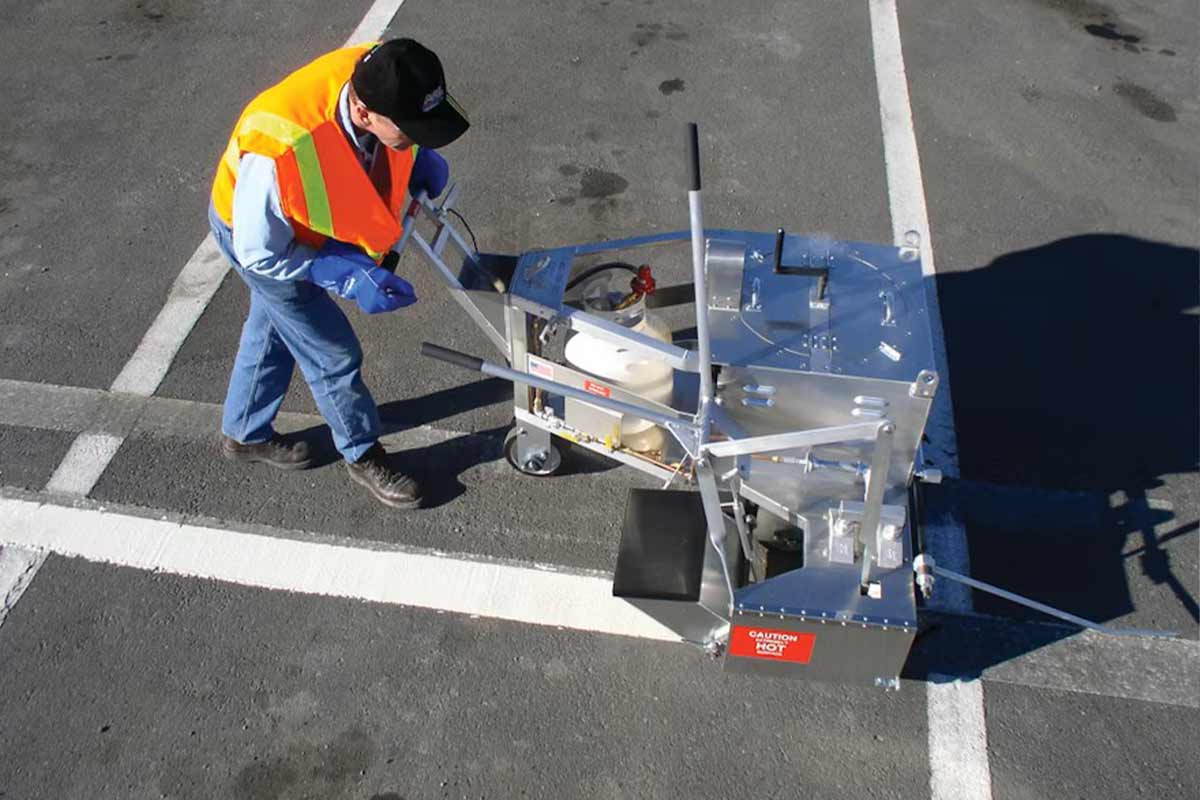
Thermoplastic Striping Services in South Phoenix
High-traffic commercial lots wear out paint fast. Drive-thrus, fuel stations, distribution centers, and big-box retail all have choke points where tires grind the same lines thousands of times a week. That’s where thermoplastic striping pays off — the marking holds up where paint would fade inside a season.
1-800-STRIPER® of South Phoenix installs thermoplastic pavement marking for stop bars at intersections and parking aisle ends, raised crosswalks and standard crosswalk ladders, directional arrows and turn indicators, fire lane lettering and curb markings, and ADA symbols using preformed thermoplastic shapes. We also handle speed hump markings and speed legends on private lots where owners want to enforce limits without signage alone.
The material works on both asphalt and concrete, though surface prep requirements differ. On concrete, a primer or sealer coat is part of the job. On asphalt, adhesion is more direct — clean surface, hot material, done.
What Thermoplastic Pavement Marking Is
Thermoplastic is a resin-based marking material, not a paint. The compound sits solid at room temperature. It gets loaded into a kettle, heated to roughly 400°F, and applied molten to the pavement surface. It flows into the texture of the surface, bonds as it cools, and is typically firm enough to drive on within minutes.
Two application methods exist. Screed or extrusion equipment lays long lines — stop bars, lane lines, edge lines — in a single continuous pass. Preformed thermoplastic takes a different approach: sheets are pre-cut into symbols, arrows, and word legends at the factory, then positioned on the pavement and bonded in place with a hand torch. That’s the method used for ISA wheelchair symbols, ADA access aisle legends, and directional arrows where dimensional accuracy matters.
Both methods include glass beads — either blended into the material or dropped on immediately after application, sometimes both. The beads reflect headlights at night and in rain, which is why AASHTO M249 sets performance standards for reflectivity, not just material composition.
Thermoplastic vs. Traffic Paint
Choosing between thermoplastic and traffic paint isn’t always obvious. This comparison covers the factors that matter for commercial lot decisions.
| Factor | Traffic Paint | Thermoplastic Striping |
|---|---|---|
| Service life | Shorter in high-traffic areas; typically needs reapplication within 1–2 years at busy choke points | Several times longer in high-traffic zones; better value per repaint cycle at stop bars, crosswalks, fire lanes |
| Application | Sprayed or rolled onto surface | Hot-applied molten at roughly 400°F; preformed shapes torch-bonded in place |
| Cure time | 30–60 minutes depending on temperature and humidity | Firm in minutes; faster return to traffic |
| Thickness | Mils-thin film sitting on the surface | Substantially thicker profile; sits proud of the surface for tactile awareness |
| Retroreflectivity | Glass-bead drop-on available, but less consistent over time | Glass beads blended in plus surface-applied; maintains retroreflectivity as material wears |
| Relative cost | Lower upfront cost | Higher upfront cost; fewer repaint cycles at high-wear points offsets the difference over time |
| Best use | Full-lot restriping, low-traffic areas, standard stall lines | Stop bars, crosswalks, fire lane lettering, directional arrows, ADA symbols — high-wear, high-visibility points |
We’ll tell you honestly which product makes sense for your lot. For most commercial properties, the answer is a combination: paint for the standard stall grid, thermoplastic pavement marking for the high-wear and safety-critical spots.
Durability in Arizona Heat
Arizona heat doesn’t damage thermoplastic the way it damages paint. That’s one reason the Arizona Department of Transportation uses thermoplastic striping on state freeways — not just because it lasts, but because it holds up under conditions that eat paint fast.
UV exposure and surface temperatures above 100°F accelerate oxidation in latex and alkyd traffic paints. Color fades, the binder breaks down, and the adhesion weakens. On a South Phoenix parking lot in July, a freshly painted stop bar can look weathered in months.
Thermoplastic handles those conditions better because the resin matrix is more UV-stable and the thickness means there’s more material to wear through before the line disappears. That said, results depend on proper surface prep. Asphalt that’s soft or contaminated with oil won’t bond well regardless of material. Concrete needs a compatible primer. Skip the prep, and you’re shortening the service life of either product.
One honest point: thermoplastic is not indestructible. Heavy truck traffic on thin asphalt sections, or application over a failing base, will stress any pavement marking. We assess the surface before recommending a material so the spec fits the actual conditions.
Our Thermoplastic Application Process
- Surface assessment — We inspect the asphalt or concrete substrate, check for cracks, delamination, oil contamination, or soft spots that would affect adhesion. We note whether primer is required (concrete typically yes; asphalt case-by-case).
- Clean and dry pavement — Power sweeping removes loose debris. Any oil or contamination in the application zone gets treated before material goes down. Damp or wet surfaces are a no-go; we schedule around Arizona’s monsoon window when needed.
- Primer application — On concrete and any asphalt surface where adhesion is marginal, a compatible primer coat goes down first and gets time to tack before the thermoplastic application.
- Hot application — Material is loaded into the kettle and heated to temperature. Long lines go down with screed or extrusion equipment; symbols and legends use the preformed torch-bond method. Layout lines are snapped first so placement is accurate.
- Glass-bead drop — Drop-on beads are applied immediately after the thermoplastic is placed to embed into the surface layer before it cures. This is the retroreflective layer that makes markings visible at night and in wet conditions.
- Cool and open — Thermoplastic cures quickly. Most applications are ready for vehicle traffic within a few minutes, which matters on lots that can’t afford long downtime.
Call (480) 662-2363 for a free estimate — we’ll walk the lot, assess the surface, and give you a straight answer on what material makes sense where.
Why Choose 1-800-STRIPER® of South Phoenix
Josh Hatch runs 1-800-STRIPER® of South Phoenix with a 5.0-star Google rating from 12 local customers. That rating reflects work done on actual commercial properties in Maricopa and Pinal counties — the same territory where your lot sits.
Thermoplastic striping in South Phoenix isn’t a specialty job we subcontract. It’s part of the core service set, alongside parking lot restriping, fire lane marking, ADA compliance work, and new layout design. When a property manager needs a full scope — new layout, thermoplastic at the high-wear points, paint everywhere else — that’s one contractor, one mobilization.
We won’t oversell thermoplastic. If your lot’s choke points are low-traffic and paint is the right call, we’ll say so. Free estimates let you get the information before committing to a scope. Call (480) 662-2363 or reach us at SouthPhoenix@1800STRIPER.com.
For a full list of our pavement marking services, visit our parking lot striping in South Phoenix page.
Businesses We Serve



How it Works

GET A FREE ESTIMATE
Contact us today and we’ll have a quote to you in 24 hours

SCHEDULE AN INSTALLATION
We’ll have your installation scheduled restriped in less than 7 days, without affecting your business hours

GET A PARKING LOT THAT POPS
For a budget-friendly price, you’ll get a parking lot that looks like new
We proudly work with:


We proudly work with:

Frequently Asked Questions About Thermoplastic Striping in South Phoenix, AZ
How long does thermoplastic striping last compared to paint?
In high-traffic zones — stop bars, crosswalks, fire lane lettering, heavily used drive-thru lanes — thermoplastic striping typically lasts several times longer than traffic paint. The difference is smaller on low-traffic areas where either product holds up reasonably well. Actual service life depends on traffic volume, surface condition, and how well the substrate was prepped before application. We won’t give you a guarantee number, but the math on repaint cycles usually favors thermoplastic at the spots that wear fastest.
Will thermoplastic stick to concrete?
Yes, with the right prep. Thermoplastic bonds most readily to asphalt, where the porous surface and similar base chemistry help adhesion. On concrete, a compatible primer or sealer coat is applied first to create the bond surface. Skipping the primer on concrete is the most common reason thermoplastic fails early on that substrate. We assess concrete surfaces before application and include primer in the scope when it’s needed.
Is thermoplastic worth it, or is paint a better value?
That depends on where you’re applying it and how much traffic those spots see. Thermoplastic costs more upfront. On a stop bar at a busy drive-thru exit or a crosswalk in front of a distribution center entrance, it earns back the difference by lasting through multiple paint cycles without reapplication. On standard stall lines in a lower-traffic section of the same lot, paint is often the better buy. Most commercial properties end up with a split scope: paint for the grid, thermoplastic pavement marking for the high-wear and safety-critical points. Call (480) 662-2363 for a free estimate — we’ll tell you where each product makes sense on your lot.
Thermoplastic vs. paint — which do I need for my parking lot?
The most common answer is both. Paint handles the standard stall grid efficiently and costs less per square foot. Thermoplastic striping is the right call for stop bars, crosswalks, fire lane curb markings, directional arrows, ADA symbols, and any marking that sees constant tire contact. If your lot has a drive-thru, a busy fuel canopy, or an entry crosswalk with heavy pedestrian traffic, those specific spots are strong thermoplastic candidates even if the rest of the lot goes with paint.
What is preformed thermoplastic?
Preformed thermoplastic is thermoplastic material manufactured into shapes — arrows, letters, ISA symbols, word legends — before it reaches the job site. Instead of applying material hot from a kettle, the installer positions the pre-cut shape on the pavement and uses a propane torch to heat the underside until it bonds to the surface. The result is a dimensionally precise marking that’s difficult to achieve with poured or sprayed material. Preformed thermoplastic is the standard method for ADA wheelchair symbols, “STOP” word legends, directional arrows with specific geometry, and accessible-route aisle markings where accuracy matters.
Can thermoplastic be applied over old paint?
Sometimes, with caveats. If the existing paint is well-adhered, not peeling, and the surface is clean and dry, thermoplastic can bond over it. The concern is that any loose or flaking paint between the substrate and the new thermoplastic creates a weak layer that can cause adhesion failure — the thermoplastic may eventually delaminate with the old paint underneath. On lots where the existing paint is in questionable condition, preparation work (shot blasting or scarifying to remove the old material) gives a more reliable bond. We assess existing surface conditions before recommending whether to apply over old markings or prep first.