ADA Parking Lot Striping
In South Phoenix, AZ
ADA-Compliant Accessible Parking
1-800-STRIPER® provides ADA-compliant parking lot striping in South Phoenix, AZ — installing accessible spaces, van-accessible stalls, access aisles, ISA symbols, and required signage per the 2010 ADA Standards for Accessible Design.
1-800-STRIPER® of South Phoenix PROVIDes ADA Compliance Services NEAR YOU
Need to make your property more accessible?
Upgrade your facility to become fully ADA compliant by partnering with us to create clear, accessible parking for all your visitors.
Our ADA Compliant line striping services include:
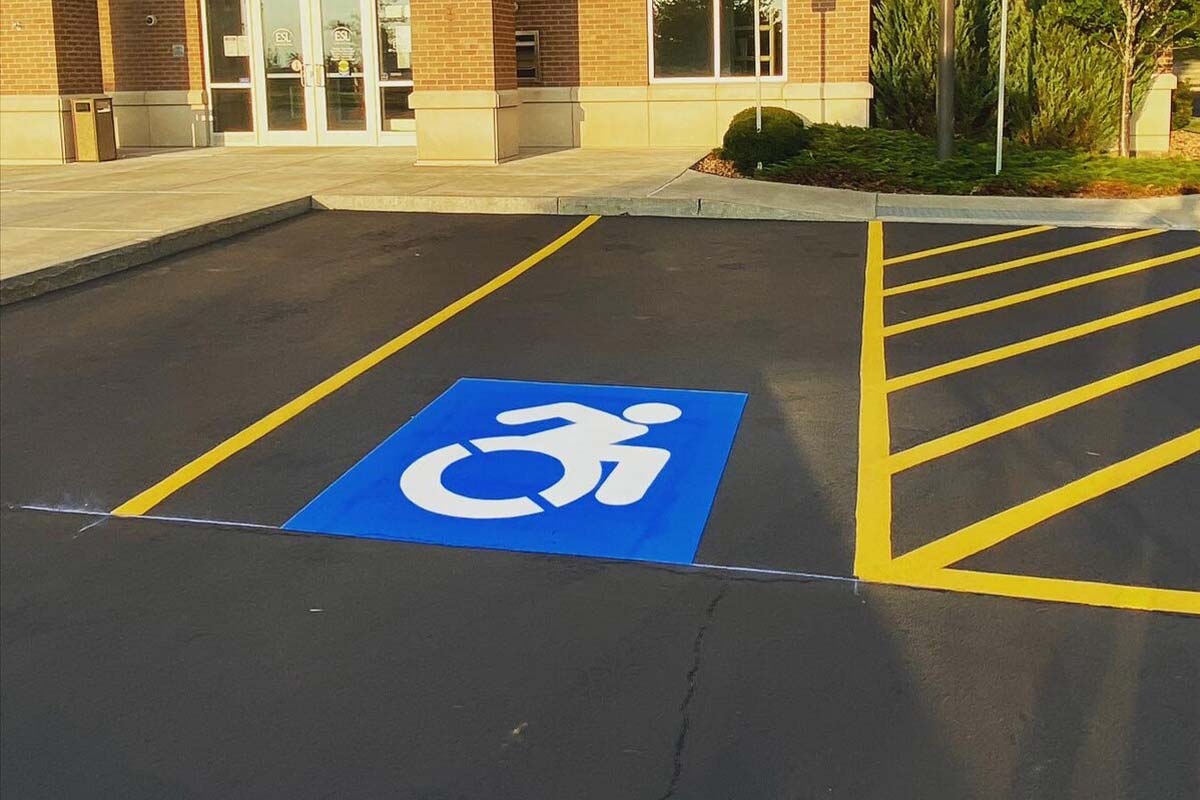
ADA Parking Lot Striping Services in South Phoenix
Parking lot accessibility isn’t a box to check once and forget. Stall lines fade, aisle hatching wears off, and signs shift or go missing — any of those conditions can create real exposure for a property owner. That’s where 1-800-STRIPER® of South Phoenix comes in.
We handle the full scope of ADA parking lot striping for commercial properties across Maricopa and Pinal counties. New construction lots get a clean layout from scratch: accessible stall counts matched to your total spaces, proper van-accessible stalls, full-length access aisles with hatching, International Symbol of Accessibility (ISA) pavement markings, and coordination with your signage installer. Existing lots get a thorough look before anything hits pavement — we compare current striping against the published standards and correct what’s out of spec.
Property types we regularly work with include retail centers, medical offices, office parks, multifamily complexes, churches, and K–12 schools. Each has the same federal baseline under the 2010 ADA Standards, but lot sizes and layouts vary. South Phoenix’s climate adds another layer: the combination of intense UV exposure and temperature swings between winter nights and summer days (regularly above 110°F) breaks down paint faster than most markets. Lines that looked fine last spring may be barely visible now. A regular striping schedule keeps accessible spaces identifiable and the hatching that protects access aisles legible.
Give 1-800-STRIPER® of South Phoenix a call at (480) 662-2363 for a free estimate. We’ll assess your lot and tell you exactly what’s needed.
2010 ADA Standards §502: What a Compliant Stall Looks Like
The dimensions for an accessible parking stall aren’t arbitrary — they’re published in the 2010 ADA Standards for Accessible Design, and every number has a reason.
A standard accessible stall must be at least 96 inches (8 feet) wide. That width lets a door open fully and gives a wheelchair user or someone with a mobility device enough clearance to transfer safely. The stall runs alongside an access aisle — a marked, hatched zone that must extend the full length of the stall and be at least 60 inches wide. The access aisle is where the door swings and where equipment deploys; a car parked in it defeats the entire setup.
Van-accessible stalls require more room. The standard van configuration is 132 inches (11 feet) wide with a 60-inch access aisle alongside. An alternative layout allows a 96-inch stall if the adjacent access aisle is widened to 96 inches instead. Either way, the extra width exists because wheelchair lift and ramp systems on accessible vans need clear, level space to deploy.
Surface slope is a detail that often gets overlooked. The entire accessible parking space and its access aisle must have a running slope and cross slope no steeper than 1:48 in every direction (§502.4). A stall that’s otherwise correct but pitched too steeply fails the standard.
Signage requirements under §502.6 add one more element: each accessible space must have a sign displaying the ISA mounted so the bottom of the sign is at least 60 inches above the finished floor surface. Low-mounted signs get obscured by vehicles; 60 inches keeps them visible to approaching drivers.
We stripe to these published specifications. If there’s a question about what a local code adds on top of the federal baseline, we recommend consulting your local building department.
How Many Accessible Spaces Does Your Lot Need? (§208.2)
The federal formula is laid out in §208.2 of the 2010 ADA Standards. The number of required accessible spaces scales with your total parking count:
| Total Parking Spaces | Minimum Accessible Spaces Required |
|---|---|
| 1–25 | 1 |
| 26–50 | 2 |
| 51–75 | 3 |
| 76–100 | 4 |
| 101–150 | 5 |
| 151–200 | 6 |
| 201–300 | 7 |
| 301–400 | 8 |
| 401–500 | 9 |
| 501–1,000 | 2% of total |
| 1,001 and over | 20 spaces, plus 1 for each 100 spaces over 1,000 |
On top of the total accessible space count, §208.2.4 requires that at least 1 of every 6 accessible spaces be van-accessible. For a lot with 4 accessible spaces, that means at least 1 must be van-accessible. For a lot with 12 accessible spaces, at least 2 must be van-accessible.
One practical note: the table above gives minimums. Lots with heavy medical or senior-population traffic often benefit from exceeding the minimum — that’s a business decision, not a federal one.
When we walk a South Phoenix lot before striping, we pull the total space count and verify the current accessible space tally against this table. If the count is short, we add spaces before anything else gets restriped. Getting the number wrong at the start means correcting it later, which costs more time and material.
Van-Accessible Stalls and Access Aisles
Van-accessible stalls are the spaces most likely to cause problems on older lots. When a lot was originally striped years ago, van-accessible requirements either didn’t exist in current form or weren’t enforced consistently. A lot that was “compliant” in 2005 may have stalls that don’t meet current dimensional standards.
The issue matters practically. A wheelchair user who drives or travels in an accessible van needs a stall wide enough for their lift or ramp to deploy fully — and an adjacent access aisle that’s clear and level. If the aisle is too narrow, the lift hits the neighboring vehicle. If hatching has faded, drivers treat the aisle as an open parking spot, which happens constantly on busy retail lots.
Common violations we see on South Phoenix lots:
- Faded ISA symbols — The pavement marking degrades faster on lots with heavy sun exposure. When the ISA is no longer clearly visible from the driving approach, the stall loses its functional identification.
- Worn access aisle hatching — Diagonal hatch lines that have worn smooth invite drivers to park in them. A car in the access aisle makes the accessible stall unusable regardless of how well-marked the stall itself is.
- Missing van-accessible designation — A stall may be wide enough but lack the van-accessible sign required by §502.6. Without it, drivers with standard accessible placards may park there, leaving van users without a usable space.
- Stall width just under spec — Older lots sometimes have stalls that were striped at 90 inches instead of 96. The difference looks minor but matters for accessibility.
We resurface these issues during the compliance walkthrough phase before any paint is applied. If a van stall needs to be shifted or a new one added, we plan that in the measurement step so the layout is correct before striping begins.
Our ADA Compliance Process
Every ADA parking lot striping job in South Phoenix follows the same sequence. Skipping steps is how mistakes get sealed into asphalt.
- Compliance walkthrough and measurement — We walk the lot with measuring equipment and document every accessible space: stall widths, aisle widths, surface slopes, ISA condition, and sign height. This gives us a clear picture of what exists and what needs to change.
- Space count verification against §208.2 — We compare your current accessible space count to the federal table for your total parking supply. If you’re short, we determine where additional spaces can be added based on lot layout and accessible-route connections.
- Layout correction plan — If stalls need to move, widen, or be added, we work out the revised layout before touching the lot. That plan accounts for access aisle placement (shared aisles between two spaces are permitted under the standards and can help with tight lots), slope in the stall and aisle areas, and the path connecting accessible spaces to the building entrance.
- Striping, ISA symbols, and aisle hatching — Once the plan is set, we stripe the stalls to published dimensions, apply ISA pavement symbols, and install full-length diagonal hatch lines in every access aisle. Hatch density matters — hatching that’s too sparse still invites parking in the aisle.
- Signage check — We verify that sign mounting height meets the 60-inch-to-bottom requirement and that van-accessible spaces have the required van-accessible designation. We don’t install signs ourselves, but we flag deficiencies so your property manager can coordinate the sign work.
- Documentation photos — We photograph the completed accessible spaces before leaving the lot. You get a record showing the finished stalls, ISA symbols, access aisles, and signs — useful documentation for your own records.
Call (480) 662-2363 to schedule your free walkthrough.
Why Choose 1-800-STRIPER® of South Phoenix
Josh Hatch owns and operates 1-800-STRIPER® of South Phoenix, serving commercial properties throughout Maricopa and Pinal counties. The operation holds a 5.0-star Google rating from 12 local customers.
Knowing the published ADA standards cold is table stakes for this work. What matters on South Phoenix lots specifically is understanding how the desert environment affects striping longevity. Paint on a South Phoenix lot faces more UV degradation and thermal cycling than pavement striping in almost any other U.S. market. We use materials appropriate for high-heat, high-UV conditions, and we’ll tell you honestly how long to expect a given application to last on your surface type.
Arizona enforces accessibility requirements through both federal law and the Arizonans with Disabilities Act (A.R.S. § 41-1492), which applies to public accommodations in the state alongside the federal ADA. That means property owners in South Phoenix have two parallel frameworks to consider. We stripe to the 2010 ADA Standards — we’re striping contractors, not attorneys, and we don’t provide legal compliance opinions — but we do our part of the job to the published dimensional and marking specifications.
Free estimates for every job. No obligation to book. Reach Josh’s team at (480) 662-2363.
For a full list of our pavement marking services, visit our parking lot striping in South Phoenix page.
Businesses We Serve




How it Works

GET A FREE ESTIMATE
Contact us today and we’ll have a quote to you in 24 hours

SCHEDULE AN INSTALLATION
We’ll have your installation scheduled in less than 7 days, without affecting your business hours

GET A PARKING LOT THAT POPS
For a budget-friendly price, you’ll get a parking lot that looks like new!
We proudly work with:


We proudly work with:


Frequently Asked Questions About ADA Parking Lot Striping in South Phoenix, AZ
How do you stripe a handicap parking space?
A compliant accessible space starts with the right dimensions: at least 96 inches wide for a standard stall, or 132 inches for a van-accessible stall. The adjacent access aisle must run the full length of the stall at a minimum of 60 inches wide and be marked with diagonal hatching to discourage parking in it. An ISA (International Symbol of Accessibility) goes on the pavement surface, and a sign mounted at least 60 inches to its bottom identifies the space. Surface slope in all directions must not exceed 1:48.
Does ADA striping need to be blue?
The 2010 ADA Standards don’t specify a color for the stall surface or the ISA pavement marking — the federal requirement is about dimensions, slopes, and signage, not paint color. Blue has become the widely recognized convention across most markets and is required by some local or state codes, so it’s the standard practice. Before painting, we confirm what the governing local requirements are. If your jurisdiction adds a color requirement on top of the federal baseline, we follow it.
How many accessible parking spaces does my lot need?
The count depends on your total parking supply. A lot with 1–25 total spaces requires 1 accessible space; 26–50 requires 2; 51–75 requires 3; up to 100 requires 4; and the required count increases from there per the §208.2 table in the 2010 ADA Standards. At least 1 of every 6 accessible spaces must be van-accessible. We verify your space count and current accessible inventory during our pre-striping walkthrough and make sure the numbers are right before paint goes down.
What makes a stall van-accessible?
A van-accessible stall is wider than a standard accessible space, giving enough clearance for a wheelchair lift or ramp to deploy fully. The standard configuration is 132 inches wide with a 60-inch access aisle alongside. An alternative allows a 96-inch stall if the access aisle is widened to 96 inches. The space also requires a van-accessible designation sign in addition to the standard accessible space sign. Without that extra width and signage, a van user with a lift or ramp system may not be able to use the space safely.
Can an existing lot be grandfathered out of ADA parking requirements?
Generally, no — not for parking. The ADA’s “readily achievable barrier removal” requirement applies to existing facilities, meaning private entities that serve the public have an ongoing obligation to remove access barriers when doing so is achievable without significant difficulty or expense. Parking accessibility is specifically identified in federal guidance as a priority area for barrier removal. If your lot hasn’t been updated in years, it’s worth having a compliance review done. We can walk the lot and document what we see; questions about your specific legal obligations are best directed to an attorney familiar with ADA compliance.
Who enforces ADA parking requirements in Arizona?
At the federal level, the Department of Justice enforces Title III of the ADA for places of public accommodation, and private individuals can bring civil actions for violations. At the state level, the Arizonans with Disabilities Act (A.R.S. § 41-1492) creates a parallel framework for public accommodations in Arizona. Municipalities and local building departments also conduct inspections that can flag accessibility deficiencies. Property owners in South Phoenix are subject to all of these frameworks simultaneously, which is why keeping parking lot striping current and to spec matters.