Bollard Installation
In South Phoenix, AZ
Safety and Security Bollards
1-800-STRIPER® provides professional bollard installation in South Phoenix, AZ — installing steel-pipe, removable, and decorative safety bollards per ASTM F3016 and ASTM F2656 impact-protection standards to safeguard storefronts, walkways, and utilities for commercial properties throughout Maricopa and Pinal counties.
1-800-STRIPER® of South Phoenix PROVIDes Bollard Installation Services NEAR YOU
Want to prevent accidents and protect your property?
Bollards provide physical protection for your customers and your property.
Safety and security:
Bollards create a physical barrier between vehicles and pedestrians, protecting people in walking areas from accidental or intentional vehicle intrusions.
Bollards act as a protective barrier around storefronts, gas stations, and other vulnerable areas, minimizing the risk of costly damage from vehicle impacts.
Strategic Placement Locations:
Bollard Types We Install in South Phoenix
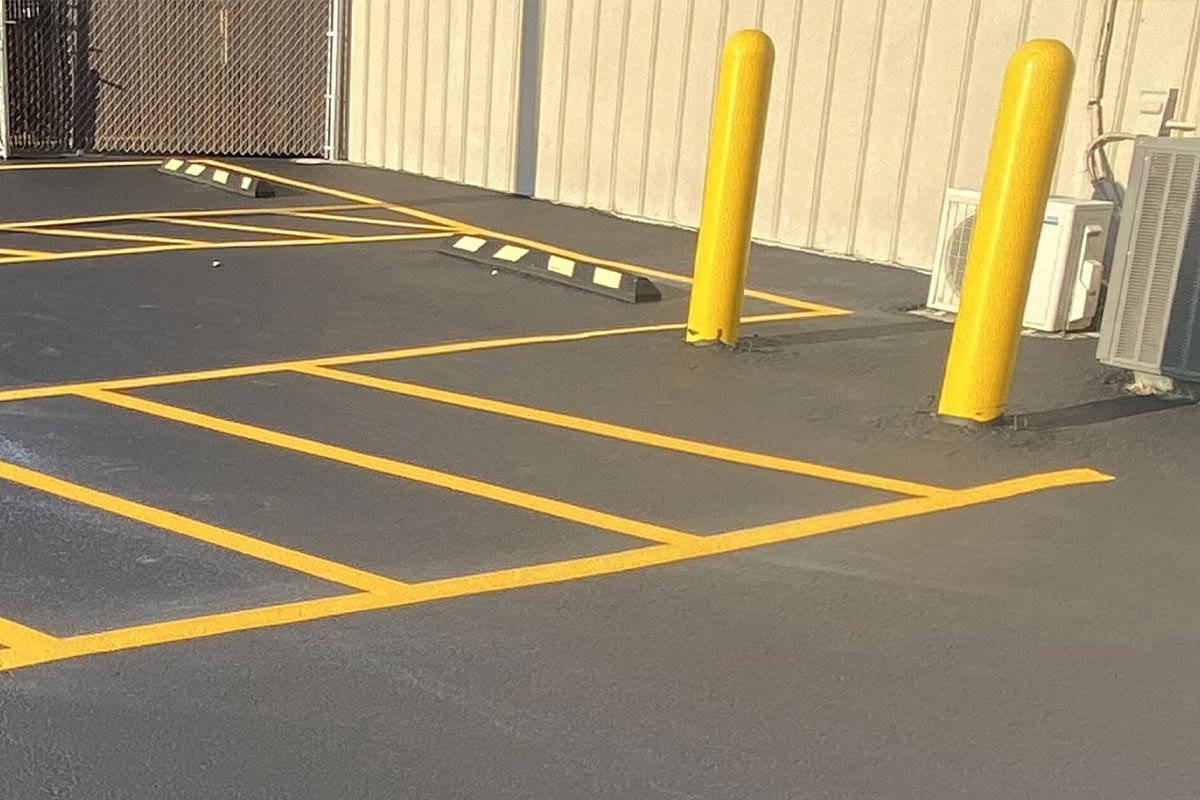
Fixed steel-pipe bollards are the backbone of most commercial bollard jobs in South Phoenix. A concrete-filled steel pipe set in a deep footing can stop a vehicle that drifts or accelerates into a storefront — and that’s the point. Retailers, pharmacies, and convenience stores use them along building faces and at entrance corners where a cart return or a parking stall sits close to the glass line.
Removable and lockable bollards serve a different purpose. Loading docks, delivery lanes, and service bays often need controlled access — the bollard blocks the area overnight or on weekends, then drops out of its receiver sleeve during business hours. That flexibility matters in busy commercial districts in Maricopa County where traffic patterns change by shift.
Flexible rebounding bollards work well for interior lane delineation — drive-thru queuing lanes, parking structure entrances, and pedestrian separators. They’re not rated for vehicle impact, but they guide traffic flow and take low-speed contact without shattering.
Decorative bollard covers are a finish layer, not a structural element. A steel-core bollard can wear a cast-iron or polymer sleeve that matches a retail center’s aesthetics. The protection comes from the core; the cover handles curb appeal.
Security bollards for high-risk frontage — a pharmacy with a large glass storefront, a bank drive-thru, or an EV charger island exposed to a parking lane — are spec’d to a tested impact rating. Protecting utilities like gas meters and drive-thru menu boards with steel-pipe bollards is also straightforward bollard installation work we handle routinely.
Bollard repair and replacement round out what we do. A bent or rusted bollard from a previous impact doesn’t just look bad — it signals to your property manager and insurer that the protective perimeter has a gap. We remove the damaged unit, inspect the footing, and set a fresh bollard to the same embedment depth.
ASTM F3016 and F2656: Impact Protection Standards
These two standards come up often when property managers ask how protective a bollard actually is. Here’s what each one means in plain terms.
ASTM F3016 is the storefront-protection benchmark. It tests bollards against low-speed surrogate vehicle impacts at 10, 20, and 30 mph. A bollard rated to F3016 has been physically tested at one of those speed thresholds, and the results confirm it can stop or deflect that impact. For most retail storefronts and strip-mall entrances in South Phoenix, an F3016-rated bollard is the appropriate specification.
ASTM F2656 covers higher-speed vehicle-barrier crash ratings used at higher-security sites — government facilities, critical infrastructure, and locations where a deliberate vehicle attack is a realistic concern. These installs are engineered differently, often with deeper footings and anchor systems tested at much higher energy levels.
For a standard commercial property, the practical question is: what speed and vehicle weight does your site need to be rated against? A parking lot fronting a busy arterial in South Phoenix has different exposure than a back-lot utility area. We talk through the use case with you before recommending a bollard type, so you’re not over-specifying (or under-protecting).
Unrated decorative posts — the thin-walled pipes you see at some strip malls — aren’t tested to either standard. They’re visual guides, not vehicle barriers. If your property needs actual crash protection, the bollard needs to carry a tested rating.
Our Bollard Installation Process
- Site assessment and utility locate. Before any digging, we call 811 — Arizona’s “Call Before You Dig” line — to have underground utilities marked. This is standard practice on every bollard job and protects against striking gas, water, and electrical lines during core drilling.
- Spacing and layout plan. We map bollard positions relative to pedestrian flow and vehicle gaps. The spacing has to stop a vehicle from passing between posts while still letting carts, people with strollers, and ADA-compliant mobility devices move freely. We mark the layout before drilling.
- Core drill or excavate footing. Existing concrete — sidewalks, aprons, drive lanes — gets core-drilled to the footing depth. For new poured concrete areas, we excavate. Embedment depth depends on bollard diameter and the protective purpose of the install.
- Set bollard in concrete footing. The bollard goes into the prepared hole, plumb and at the correct height above grade. We pour concrete around it to the specified depth, ensuring the footing cures before the site reopens to vehicle traffic. Concrete-filled steel-pipe bollards get filled at this stage as well.
- Finish: paint, sleeve, and reflective banding. Once set, bollards can be painted to match site standards, fitted with a decorative sleeve, or banded with reflective tape for nighttime visibility. Parking lots in South Phoenix that run evening operations benefit from the reflective finish — it reads clearly under headlights.
Why Choose 1-800-STRIPER® of South Phoenix
Josh Hatch runs the South Phoenix franchise, and the business holds a 5.0-star Google rating from 12 local customers. That rating comes from commercial accounts — property managers, facility directors, and retail operators who needed the work done right and on schedule.
One mobilization for bollard installation and line striping is a practical advantage for property managers juggling contractor schedules. We do both, so a parking lot refresh that includes new bollard protection doesn’t require a second crew, a second scheduling window, or a second site walkthrough.
Free estimates are standard. Call (480) 662-2363 and describe the site — number of bollards, surface type, whether the area has existing footings — and we’ll put together a scope before any commitment. South Phoenix commercial properties in Maricopa and Pinal counties are our service area.
For a full list of our pavement marking services, visit our parking lot striping in South Phoenix page.
Businesses We Serve




How it Works

GET A FREE ESTIMATE
Contact us today and we’ll have a quote to you in 24 hours

SCHEDULE AN INSTALLATION
We’ll have your installation scheduled in less than 7 days, without affecting your business hours

GET A PARKING LOT THAT POPS
For a budget-friendly price, you’ll get a parking lot that looks like new
We proudly work with:


We proudly work with:


Frequently Asked Questions About Bollard Installation in South Phoenix, AZ
How deep should a bollard be buried?
Embedment depth depends on bollard diameter, post height, and the protective purpose. A general rule of thumb puts embedment at roughly one-third of the total bollard length, but security-rated installs follow the specific tested configuration for that bollard — the depth is part of what gets tested under ASTM standards. A visual decorative post can sit shallower; a crash-rated bollard cannot. We size the footing to the bollard type and use case during the site assessment.
Are parking bollards difficult to install?
Surface-mount bollards with anchor bolts are available as DIY products, but they offer limited protection. A vehicle impact on a surface-mount can shear the anchors or pop the base plate off the pavement. Embedded bollard installation requires core drilling or excavation, precise footing depth, and concrete cure time — it’s work that benefits from proper equipment and experience. The protection level tracks directly to how the bollard is anchored.
What factors affect the cost of bollard installation?
We don’t quote pricing here, but the main scope factors are bollard type (fixed vs. removable, standard vs. security-rated), quantity, surface conditions (fresh concrete vs. existing hard pavement requiring core drilling), footing depth, and whether any site clearance or utility marking is needed. The fastest way to get an accurate number is a free estimate. Call (480) 662-2363 and we’ll scope the job based on your specific site.
What’s the difference between fixed and removable bollards?
Fixed bollards are permanent — set in concrete, they stay in place and block vehicle access continuously. Removable bollards use a sleeve receiver set in the footing; the post lifts out when access is needed and drops back in to close the area. Fixed bollards make sense for storefronts, utility protection, and perimeters that should never open to vehicles. Removable bollards work well for loading docks, service lanes, and event areas that need controlled, scheduled access.
Do bollards actually stop cars?
Rated bollards — those tested to ASTM F3016 or ASTM F2656 — are designed and tested to stop or deflect vehicles at specific speeds and impact energies. A bollard that carries an F3016 rating has passed that physical test. Decorative posts and thin-walled pipes are visual guides; they can redirect a slow, glancing contact but aren’t designed to stop a vehicle with momentum behind it. The distinction matters when you’re choosing protection for a high-exposure storefront or utility area.
How long does bollard installation take?
A standard commercial bollard job — site assessment, core drilling, setting, and concrete pour — typically wraps in a single day for most installs. The limiting factor is concrete cure time: the footing needs to cure before the area reopens to vehicle traffic, which generally means keeping vehicles off the newly set bollards for 24–48 hours. Larger projects with many posts or specialty footings take longer. We’ll give you a realistic timeline during the estimate so you can plan around it.