Fire Lane Striping
In Allentown, PA
Code-Compliant Fire Lane Markings
1-800-STRIPER provides professional fire lane striping in Allentown, PA — marking fire lanes, fire-hydrant zones, and no-parking curbs to the layout your municipal fire official approves for commercial properties across Lehigh and Northampton counties.
1-800-STRIPER of Allentown PROVIDes Fire Lane Striping Services NEAR YOU
Is your parking lot ready for first responders?
Our team is well-versed in local fire regulations and will parter with you to design a fire lane striping plan that creates unobstructed emergency access to protect your customers and property.
Core Services:
The Pennsylvania fire-code fact no competitor publishes
Franchise rivals routinely publish a confident line about marking fire lanes “per the International Fire Code” or “per NFPA 1.” In Pennsylvania both are unsupportable as statewide authority, and saying so accurately is information almost nobody in this market carries.
Pennsylvania does not adopt NFPA 1 at all — the term appears zero times in the chapter that carries the state’s construction-code adoption. And it does not adopt the International Fire Code as a free-standing statewide code either. 34 Pa. Code Section 403.21(a)(8) adopts the International Fire Code of 2021 “only to the extent it is referenced by other ICC codes adopted in this chapter.” That cross-reference is the whole of the state’s fire-code adoption. Section 403.21(c) then excludes appendices generally: appendices to the codes adopted in that section are not part of the Uniform Construction Code, save for two named International Building Code appendices — neither of which is the fire-apparatus-access appendix. So that appendix is not adopted at state level either.
So where does the requirement come from? From the municipality. Under Section 403.102(a) a municipality electing to enforce the Uniform Construction Code adopts it by its own ordinance; under Section 403.103(a) a municipality may decline to administer and enforce it entirely; and under Section 403.102(d) it may retain its own pre-1999 ordinances where those equal or exceed the state code. That is why two neighboring Lehigh Valley townships can legitimately hold different requirements for the same lot layout.
In Allentown specifically: the City adopts the Uniform Construction Code at Chapter 225 of the City Code. Its Fire Prevention and Protection chapter, Chapter 285, runs only two sections and addresses the negligent setting of fires — it is not a fire-lane marking ordinance. In practice this means the operative requirement for a given property comes from the approved site plan and from the fire official with jurisdiction, not from a code section that can be quoted at you from a national web page.
What we mark
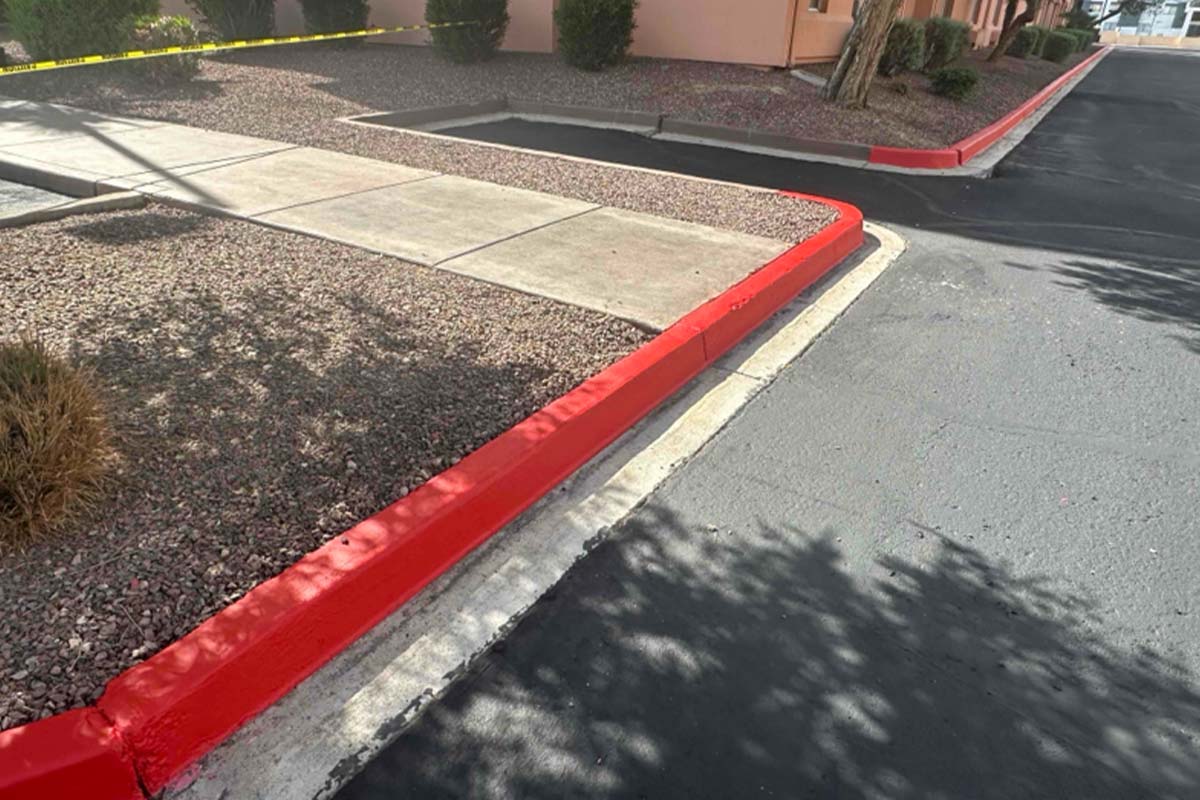
- Fire lanes — the access route itself, marked out to the width and alignment the approved plan shows.
- Curbs — painted along the designated no-parking edge.
- Legends — NO PARKING FIRE LANE lettering at the intervals the approving official specifies.
- Hydrant and connection zones — the keep-clear areas at hydrants and fire department connections.
- Signage coordination — where posted signs accompany the paint, marked so the two agree.
Color, lettering interval and legend wording are set by the authority having jurisdiction rather than by a universal rule. We ask what your fire official requires before marking, because re-marking a lane to a different legend interval is a wholly avoidable second visit.
Why faded fire lanes are a live problem
A fire lane that cannot be read is not doing its job, and it stops being enforceable in the practical sense: a driver who parks in an unmarked lane has a defense that a driver in a clearly marked one does not. Marking degrades fastest where it matters most — at entrances, in turning areas, and along the curb lines that catch tire scrub and plow damage through a Lehigh Valley winter. Freeze-thaw cycling and road salt are hard on curb paint specifically.
How a fire lane job runs
- Confirm the requirement. What the approved plan shows and what the fire official with jurisdiction requires — legend wording, interval, color.
- Set out the lane. Alignment and width marked against the plan.
- Mark curbs and legends. Applied to the confirmed specification.
- Coordinate signage. So posted signs and painted legends say the same thing.
For a full list of our pavement marking services, visit our parking lot striping in Allentown page.
Businesses We Serve




How it Works

GET A FREE ESTIMATE
Contact us today and we’ll have a quote to you in 24 hours

SCHEDULE AN INSTALLATION
We’ll have your installation scheduled in less than 7 days, without affecting your business hours

GET A PARKING LOT THAT POPS
For a budget-friendly price, you’ll get a parking lot that looks like new
We proudly work with:


We proudly work with:
Frequently Asked Questions About Fire Lane Striping in Allentown, PA
What code requires fire lane markings in Allentown?
Not the one most contractors name. Pennsylvania does not adopt NFPA 1, and it adopts the International Fire Code only where another adopted ICC code references it, under 34 Pa. Code Section 403.21(a)(8). The requirement for your property comes from the municipality — Allentown adopts the Uniform Construction Code at Chapter 225 of its Code — and, in practice, from your approved site plan and the fire official with jurisdiction. Anyone quoting you a national fire-code section number for a Pennsylvania lot is reaching.
What color should a fire lane be?
Whatever your authority having jurisdiction specifies. Red with white lettering is the most common convention in this region and the one most drivers read instinctively, but it is a convention rather than a Pennsylvania statewide mandate, and municipalities differ. Because the fire official is the one who signs off, the sequence that avoids rework is to confirm the specification first and mark second. We will ask before quoting.
How often does NO PARKING FIRE LANE lettering need to be repeated?
The interval is set locally rather than by a uniform statewide figure, so it is confirmed with the approving official for your site. What is consistent is the intent: the legend has to be readable to a driver looking for somewhere to stop, which means it repeats along the length of the lane rather than appearing once at the entrance. If your existing lane has legends at an interval that was approved previously, matching it is normally the right answer.
Do fire lanes apply to private commercial property?
Yes. A privately owned lot that the public uses — retail, medical, industrial, multifamily — routinely carries a designated fire access route as a condition of its approved site plan, and that obligation runs with the property regardless of ownership. The common misconception is that private property is outside the scope. What is genuinely true in Pennsylvania is narrower and different: the authority is municipal rather than a statewide fire code.
Can you repaint faded fire lane markings without re-approval?
Refreshing an existing, previously approved marking in place is normally maintenance — same alignment, same legend, same color. Changing the lane’s position, width, legend wording or extent is a different matter and should be confirmed with the fire official before work starts. If the existing markings have faded to the point where the original layout is uncertain, say so at the estimate: reconstructing the intended alignment from a worn lane is part of the job.
What happens if our fire lane markings have worn away?
Practically, you lose enforceability and you invite a finding at your next inspection. A lane nobody can see gets parked in, and an obstructed fire access route is the thing the marking exists to prevent. Because the requirement attaches to your site plan rather than to a general statewide code, the exposure is a local enforcement matter — which is exactly why it is worth resolving before an inspection rather than after one. Call (484) 935-4114 for a free estimate.