Wheel Stop Installation
In Midwest Houston, TX
Concrete and Rubber Parking Stops
1-800-STRIPER provides professional wheel stop installation in Midwest Houston, TX — anchoring concrete, recycled-rubber, and plastic-composite wheel stops at stall heads to protect sidewalks, storefronts, and ADA-accessible routes per the 2010 ADA Standards for Accessible Design.
1-800-STRIPER® of Midwest Houston PROVIDes Wheel Stops Services NEAR YOU
Need to protect vehicles or walls from accidental damage?
Wheel stops (also called parking blocks) protect your property, enhance safety, and improve parking lot organization.
Benefits:
Wheel stops prevent vehicles from parking too far into a space or overextending into other spots, pedestrian walkways, and other areas, while also helping with vehicle alignment. They can prevent damage to buildings, curbs, or landscaping. Wheel stops also serve as clear visual cues for proper parking and are sometimes used on slopes to prevent cars from rolling.
What Wheel Stop Installation Includes
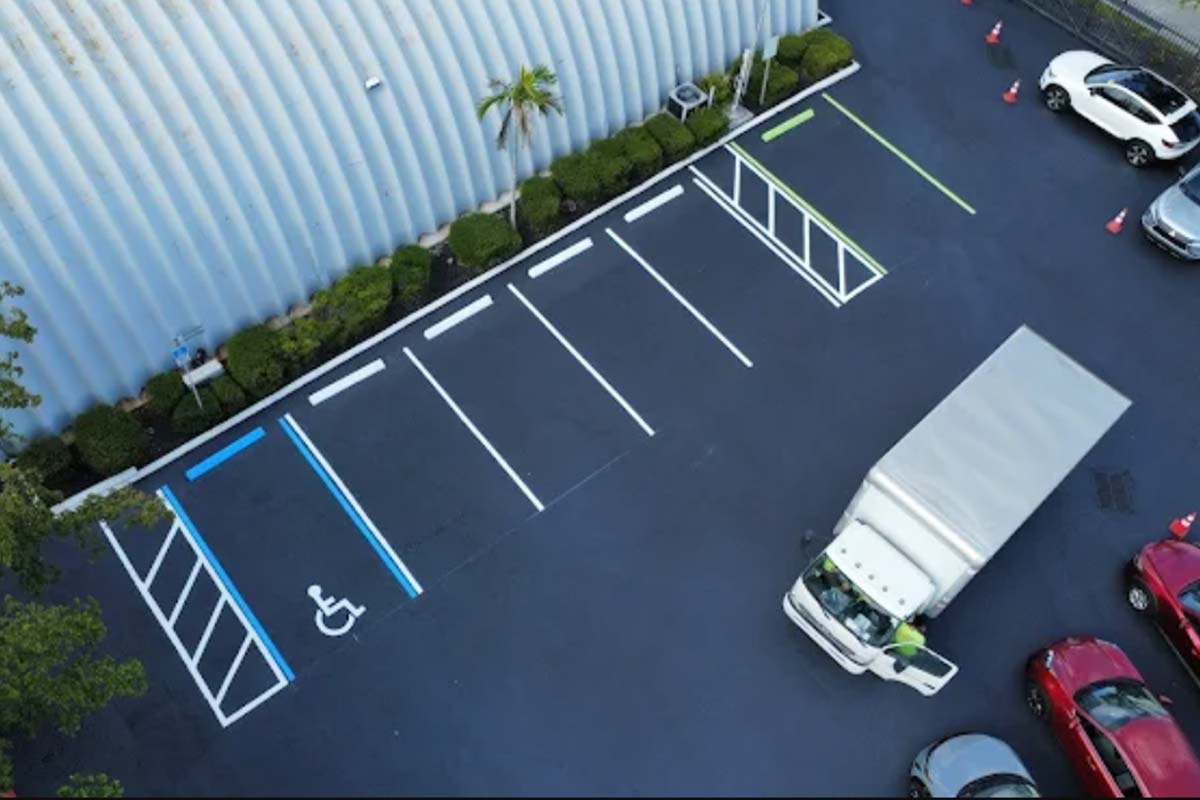
Wheel stops — the low bumpers, or “parking blocks,” at the head of a stall — keep a parked car from rolling or pulling too far forward. We supply and install them in concrete, recycled rubber, and plastic composite, anchoring each one to the surface so it stays put under daily use. The job covers new lots that need stops from the start, replacements for cracked or dislodged blocks, and additions where a curb, storefront, or accessible route needs protecting.
Placement is the part that matters as much as the hardware: a stop set at the right depth in the stall keeps bumpers off the sidewalk without making the space hard to use.
Wheel Stops & ADA Accessible Routes
Wheel stops do real work on accessible parking. Section 502.7 of the 2010 ADA Standards for Accessible Design requires that parking spaces and access aisles be designed so vehicles do not overhang and reduce the clear width of an accessible route. Where an accessible space or aisle sits next to a sidewalk that doubles as the route to the entrance, a car nosing over the curb can eat into that clear width — and a wheel stop is the simplest way to hold the vehicle back and keep the route usable.
We place stops at accessible spaces and along routes where overhang is a risk, set so they protect the walkway while leaving the space and its access aisle at full dimension.
Material Options: Concrete vs Rubber vs Composite
The three common materials trade off weight, durability, and handling. There is no single best choice — it depends on your lot and how often the layout changes:
| Material | Strengths | Trade-offs | Best for |
|---|---|---|---|
| Concrete | Heaviest and most solid; stays put; long-standing standard | Can crack, chip, or spall over years; heavy to move or reconfigure | Permanent layouts, high-traffic lots |
| Recycled rubber | Flexible, will not crack; lighter to install and relocate; often high-visibility color | Lower mass than concrete | Lots that get reconfigured; areas wanting high visibility |
| Plastic composite | Lightweight; resists weather, rot, and chemicals; easy to install | Less mass than concrete | Mild-duty lots; fast installs; sustainability-minded specs |
We will walk you through which fits your lot, your traffic, and whether you expect to change the layout down the road.
Our Wheel Stop Installation Process
- Lay out placement. We mark where each stop goes so bumpers stay off sidewalks and accessible routes and the stalls remain easy to use.
- Prep the spot. We clean the surface and set the anchoring for asphalt or concrete.
- Anchor each stop. On asphalt we typically drive steel spikes or rebar pins through the stop into the base; on concrete we anchor with bolts or pins set into the slab.
- Check the set. We confirm each stop is secure, aligned, and correctly placed before we finish.
For a full list of our pavement marking services, visit our parking lot striping in Midwest Houston page.
Businesses We Serve




How it Works

GET A FREE ESTIMATE
Contact us today and we’ll have a quote to you in 24 hours

SCHEDULE AN INSTALLATION
We’ll have your installation scheduled restriped in less than 7 days, without affecting your business hours

GET A PARKING LOT THAT POPS
For a budget-friendly price, you’ll get a parking lot that looks like new
We proudly work with:


We proudly work with:


Frequently Asked Questions About Wheel Stop Installation in Midwest Houston, TX
Which is better — concrete, rubber, or composite wheel stops?
It depends on your lot. Concrete is the heaviest and most permanent but can crack over years. Recycled rubber is flexible, will not crack, and is easier to move, which suits lots that get reconfigured. Plastic composite is lightweight and resists weather and chemicals. None is best across the board — we match the material to your traffic, your layout, and whether you expect to change it later.
How are wheel stops anchored?
It depends on the surface. On asphalt, stops are usually anchored with steel spikes or rebar pins driven through the block into the base. On concrete, they are bolted or pinned into the slab. Proper anchoring is what keeps a stop from shifting or being pushed out of place under daily use, so we set each one for the surface it sits on.
Do wheel stops help protect ADA-accessible routes?
Yes. The ADA requires that parked vehicles not overhang and reduce the clear width of an accessible route (§502.7), and a wheel stop holds a car back so its bumper does not encroach on a sidewalk that serves as that route. We place stops at accessible spaces and along at-risk routes to keep the clear width intact.
What size are wheel stops, and how far apart do they go?
Standard wheel stops are commonly around six feet long, set one per stall at the head of the space, positioned so the front tires stop before the bumper reaches the curb or sidewalk. Placement depth in the stall matters more than a fixed spacing. We size and place them to your stall dimensions.
Do wheel stops prevent curb and sidewalk damage?
That is a large part of what they do. By stopping a vehicle before its bumper reaches the curb, storefront, or landscaping, wheel stops prevent the slow damage that overhanging cars cause — cracked curbs, scuffed walls, and crushed sidewalk edges. They also protect pedestrians on the walkway from encroaching bumpers.
Can you replace broken or missing wheel stops?
Yes. Concrete stops crack and spall, and any stop can be knocked loose over time. We replace individual damaged stops or re-do a full lot, and we can switch materials — for example from cracking concrete to recycled rubber — if that suits how the lot is used now.