Parking Lot Restriping
In Des Moines, IA
Restripe Existing Lines and Markings
1-800-STRIPER® provides professional parking lot restriping in Des Moines, IA — refreshing faded stalls, ADA accessible spaces, fire lanes, and directional arrows, and flagging when a resurfacing job triggers accessible-parking scoping under the 2010 ADA Standards for Accessible Design across Polk, Dallas, and Story counties.
1-800-STRIPER of Des Moines PROVIDes Parking Lot Restriping Services NEAR YOU
Need to brighten up your faded parking lot?
Keep your parking lot safe and attractive by restriping annually to freshen up lines and symbols that have faded from the sun, weather, and traffic. Nothing beats a fresh coat of paint!
Benefits:
Parking Lot Restriping in Des Moines, IA
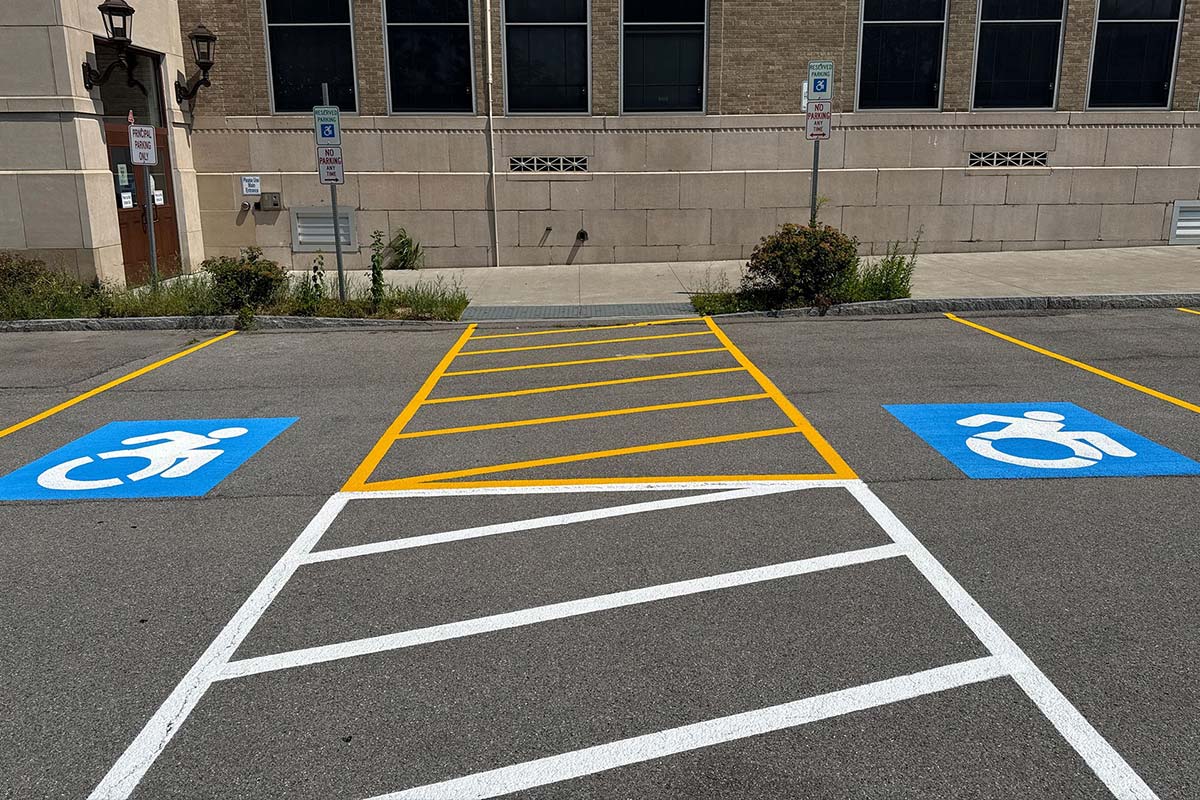
Restriping is the maintenance half of lot marking: the stall plan stays where it is, and the paint that defines it gets renewed. Parking lot restriping in Des Moines, IA is the right call when the layout still works and the lines have simply stopped doing their job — stalls drivers park across, arrows nobody follows, an accessible space that reads as ordinary asphalt. It is faster and less disruptive than a new layout, and on a sound surface it restores the lot to full legibility in a single visit.
When a Lot Needs Restriping
Three signals, in order of urgency. Legibility first: if a driver cannot tell where one stall ends and the next begins from inside a moving vehicle, the lot has already lost the argument. Contrast second — paint does not vanish evenly, it greys down against the asphalt until the edge blurs, and that happens well before the line physically disappears. Compliance third, and this one is not a judgment call: an accessible space, an access aisle or a fire lane marking that is no longer clearly visible is a different problem from a faded ordinary stall, because those three carry duties that ordinary stalls do not. Entrances, drive lanes and turning areas always fade first, so inspect those before concluding the whole lot needs work.
Restriping vs. Resurfacing — and Why the Difference Is Legal, Not Cosmetic
Most owners treat these as two grades of the same job. They are not, and the distinction has consequences. Routine maintenance keeps an existing surface in working order. An alteration changes the facility in a way that affects usability — and once work rises to an alteration, the accessible-parking requirements are triggered for the area being altered. That means a resurfacing project can obligate you to bring the accessible spaces up to the current standard, including their count, dimensions, access aisles and signage, even though nobody set out to change the accessible parking at all. Resurfacing and then restriping falls squarely on that side.
A straight repaint sits on less settled ground than most owners assume, and it is worth being precise about why. The Department of Justice publishes a compliance brief on restriping parking spaces which states that when a business restripes a lot, it must provide accessible parking spaces as required by the 2010 ADA Standards. That brief is informal guidance, and says of itself that it has no force or effect of law — so it is a strong signal about how the agency reads the rules, not a rule of its own.
The duty it points at is separate and does have force. A place of public accommodation has a continuing obligation to remove architectural barriers in existing facilities where removal is readily achievable, meaning easily accomplishable and able to be carried out without much difficulty or expense — judged against the nature and cost of the work, the resources of the facility and of the business behind it. That is a real test with real limits, and it does not reach every commercial property: a warehouse or a private industrial site is generally not a public accommodation.
Whether a like-for-like repaint is itself an alteration is genuinely unsettled, and we are not going to tell you it is. What we will say is that the striping visit is the cheapest moment you will ever have to check the accessible spaces — which is worth settling before the paving contractor mobilizes, not after.
What Gets Restriped: Stalls, Accessible Spaces, Fire Lanes, Arrows
A full restripe covers every marking on the lot, not just the parking stalls. Standard stalls and their end caps. Accessible spaces, access aisles and the international symbol of accessibility. Fire lane markings and legends. Directional arrows and lane lines. Stop bars and crosswalks where the lot has them. Loading zones, no-parking hatching, and curb markings. Numbered or reserved stalls where a tenant has them assigned. We mark what is already there unless you tell us the plan has changed — restriping reproduces the layout, it does not redesign it.
Fire Lane Markings Have a Maintenance Duty Ordinary Stalls Do Not
This is the part that surprises people. Iowa adopts the International Fire Code, 2015 edition, through Iowa Administrative Code rule 661—201.2(1), and Section 503 applies as published. Section 503.3 says that where signs or markings designating fire lanes are required by the fire code official, the means by which those fire lanes are designated shall be maintained in a clean and legible condition at all times, and be replaced or repaired when necessary to provide adequate visibility. Read that again: at all times. An ordinary stall line that has faded is an inconvenience. A fire lane marking that has faded is a maintained-condition duty that the code states explicitly, and it does not wait for your next scheduled repaint.
Our Restriping Process
The order matters more than any single step, because each one destroys information the next one needs.
- Walk and photograph the existing layout before anything is cleaned. Faded lines are the only record of where the markings go, and they get harder to read once the surface is prepped.
- Sweep and clear the lot of debris and loose material. Paint will not bond to either.
- Measure anywhere a line has faded past the point of reliable tracing, rather than guessing at its position.
- Apply markings in sequence: stalls, then accessible spaces and aisles, then fire lanes and legends, then arrows and lane markings. Sequencing this way means nobody has to cross wet paint.
- Allow cure time before the section reopens. This is the step that decides whether the work lasts.
Scheduling Around Your Operating Hours
Fresh traffic paint needs undisturbed cure time, which is the whole scheduling problem in one sentence. A lot striped mid-day either gets driven over too early or forces you to close stalls your customers need. 1-800-STRIPER® runs 24/7 service and completes projects on your schedule, so the work happens overnight, on weekends, or in phased sections that keep part of the lot open throughout. Phasing costs a little more time overall and is usually the right answer for medical, grocery and multi-tenant properties that cannot close.
For a full list of our pavement marking services, visit our parking lot striping in Des Moines page.
Businesses We Serve




How it Works

GET A FREE ESTIMATE
Contact us today and we’ll have a quote to you in 24 hours

SCHEDULE AN INSTALLATION
We’ll have your installation scheduled in less than 7 days, without affecting your business hours

GET A PARKING LOT THAT POPS
For a budget-friendly price, you’ll get a parking lot that looks like new
We proudly work with:


We proudly work with:

Frequently Asked Questions About Parking Lot Restriping in Des Moines, IA
Do you need a permit to restripe a parking lot?
Permit requirements for work on a private commercial lot are set locally, and they vary by jurisdiction and by what the work involves — a straight repaint of existing lines is treated differently from a new layout or a project tied to resurfacing. Requirements in this market are set by the City of Des Moines and by the relevant municipality for properties outside the city. We confirm what applies to your property before we schedule, rather than assume.
What does restriping a parking lot mean?
Restriping means renewing the existing markings on a lot without changing where they go. The stall plan, accessible spaces, fire lanes and arrows stay in their current positions, and fresh traffic paint is applied over them. Parking lot restriping in Des Moines, IA is maintenance, not redesign. If the lines are in the wrong place, that is a layout job instead — repainting a poor layout only makes it easier to follow.
How is a lot restriped?
The lot is swept and cleared first, since paint will not bond to dust or loose material. The existing markings are photographed and measured while they are still readable. Then markings go down in sequence — stalls, accessible spaces and access aisles, fire lanes and legends, then arrows and lane lines — so nobody has to cross wet paint. The final step is cure time before traffic returns, and cutting that short is the most common cause of early failure.
Does resurfacing my lot trigger ADA requirements?
It can, and this catches people out. Routine maintenance that keeps an existing surface in working order does not trigger accessible-parking scoping. Work that rises to an alteration does, and once triggered, the accessible spaces in the altered area have to meet the current standard for count, dimensions, access aisles and signage. Resurfacing followed by restriping generally falls on the alteration side. Worth resolving before paving starts, not after.
How often should a commercial lot be restriped?
There is no fixed interval we can honestly quote you, because line life depends on traffic volume, whether the surface is sealed, sun exposure and snow removal. Entrances and drive lanes wear years faster than perimeter stalls on the same lot. The practical test is legibility from a moving vehicle, checked annually. Accessible spaces and fire lanes deserve a closer look than the rest, because their markings carry duties ordinary stalls do not.
Do faded fire lane markings have to be repainted?
Yes, and the duty is explicit rather than implied. Under the International Fire Code as adopted in Iowa, where fire lane markings are required by the fire code official, the means of designation must be maintained in a clean and legible condition at all times and replaced or repaired when necessary for adequate visibility. That is a standing maintenance obligation, not a repaint-when-convenient one, and it applies independently of when the rest of the lot is due.