Parking Lot Layout Design
In Columbus, OH
Customized Parking Lot Layouts
1-800-STRIPER® provides professional parking lot layout design in Columbus, OH — custom-engineered layouts that maximize parking capacity, ensure ADA compliance per the 2010 ADA Standards for Accessible Design, and meet Columbus City Code Chapter 3312 off-street parking requirements.
1-800-STRIPER® of Columbus PROVIDes New Layouts Services NEAR YOU
Are you ready to create a great first impression?
A proper parking lot layout with clear markings is critical for any business that serves the public. Let us help you make a great first impression with an attractive, well-organized, and safe parking lot.
Benefits:
How It Works
We break layout design into sequential passes, resolving each constraint before the next stacks on top:
- Paved-area measurement. We capture the actual paved footprint, noting any landscape islands, existing curbing, and unpaved edges that bound the usable area.
- Code overlay. We apply Columbus City Code Chapter 3312 dimensional requirements, the Preliminary Site Plan Checklist fire-access clearances, and the 2010 ADA Standards accessible-space counts as constraint layers on the drawing.
- Geometry optioning. We model perpendicular 90-degree, angled 60-degree, and angled 45-degree configurations against stall count, drive-aisle width, and turning radii to identify the layout that maximizes compliant capacity.
- Accessibility routing. We place accessible spaces on the shortest accessible route to the building entrance, with van-accessible stalls grouped where aisle geometry supports the wider 8-foot access aisle or 11-foot stall option.
- Fire access confirmation. We confirm fire apparatus access roads, turn-arounds, and building-frontage clearances meet Ohio Fire Code minimums before we commit the layout.
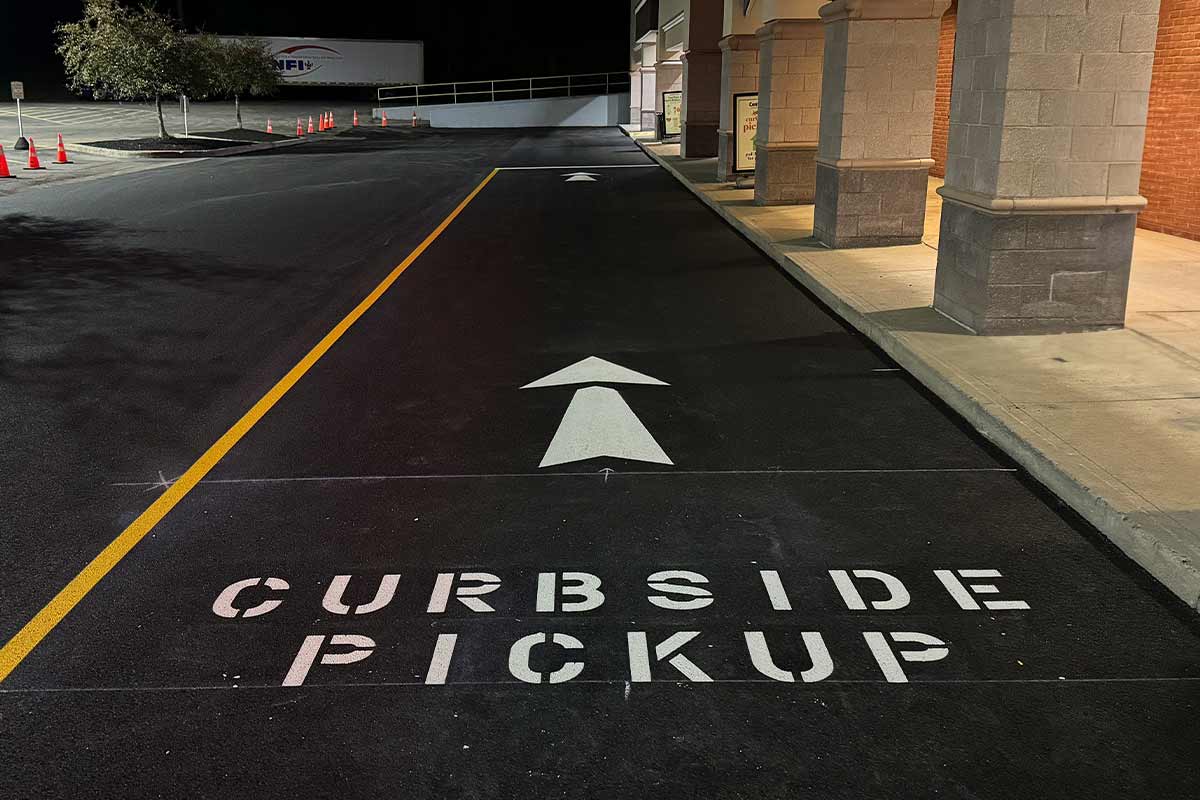
- Layout marking. We chalk guide lines on the pavement, verify dimensions against the plan, and apply the final paint scope — stalls, aisles, arrows, crosswalks, ADA markings, and fire lanes — in a single mobilization.
Why Choose Us
Existing Columbus lots often lose 10 to 20 percent of their potential capacity to oversized drive aisles, dead corner space, or sub-optimal stall angles carried over from decades-old layouts. 1-800-STRIPER® of Columbus redesigns existing lots as often as we stripe newly paved ones. That means measuring, modeling alternatives on scaled plans, confirming ADA and fire code clearances against the new geometry, blacking out superseded lines, and applying the optimized layout in the same dry-weather window. Late spring through early fall is our scheduling target because Central Ohio’s freeze-thaw season stresses fresh paint bonds. Laying out and painting during May, June, September, or early October gives new geometry the best possible first winter. Property owners in Columbus, Franklin County, and the Newark, Grove City, and Lancaster service corridors get a single-contractor path from measurement to paint, with no handoff between a design consultant and a paint crew.
Columbus Zoning and Parking Ratio Considerations
Parking ratio minimums, drive-aisle widths, and landscape-island requirements vary across Columbus zoning districts. Commercial (C-1, C-2, C-3, C-4, C-5), manufacturing (M, M-1, M-2), institutional, and mixed-use districts each apply different off-street parking provisions under Columbus City Code Chapter 3312. Suburban Franklin County jurisdictions, including Grove City, Dublin, Westerville, and Worthington, apply their own local overlays. The federal accessibility constraint layer comes from the U.S. Access Board, which authors Chapter 5 of the 2010 ADA Standards: the governing text on accessible parking space counts, dimensions, access-aisle placement, and the accessible route back to the building entrance. Treating these variances as a constraint layer up front, instead of discovering them mid-project, avoids rework and protects the stall count calculation. 1-800-STRIPER® of Columbus confirms current district requirements with the Columbus Department of Building and Zoning Services or the applicable municipal planning office before finalizing any new layout. We also flag any variance, special-exception, or conditional-use scenario that a property owner may want to pursue to unlock additional capacity on a tightly constrained site.
For a full list of our pavement marking services, visit our parking lot striping in Columbus page.
Businesses We Serve




How it Works

GET A FREE ESTIMATE
Contact us today and we’ll have a quote to you in 24 hours

SCHEDULE AN INSTALLATION
We’ll have your installation scheduled in less than 7 days, without affecting your business hours

GET A PARKING LOT THAT POPS
For a budget-friendly price, you’ll get a parking lot that looks like new
We proudly work with:


We proudly work with:


Frequently Asked Questions About Parking Lot Layout Design in Columbus, OH
What does parking lot layout design involve?
Parking lot layout design in Columbus, Ohio is the process of planning, measuring, and marking where every stall, drive aisle, accessible space, fire lane, crosswalk, and directional arrow will go before any paint is applied. It accounts for total square footage, the target number of spaces, drive aisle widths for two-way and fire apparatus traffic, ADA-accessible space counts and placement per the 2010 ADA Standards, and any Columbus zoning or site plan review requirements specific to your property’s use and district.
How many parking spaces can fit on a given lot area in Columbus?
Stall count depends on stall angle, drive aisle geometry, and ADA accessibility requirements. A 90-degree perpendicular layout is typically the most space-efficient. A professional layout designer will measure your Columbus property’s actual paved area, subtract fire apparatus aisles, ADA van-accessible zones, and required setbacks, then calculate the maximum compliant stall count. Standard stalls are typically 9 feet wide by 18 feet deep in Central Ohio commercial lots, with compact-car zones sometimes used to add capacity on tight sites.
What ADA requirements apply to new parking lot layouts in Ohio?
Under the 2010 ADA Standards for Accessible Design, the number of required accessible spaces scales with total lot size — one accessible stall for lots of up to 25 total spaces, with more required for larger lots. At least one of every six accessible spaces must be van-accessible. In Ohio, accessible spaces must be on the shortest accessible route to the building entrance, properly striped with blue access-aisle diagonals, stenciled with the International Symbol of Accessibility, and paired with compliant R7-8 signage.
Does Columbus, OH have site-specific parking lot design requirements?
Yes. The City of Columbus Department of Building and Zoning Services reviews parking layout as part of site plan approval under Columbus City Code Chapter 3312, which governs off-street parking dimensions, landscaping, and access. The Columbus Preliminary Site Plan Checklist also flags fire apparatus access and circulation. Minimum parking ratios, landscape islands, and drive-aisle widths vary by zoning district, so property owners in Columbus should confirm current requirements with Building and Zoning Services before finalizing any new layout.
Can an existing Columbus parking lot be redesigned to add more spaces?
Yes. If the current layout uses oversized drive aisles, substandard stall angles, or under-used corner space, a professional layout redesign for a Columbus, Ohio property can often increase capacity by 10 to 20 percent without expanding the paved area. The process involves measuring the existing lot, modeling alternative configurations on scaled plans, confirming the new arrangement still meets ADA and fire code clearances, then blacking out old lines and applying the optimized layout.
How long does a new parking lot layout design and striping take?
A new layout requires more time than restriping because stall measurements, chalk lines, and geometry are all established from scratch rather than tracing existing paint. A typical Columbus commercial lot often needs a full day for measurement and layout marking, followed by a separate day for paint application. Scheduling during stable, dry Central Ohio weather — late spring through early fall — ensures optimal paint adhesion and curing before freeze-thaw season stress begins.