Wheel Stop Installation
In Corpus Christi, TX
Concrete and Rubber Parking Stops
1-800-STRIPER provides professional wheel stop installation in Corpus Christi, TX — anchoring concrete and rubber wheel stops, also called parking blocks, at stall heads so parked vehicles cannot overhang accessible routes, as Advisory 502.7 of the 2010 ADA Standards recommends.
1-800-STRIPER® of Corpus Christi PROVIDes Wheel Stops Services NEAR YOU
Need to protect vehicles or walls from accidental damage?
Wheel stops (also called parking blocks) protect your property, enhance safety, and improve parking lot organization.
Benefits:
Wheel stops prevent vehicles from parking too far into a space or overextending into other spots, pedestrian walkways, and other areas, while also helping with vehicle alignment. They can prevent damage to buildings, curbs, or landscaping. Wheel stops also serve as clear visual cues for proper parking and are sometimes used on slopes to prevent cars from rolling.
What a wheel stop is for
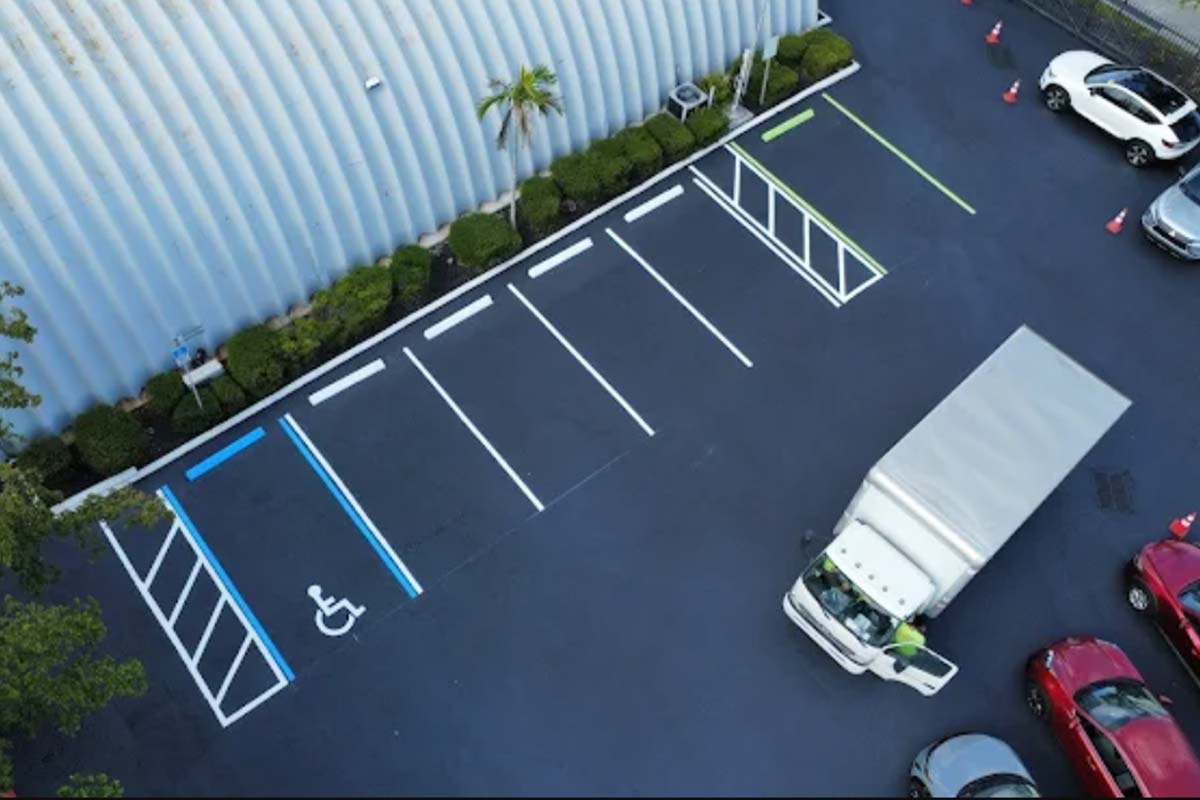
A wheel stop, also called a parking block, a parking stop, or a parking bumper, is a low barrier anchored at the head of a stall to stop a vehicle before it travels too far forward.
The most important reason to install one is written into the federal accessibility standard. Section 502.7 of the 2010 ADA Standards for Accessible Design requires that parking spaces and access aisles be designed so that cars and vans, when parked, cannot obstruct the required clear width of adjacent accessible routes. Advisory 502.7 then names the remedy directly: wheel stops are an effective way to prevent vehicle overhangs from reducing the clear width of accessible routes.
That is the standard naming this product by name, and it is worth understanding why. A sedan overhangs the line it parks against by a couple of feet. Park one nose-in against a four-foot sidewalk and the walkway that remains is no longer wide enough for a wheelchair. Nothing about the stall looks wrong from a distance. The route is blocked anyway.
Beyond accessibility, wheel stops protect storefront glass, curbs, light poles, landscaping, and fencing from slow-speed contact, and they give drivers a consistent physical cue for where the stall ends. Read the U.S. Access Board text for the full section and advisory.
Where Corpus Christi’s code puts a barrier
The city has its own requirement, and it is broader than most owners realize.
Section 7.2.5.C of the Corpus Christi Unified Development Code requires that each required parking space and parking area be designed to physically prevent any portion of a vehicle from encroaching into or overhanging any public or private property line, by means of a permanently installed curb, wall, or other such physical barrier.
Read that carefully. The code does not name a wheel stop, and we are not going to tell you it does. What it does is create a duty, and then describe a category of things that satisfy it. A wheel stop is one of the barriers in that category, and on an existing lot it is very often the least disruptive one, because installing it does not mean pouring curb or building wall.
So there are two separate duties pointing at the same fixture from different directions.
| Provision | What it protects | What it requires |
|---|---|---|
| 2010 ADA Standards Section 502.7, with Advisory 502.7 | The clear width of an adjacent accessible route | Spaces and aisles designed so parked cars and vans cannot obstruct that width; the advisory names wheel stops as an effective way to achieve it |
| Corpus Christi Unified Development Code Section 7.2.5.C | Any public or private property line | A permanently installed curb, wall, or other such physical barrier preventing any portion of a vehicle from encroaching or overhanging |
The federal standard is concerned with vehicles overhanging an accessible route. The city code is concerned with vehicles overhanging a property line. A stall that sits at the boundary of your site next to a walkway is subject to both.
The same subsection also prohibits dead-end aisles for angle parking unless an adequate turnaround is provided, which is worth checking at the same time.
For a full list of our pavement marking services, visit our parking lot striping in Corpus Christi page.
Businesses We Serve




How it Works

GET A FREE ESTIMATE
Contact us today and we’ll have a quote to you in 24 hours

SCHEDULE AN INSTALLATION
We’ll have your installation scheduled restriped in less than 7 days, without affecting your business hours

GET A PARKING LOT THAT POPS
For a budget-friendly price, you’ll get a parking lot that looks like new
We proudly work with:


We proudly work with:


Frequently Asked Questions About Wheel Stop Installation in Corpus Christi, TX
What does a wheel stop do?
Wheel stop installation stops a vehicle before it travels far enough forward to cause a problem. The clearest statement of why comes from the federal standard itself. Advisory 502.7 of the 2010 ADA Standards for Accessible Design says that wheel stops are an effective way to prevent vehicle overhangs from reducing the clear width of accessible routes. Section 502.7 sets the underlying requirement: parked cars and vans must not obstruct the clear width of an adjacent accessible route.
Are wheel stops required by code in Corpus Christi?
Not by name, and we would rather be precise than sell you something on a false premise. No code we found names wheel stops as mandatory. Two provisions create a duty they satisfy. Section 7.2.5.C of the Corpus Christi Unified Development Code requires parking areas to physically prevent any portion of a vehicle from encroaching or overhanging a property line by means of a permanently installed curb, wall, or other such physical barrier. Section 502.7 of the ADA standards covers the accessible route.
Are wheel stops the same as parking blocks or parking bumpers?
Yes. Wheel stop, parking block, parking stop, parking bumper, and parking curb all describe the same fixture: a low barrier anchored at the head of a stall. The terminology varies by region and by supplier, which is why searching for one term can miss the other. If you have been quoted for parking blocks and are reading about wheel stops, you are in the right place.
Concrete or rubber, which should I choose?
They behave differently rather than one being better. Concrete is heavy and rigid, sits firmly once set, and is the traditional choice. Recycled rubber is lighter, does not spall or chip at the edges the way concrete can, is easier to handle and reposition, and is often supplied with molded reflective inserts. Weight is the real trade-off: heavier resists displacement, lighter is easier to relocate if your layout changes.
How are wheel stops anchored?
On asphalt the usual method is steel spikes or rebar pins driven through pre-formed holes in the stop and into the surface below. On concrete it is anchor bolts set into drilled holes. Either way the fixing runs through the body of the stop rather than relying on its weight. Anchoring is the part that decides whether a stop is still in position in three years.
Where should wheel stops go?
Wheel stop installation goes at the head of the stall, positioned so the vehicle stops before its overhang causes a problem. The priority locations are stalls that face a sidewalk or accessible route, stalls at a property line, and stalls facing a storefront, glazing, light pole, or landscaped area. Accessible spaces and their access aisles are usually first on the list, because that is where an overhang has the most consequence.