Warehouse Line Painting
In Corpus Christi, TX
OSHA-Compliant Safety Markings
1-800-STRIPER provides professional warehouse line painting in Corpus Christi, TX — marking permanent aisles, pedestrian walkways, equipment zones, and dock lanes per OSHA 29 CFR 1910.176(a) for distribution centers and industrial facilities across the Coastal Bend.
1-800-STRIPER® of Corpus Christi PROVIDes Warehouse Floor Markings Services NEAR YOU
Want your indoor space to operate more efficiently?
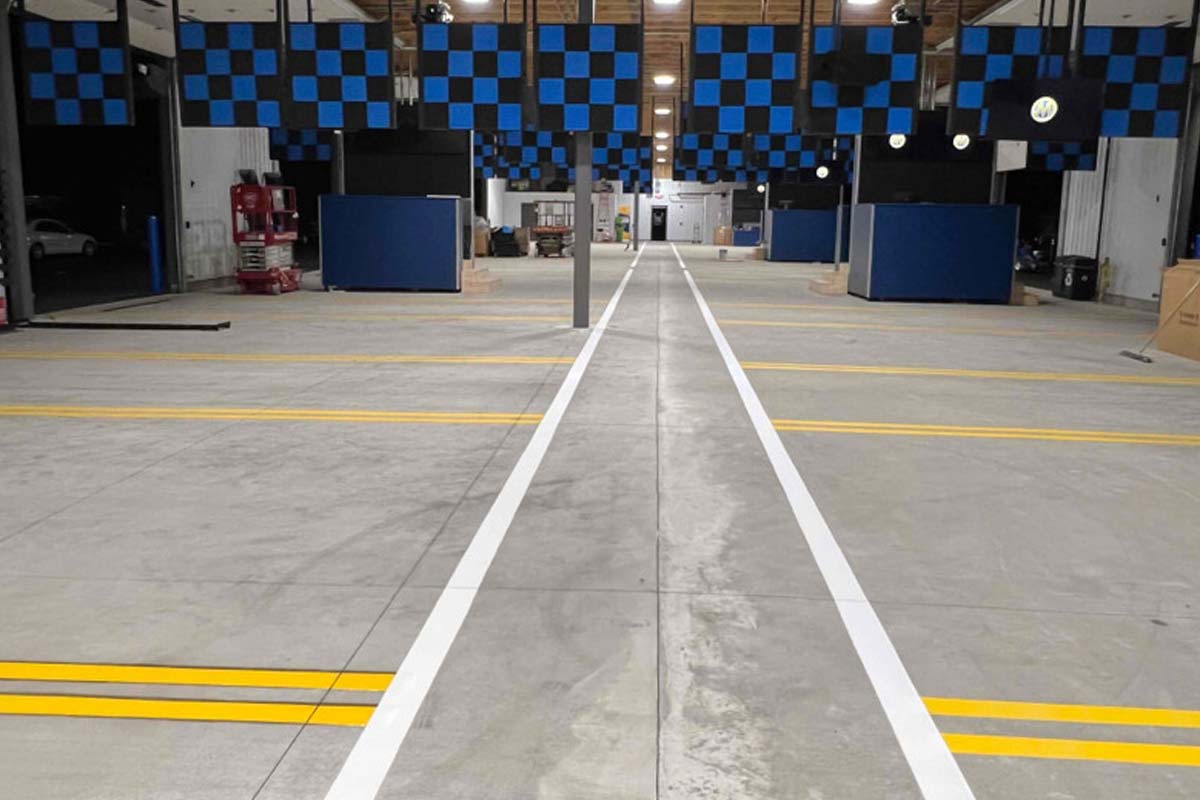
Warehouse and interior markings ensure clear traffic lanes, organized storage zones, and designated spaces designed to help your business operate safely and efficiently.
Benefits:
What OSHA actually requires you to mark
The aisle marking duty is in 29 CFR 1910.176, subsection (a), and it is one sentence: permanent aisles and passageways shall be appropriately marked.
It is worth being precise about this, because the citation you will see quoted on most warehouse striping pages is 29 CFR 1910.22, and that provision contains no reference to aisles at all. Its subsections cover surface conditions, loads, access and egress, and inspection. The confusion traces to an OSHA rewrite that deleted an older subsection, leaving a widely circulated interpretation letter pointing at a section number that no longer says what people think it says.
What the regulation does not do is give you numbers. There is no required line color, no required line width, and no required aisle width anywhere in 1910.176. It asks for sufficient safe clearances instead, which turns on the equipment actually operating in your building. A narrow-aisle reach truck and a sit-down counterbalance forklift do not need the same room.
On a working floor the scope breaks into six kinds of marking:
Aisles and passageways. The permanent circulation routes, which are the ones 1910.176(a) names.
Pedestrian walkways and crossings. Where people on foot travel and where they cross equipment routes.
Equipment and battery charging zones. Forklift parking and the charging bays that serve it.
Dock approaches, staging, and stretch-wrap areas. The inbound and outbound working floor.
Rack and equipment footprints. The positions racking and fixed equipment occupy.
Keep-clear zones. Electrical panels, fire extinguishers, and eyewash stations.
Because the federal rule sets no dimensions, the specification that actually governs your floor is usually one you already hold. Customer audit programs, insurer requirements, and internal EHS standards are all routinely more prescriptive than 1910.176, and a facility running to a retailer or third-party logistics standard often has line colors and widths written into the contract. Bring us that document and we will mark to it. Where no such standard exists we default to conventional practice and tell you plainly that it is convention rather than regulation.
For a full list of our pavement marking services, visit our parking lot striping in Corpus Christi page.
Businesses We Serve




How it Works

GET A FREE ESTIMATE
Contact us today and we’ll have a quote to you in 24 hours

SCHEDULE A STRIPING
We’ll have your space restriped in less than 7 days, without affecting your business hours

GET A PARKING LOT THAT POPS
For a budget-friendly price, you’ll get a parking lot that looks like new
We proudly work with:


We proudly work with:


Frequently Asked Questions About Warehouse Line Painting in Corpus Christi, TX
Does OSHA require aisle marking?
Yes, and it is the reason warehouse line painting exists as a service. 29 CFR 1910.176 subsection (a) states that permanent aisles and passageways shall be appropriately marked. Note the word permanent. The duty attaches to aisles you have established as fixed circulation, not to every temporary gap between pallets. This is the provision to cite, not 1910.22, which does not mention aisles.
What color must aisle lines be?
No regulation sets one. 29 CFR 1910.144 assigns red to fire protection equipment, danger, and stop, and yellow to caution and physical hazards such as striking against, stumbling, falling, tripping, and caught-in-between. Neither that provision nor 1910.176 specifies a color for aisle lines. Yellow is a strong and sensible convention, and we use it by default, but calling it an OSHA requirement is not accurate.
How wide must aisle lines be?
The regulation gives no width. 1910.176 requires that aisles and passageways be kept clear with sufficient safe clearances and appropriately marked, and stops there. Two to four inches is common practice and reads well from a forklift seat. If your facility operates under a customer audit standard or an internal EHS specification, that document will usually be more prescriptive than the federal rule.
How wide must the aisle itself be?
Also unspecified. The standard asks for sufficient safe clearances where mechanical handling equipment is used, which makes the answer a function of your equipment, your load sizes, and your turning requirements rather than a number we can look up. Measure the widest load your busiest truck carries, then design clearance around that.
What gets marked in a distribution center?
A typical warehouse line painting scope in Corpus Christi covers permanent aisles and passageways, pedestrian walkways and crossings, forklift and battery charging zones, dock door approaches and staging lanes, rack and equipment footprints, and keep-clear zones in front of electrical panels, fire extinguishers, and eyewash stations. We walk the floor with your operations lead first, because the person who works the shift knows where the near misses happen.
Can you stripe while the warehouse is running?
Usually yes, by working the floor in sections and around your shift pattern. Night and weekend work is common for exactly this reason. The practical limits are cure time before traffic returns to a marked section, and having enough clear floor to work safely. Tell us your shift schedule and your peak inbound and outbound windows, and we will phase around them.