Warehouse Line Painting
In Nashville, TN
OSHA-Compliant Safety Markings
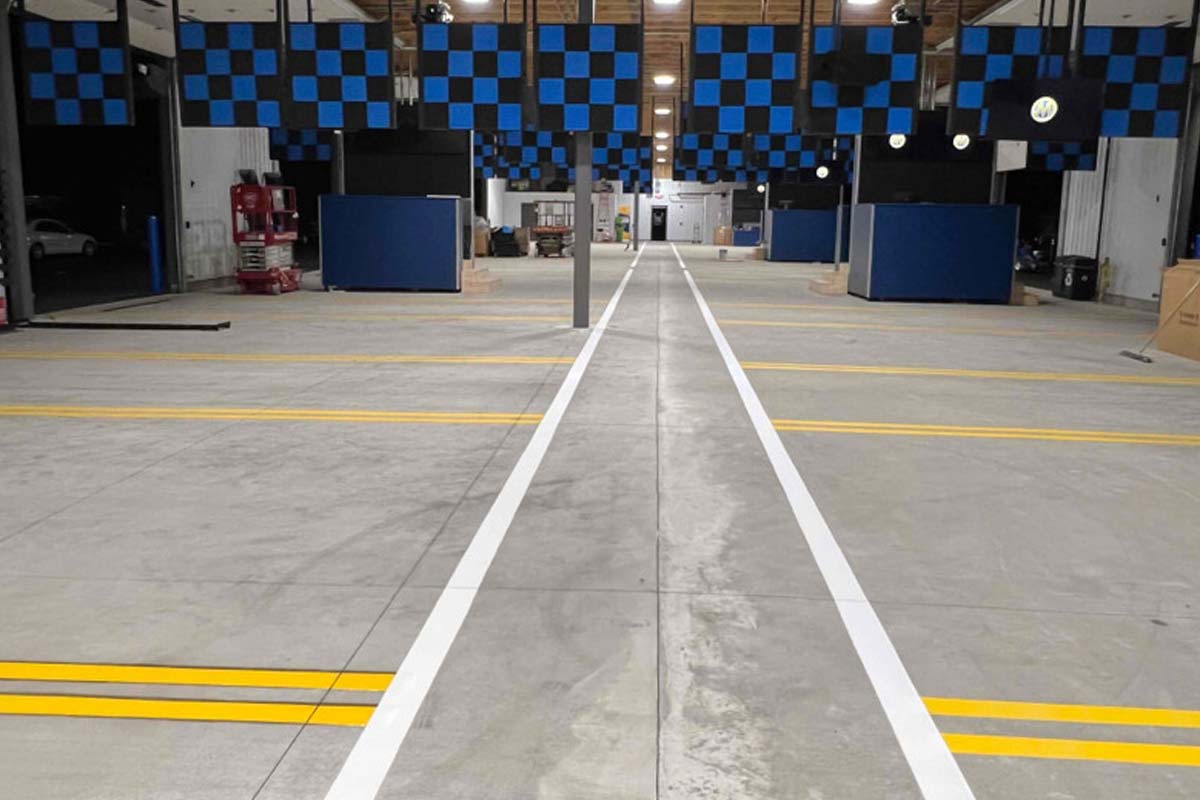
1-800-STRIPER provides professional warehouse line painting in Nashville, TN — OSHA-compliant aisle lines, pedestrian walkways, and safety zone markings per OSHA 1910.22 requirements using durable epoxy and traffic paint for distribution facilities along the I-24, I-40, and I-65 corridors.
1-800-STRIPER® of Nashville PROVIDes Warehouse Floor Markings Services NEAR YOU
Want your indoor space to operate more efficiently?
Warehouse and interior markings ensure clear traffic lanes, organized storage zones, and designated spaces designed to help your business operate safely and efficiently.
Benefits:
OSHA 1910.22 and the ANSI Z535.1 Color Standard
OSHA 1910.22 requires walking-working surfaces to be clean, orderly, and clear of slip / trip hazards, and requires permanent aisles and passageways to be appropriately marked. The federal regulation does not specify color, but the prevailing industrial standard is ANSI Z535.1 for safety colors. Most Middle Tennessee distribution facilities adopt a hybrid OSHA + ANSI Z535.1 marking plan that keeps the warehouse compliant with the federal walking-working-surface rule and consistent with the safety-color expectations of EHS auditors and visiting customers.
The reference table below is the full ANSI Z535.1 color-to-meaning mapping that we apply on Nashville-area warehouse floor projects:
| Color | ANSI Z535.1 meaning | Common warehouse use |
|---|---|---|
| Yellow | Caution / physical hazards | Aisle borders, pedestrian walkways, dock-door edges |
| Red | Fire / emergency / stop | Fire equipment, emergency stops, prohibited areas |
| Blue | Information | Inspection stations, gauges, meters |
| Green | Safety equipment / first aid | Eyewash, first-aid stations, emergency exits |
| Orange | Warning of dangerous parts | Moving machinery, exposed parts |
| Black-and-yellow striped | High attention | Forklift turning radii, pinch points |
| White | Housekeeping | Trash receptacles, scrap bins |
The color system is read at a glance — drivers and pedestrians orient to the color long before reading any signage. That’s why ANSI Z535.1 has held as the de facto warehouse marking standard for decades despite OSHA’s color silence.
Layout Plan: Aisles, Pedestrian Walkways, Storage Zones, Safety Equipment
Warehouse marking work always starts with a layout plan. Nashville-area distribution facilities typically include the following marking categories on a typical project:
– Forklift aisles — yellow border stripes along both sides; minimum 4-inch stripe width for visibility from a forklift cab. – Pedestrian walkways — yellow border stripes plus optional crosswalk-style hatching at intersections with forklift aisles. – Pedestrian-only safe zones — yellow border with optional green fill or hatching for walking-only space adjacent to dock doors and break rooms. – Storage zone footprints — white or yellow stripes outlining where pallets, racking, or staged inventory belongs. Helps the warehouse maintain a clean putaway and pull pattern. – Forklift turning radii — black-and-yellow striped border or hatching marking the swept volume of a forklift turning at speed. – Battery-charging stations and propane storage areas — orange or red border depending on the hazard class. – First aid, eyewash, and emergency exits — green floor markings linking the path from work zones to the safety equipment. – Fire equipment positions — red border around extinguishers, hose connections, and pull stations. – Dock-door edges — yellow border continuing from the forklift aisle to the dock-door threshold. – Inspection stations — blue border or floor footprint where periodic inspections occur.
We work from the property’s existing safety plan or, on a brand-new layout, from the warehouse drawing the operations manager provides. Most projects also benefit from a walk-through with the EHS lead before painting starts, so the marking plan reflects how the facility runs day to day.
Paint Selection: Traffic Paint vs Two-Part Epoxy vs Thermoplastic
Three different formulations work for warehouse floors, with different cycle costs and use-case scenarios:
– Standard waterborne traffic paint — same Sherwin-Williams Fast-Dry Traffic Paint we use outdoors. Lasts 12–24 months in a high-forklift-traffic facility. Easiest to refresh because it cures in 30–60 minutes and the facility can resume operations within hours of application. Best for aisle markings that may need to change as warehouse layout evolves. – Two-part epoxy coating — heavy-duty industrial epoxy applied to a properly prepped concrete floor. Lasts 5–7 years. Excellent abrasion resistance; the right pick for permanent perimeter aisles and high-wear pedestrian walkways. Cure window is 16–24 hours, so the area being painted needs to be down for a shift. We typically work overnights or weekends to fit the cure window into the operations schedule. – Indoor thermoplastic — applied at roughly 400°F per AASHTO M249. Lasts 7–10 years. The longest-life choice and best for fixed-layout dock zones and major aisles. Application equipment is specialized; we coordinate timing carefully with operations.
Most Middle Tennessee distribution facilities use a hybrid plan: epoxy or indoor thermoplastic for permanent perimeter aisles, traffic paint for movable pick-zone callouts, and a refresh cycle that touches up the traffic paint every 18–24 months while the epoxy holds for 5–7 years.
Working in an Active Distribution Facility
Active 24/7 warehouses along the I-24 (Murfreesboro / La Vergne / Smyrna), I-40 (Hermitage / Mount Juliet / Lebanon), and I-65 (Goodlettsville / Brentwood / Spring Hill) corridors cannot shut down for line painting. We work in self-contained zones with cones and barriers, complete a section, and move on. The sequence:
- Coordinate with operations and EHS — confirm the zone schedule, the cure window, the PPE requirements for our crew, and the traffic plan that keeps forklifts and pedestrians out of the cure area.
- Section work into 6-hour blocks — typical for 24/7 facilities. We complete one zone within a single 6-hour block to leave the cure window and walk-off check inside the same shift.
- Use fast-cure paint where speed matters — waterborne fast-dry traffic paint cures in 30–60 minutes; epoxy needs 16–24 hours and is sequenced over weekends or planned downtime.
- Document the marked plan — at the end of the project we provide a final marking plan that becomes the property’s reference for the next refresh cycle and for new-employee orientation.
For larger Middle Tennessee distribution centers, the project is usually phased over 4 to 8 weekends to keep operations running. We coordinate with the property’s distribution leadership team — some of the largest fulfillment, beverage, retail, and 3PL facilities in the southeastern United States sit along the Nashville-metro interstate corridors, and operational uptime is the controlling constraint on every project.
We carry general liability insurance and workers’ compensation coverage, and can provide a current certificate of insurance to property managers, EHS leads, and general contractors before mobilization. Our crews carry the standard PPE (steel-toe boots, hi-viz vests, hard hats where required, hearing protection in active distribution zones) and follow facility-specific safety protocols. Call (615) 949-6700 for a warehouse line-painting estimate anywhere in Middle Tennessee.
For a full list of our pavement marking services, visit our parking lot striping in Nashville page.
Businesses We Serve




How it Works

GET A FREE ESTIMATE
Contact us today and we’ll have a quote to you in 24 hours

SCHEDULE A STRIPING
We’ll have your space restriped in less than 7 days, without affecting your business hours

GET A PARKING LOT THAT POPS
For a budget-friendly price, you’ll get a parking lot that looks like new
We proudly work with:


We proudly work with:
Frequently Asked Questions About Warehouse Line Painting in Nashville, TN
What does OSHA require for warehouse floor markings?
OSHA 1910.22 requires walking-working surfaces to be clean, orderly, and clear of slip / trip hazards. Permanent aisles and passageways must be appropriately marked. ANSI Z535.1 sets the safety color standard adopted across most warehouses: yellow for caution and physical hazards, red for fire / emergency / stop, blue for information, green for safety equipment locations, black-and-yellow striped tape for high-attention zones. Most Middle Tennessee distribution facilities apply a hybrid OSHA + ANSI marking plan.
What color goes where on a warehouse floor?
Yellow on aisle borders, pedestrian walkways, and around physical hazards like loading dock edges. Red on fire equipment locations, emergency stops, and fire-lane equivalents inside the building. Blue for informational markings such as inspection points or gauges. Green for safety equipment like first-aid stations, eyewash, and emergency exits. Black-and-yellow striped tape for high-attention zones such as forklift turning radii. The color-code table in the body section gives the full ANSI Z535.1 mapping.
Can you stripe an active distribution facility without shutting it down?
Yes. We schedule warehouse line painting during off-shifts, weekends, and seasonal slow periods so production can keep running. Our crews work in self-contained zones with cones and barriers, complete a section, and move on. We coordinate with the operations manager and EHS lead on traffic plans, paint cure windows, and PPE access. For 24/7 facilities along the I-24 corridor, we typically work in 6-hour blocks per zone.
How long does warehouse paint and epoxy last?
Standard floor marking paint lasts 12–24 months in a high-forklift-traffic facility. Two-part epoxy coatings — applied to a properly prepped concrete floor — last 5–7 years. Thermoplastic indoor markings last 7–10 years. The right choice depends on traffic volume, dock-door proximity, and how often the marking layout is expected to change. Most large Middle Tennessee distribution hubs use a hybrid plan: epoxy for permanent perimeter aisles, traffic paint for moveable pick-zone callouts.
Do you serve distribution centers along the I-24 / I-40 / I-65 corridors?
Yes. Middle Tennessee is one of the densest distribution corridors in the southeastern United States, with major fulfillment, beverage, retail, and 3PL facilities along I-24 (Murfreesboro / La Vergne / Smyrna), I-40 (Hermitage / Mount Juliet / Lebanon), and I-65 (Goodlettsville / Brentwood / Spring Hill). We work nights and weekends so painting does not interrupt outbound truck schedules. Larger facilities often phase the project over 4–8 weekends to keep operations running.