ADA Parking Lot Striping
In Nashville, TN
ADA-Compliant Accessible Parking
1-800-STRIPER provides ADA-compliant parking lot striping in Nashville, TN — installing accessible spaces, van-accessible stalls, access aisles, ISA symbols, and required signage per the 2010 ADA Standards for Accessible Design and Tennessee Department of Commerce & Insurance code enforcement.
1-800-STRIPER® of Nashville PROVIDes ADA Compliance Services NEAR YOU
Need to make your property more accessible?
Upgrade your facility to become fully ADA compliant by partnering with us to create clear, accessible parking for all your visitors.
Our ADA Compliant line striping services include:
How Many Accessible Stalls Your Nashville Lot Needs
Your accessible-stall count is set by the 2010 ADA Standards for Accessible Design § 208.2 — a fixed table tied to your total stall count. Tennessee enforces these counts through the Tennessee Department of Commerce & Insurance Codes Enforcement program; there is no parallel state-level table. Property managers in Davidson, Williamson, and Rutherford counties get cited against the federal ADA scale during commercial site-plan review and routine accessibility inspections.
The table below is the full required-count scale. One out of every six accessible spaces must be van-accessible regardless of total lot size.
| Total stalls in lot | Required accessible stalls | Of those, van-accessible (1 in 6) |
|---|---|---|
| 1–25 | 1 | 1 |
| 26–50 | 2 | 1 |
| 51–75 | 3 | 1 |
| 76–100 | 4 | 1 |
| 101–150 | 5 | 1 |
| 151–200 | 6 | 1 |
| 201–300 | 7 | 2 |
| 301–400 | 8 | 2 |
| 401–500 | 9 | 2 |
| 501–1,000 | 2% of total | 1 per 6 of those |
| 1,001+ | 20 + 1 per 100 over 1,000 | 1 per 6 of those |
For a 200-stall Nashville office lot, you owe 6 accessible spaces with at least 1 van-accessible. For a 1,200-stall warehouse near the I-24 corridor, you owe 22 accessible with at least 4 van-accessible.
Stall, Access Aisle, and Van-Accessible Width Specs
The 2010 ADA Standards § 502 set the dimensions:
– Standard accessible parking space: at least 96 inches wide. The adjacent access aisle must be at least 60 inches wide. – Van-accessible parking space, option A: parking space at least 96 inches wide with an access aisle at least 96 inches wide. Total clear width 192 inches (16 feet). – Van-accessible parking space, option B: parking space at least 132 inches wide with an access aisle at least 60 inches wide. – Vertical clearance: at least 98 inches at the parking space, the access aisle, and along the route from the lot to an accessible building entrance.
Two adjacent accessible stalls can share a single 60-inch access aisle. Access aisles must be marked to discourage parking and connect to an accessible route to the building entrance — that route cannot pass behind parked vehicles.
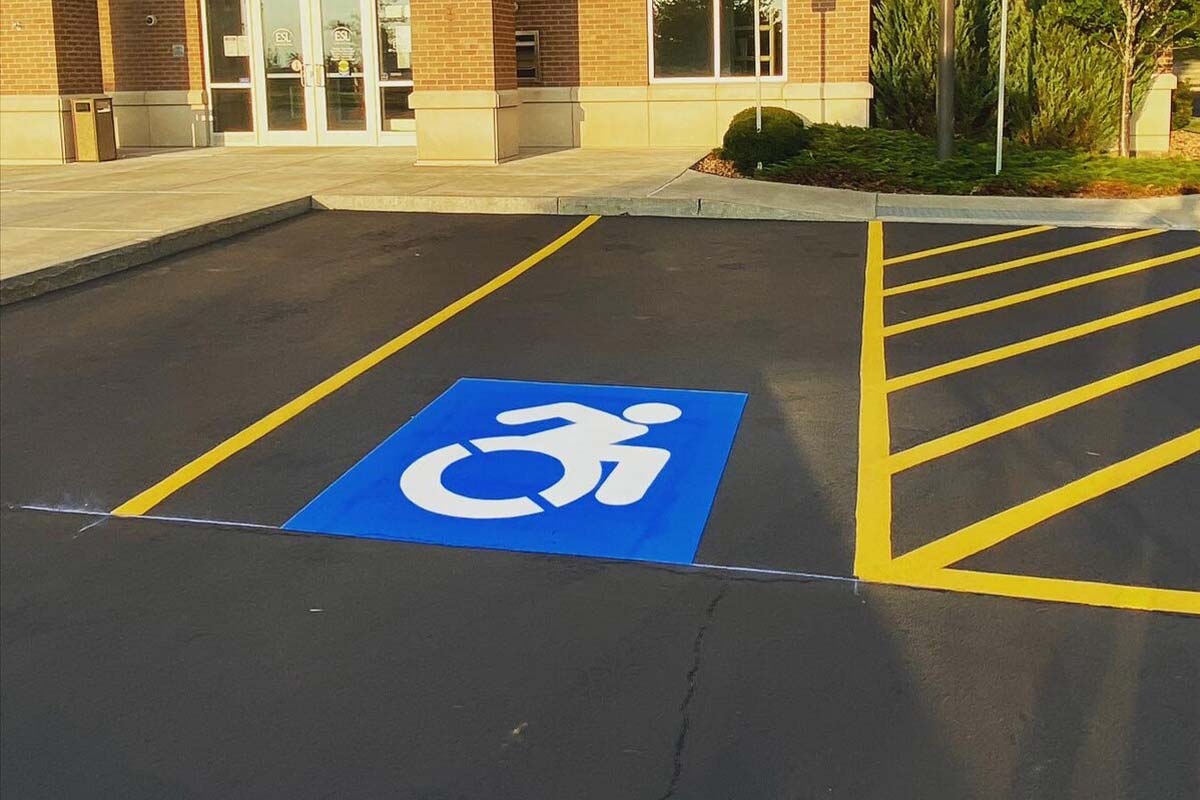
We mark the access aisle with diagonal hatching in the same blue used for the stall background, and we line the boundary in white. Parking lots in the older cores of Nashville, Franklin, and Murfreesboro often need stall reconfiguration to fit modern access aisle widths during a restripe — many predate the 2010 update.
Paint Specs: ISA Symbol, Stall Background, Boundary Lines
We use Sherwin-Williams Fast-Dry Traffic Paint for all ADA marking work in Nashville. The mil thickness, color match, and reflectivity meet the standard the 2010 ADA Standards for Accessible Design reference for stall marking.
– Stall background and access aisle: blue. Federal Standard 595B color 15090 is the recognized match. – International Symbol of Accessibility (ISA): white, painted on the blue stall background. Typical symbol size on a parking surface is 36 inches tall. The figure is positioned to be read from the lot entrance and reapplied each restripe cycle. – Boundary lines: white, 4-inch stripe width. – Required signage: ISA-marked sign (R7-8) mounted at the head of each accessible stall; “Van Accessible” plate (R7-8a) added at van-accessible spaces. Sign installation is coordinated with the property manager and is outside the painted-marking scope.
Tennessee Code Enforcement and Compliance Risk
Tennessee adopts the 2010 ADA Standards through the Tennessee Department of Commerce & Insurance — Codes Enforcement program. Local code officials in Nashville Metro, Williamson County, and Rutherford County conduct accessibility checks during commercial site-plan review and during periodic inspections triggered by complaints.
The most common compliance findings on Middle Tennessee lots: – Faded ISA symbol — visually unreadable from the lot entrance. Most common citation across all Nashville-area inspections. – Access aisle too narrow — common on lots restriped before 2010 Standards adoption. – Missing van-accessible designation — a lot with the right number of accessible stalls can still fail if none are van-accessible. – Access aisle blocked or not marked — diagonal hatching missing or covered by parking. – Accessible route conflict — accessible stall connects to the building only by routing behind parked vehicles, which is not allowed.
Federal Title III also exposes property owners to private accessibility lawsuits independent of state code enforcement. Restriping to compliance during a routine maintenance cycle is far cheaper than litigation or settlement, and the work usually qualifies as a normal commercial property line item rather than a capital expense.
Refresh Cycle and How We Schedule Nashville ADA Work
Most commercial parking lots in Nashville restripe ADA stalls every 18 to 24 months alongside the rest of the lot. ADA stalls fade on the same cycle as ordinary stalls, but inspectors apply a stricter visual standard — a faded but readable ISA symbol on a regular stall is fine, but the same fade level on the ADA stall is a citation.
Our Nashville crews mark ADA stalls and access aisles first during a restripe project, while the paint is at full mil thickness and reflectivity is at peak. We then move to fire lanes, directional arrows, and finally standard stalls. The sequence keeps ADA-related markings at the highest visible quality across the project life.
For property managers running portfolio-wide restripes across Davidson, Williamson, Rutherford, Sumner, and Wilson counties, we batch ADA recompliance into the same visit so a single contractor signs off on the full ADA scope per property. We document each accessible stall on a final marking plan that becomes the property’s reference for the next inspection cycle.
Call (615) 949-6700 for an ADA assessment and free estimate anywhere in Middle Tennessee.
For a full list of our pavement marking services, visit our parking lot striping in Nashville page.
Businesses We Serve




How it Works

GET A FREE ESTIMATE
Contact us today and we’ll have a quote to you in 24 hours

SCHEDULE AN INSTALLATION
We’ll have your installation scheduled in less than 7 days, without affecting your business hours

GET A PARKING LOT THAT POPS
For a budget-friendly price, you’ll get a parking lot that looks like new!
We proudly work with:


We proudly work with:


Frequently Asked Questions About ADA Parking Lot Striping in Nashville, TN
How many accessible parking spaces does my lot need?
The 2010 ADA Standards for Accessible Design § 208.2 set required counts by total stall count. Under 25 stalls = 1 accessible. 26–50 = 2. 51–75 = 3. 76–100 = 4. 101–150 = 5. 151–200 = 6. 201–300 = 7. 301–400 = 8. 401–500 = 9. 501–1,000 = 2% of total. Above 1,000 = 20 plus 1 per 100 over 1,000. One in six accessible spaces must be van-accessible.
How do Tennessee accessibility rules differ from the federal 2010 ADA?
Tennessee enforces the same 2010 ADA Standards through the Tennessee Department of Commerce & Insurance Codes Enforcement program — there is no parallel state-only stall-count table. Local code officials may layer additional inspection requirements during commercial site plan review, but the underlying technical spec is federal ADA. We design to the 2010 ADA and confirm with the local building department before painting.
What happens if my lot is not ADA-compliant?
The most common outcome is a code-enforcement complaint that triggers a corrective work order with a deadline. Federal Title III also exposes property owners to private accessibility lawsuits. The cost of restriping to compliance is almost always lower than litigation or settlement, and the work usually qualifies as a routine maintenance line on a commercial property budget. Specific fine amounts vary by jurisdiction and are not a useful planning number.
How wide does a van-accessible space need to be?
The 2010 ADA Standards specify the parking space at least 96 inches wide with an access aisle at least 96 inches wide — total 192 inches (16 feet) of clear width — OR the parking space at least 132 inches wide with a 60-inch access aisle. Tennessee Department of Commerce & Insurance Codes Enforcement uses the federal definition. Vertical clearance at the van-accessible space, the access aisle, and along the route to the building entrance must be at least 98 inches.
What paint do you use for ADA stalls and the ISA symbol?
We use Sherwin-Williams Fast-Dry Traffic Paint — blue for the stall background and access aisle hatching, white for the International Symbol of Accessibility (ISA) and the boundary lines. The blue must match Federal Standard 595B color 15090. The ISA symbol is rendered in white at the size and proportions specified by ADA guidance documents — typically 36-inch tall on a parking surface — and is positioned to be visible from the parking entrance.
How often should ADA stalls and the ISA symbol be repainted?
Every 18 to 24 months, on the same cycle as the rest of the lot — but with stricter visibility requirements. A faded ISA symbol or a worn blue stall background is a frequent ADA inspection citation in Middle Tennessee, even when the rest of the lot is acceptable. We mark ADA stalls and the access aisle hatching first during a restripe, while paint thickness is at full mil and reflectivity is at peak.