Thermoplastic Striping
In Nashville, TN
Long-Lasting Pavement Markings
1-800-STRIPER provides professional thermoplastic striping in Nashville, TN — long-service-life pavement markings for stop bars, crosswalks, directional arrows, and fire lanes applied at roughly 400°F per AASHTO M249 specifications and TDOT Section 716 for high-traffic commercial lots across Middle Tennessee.
1-800-STRIPER® of Nashville PROVIDes Thermoplastic Striping Services NEAR YOU
Want to reduce the maintenance requirements for your parking lot?
Thermoplastic pavement markings are a durable, weather and vehicle-resistant striping option for your parking lot or facility.
You can utilize them for stop bars, ADA stalls, no-parking zones, directional arrows, crosswalks, or your entire parking lot.
Benefits:
How Thermoplastic Differs From Traffic Paint
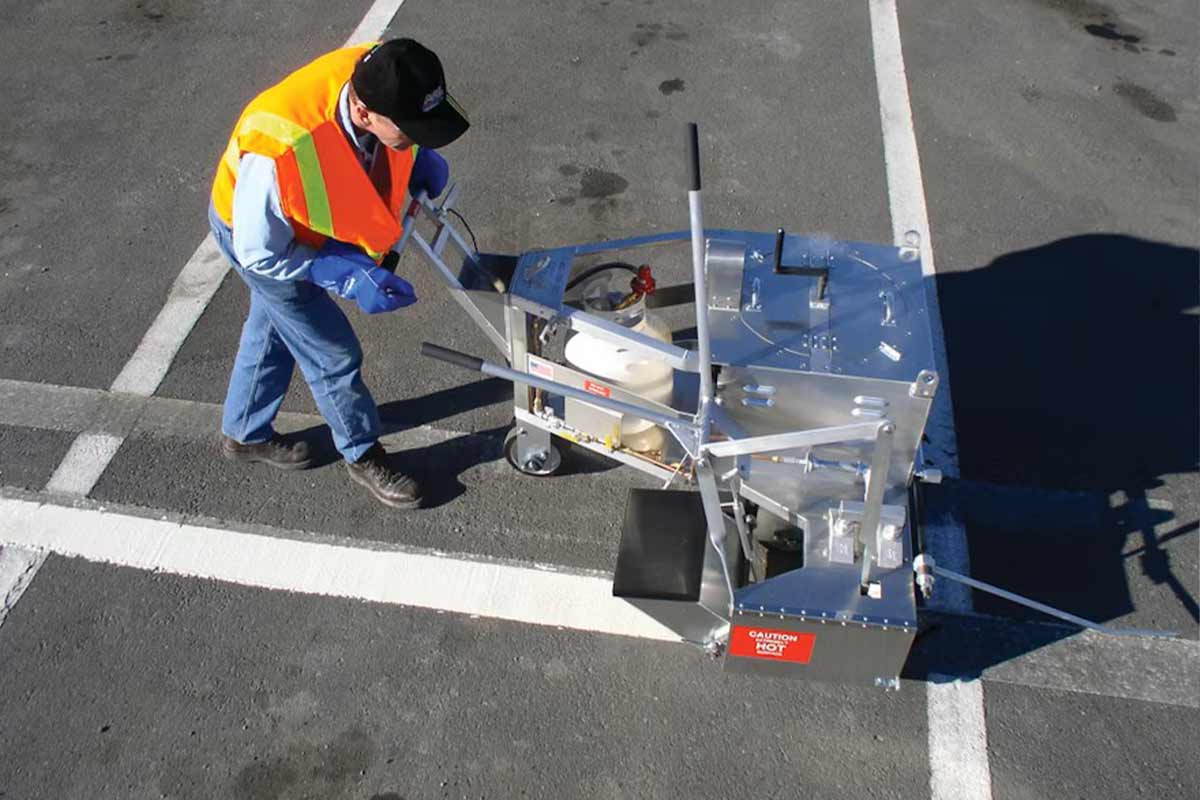
Thermoplastic is a hot-applied pavement marking compound — heated to roughly 400°F per AASHTO M249 specification and applied as a liquid stripe that physically embeds into the asphalt as it cools. The result is a 90 to 125 mil-thick stripe — versus traffic paint at 5–10 mil — with a 6-to-8-year service life rather than the 18-to-24-month cycle of waterborne paint.
The trade-offs are real. Thermoplastic costs more per linear foot up front because the compound is more expensive than paint, the application equipment is specialized (a heated kettle and pre-heat applicator, not a Graco LineLazer), and the surface preparation needs to be cleaner because contamination shows in a 100 mil stripe. The benefit is that the marking absorbs four times the wear of traffic paint over the project life, making it the right call for high-impact pavement markings where repeated tire impact would chew through ordinary paint inside two years.
When Thermoplastic Is the Right Choice
Thermoplastic is the right call for any pavement marking that takes repeated direct tire impact:
– Stop bars at lot exits and intersections. – Crosswalks at retail center entries, school zones, and pedestrian crossings. – Directional arrows in drive aisles and at turn-ins. – Fire lanes at the curb-pavement interface and across-pavement designations. – High-wear roadway markings along entry roads and main drive aisles that handle delivery vehicles and fleet traffic.
For ordinary stall lines and standard parking layouts, traffic paint is usually still the smarter buy because the cycle cost of restriping every 18–24 months is lower than the up-front cost of thermoplastic across the project life — even though thermoplastic lasts 4× as long. The break-even depends on stall density, traffic volume, and the property manager’s preference for fewer mobilizations versus lower one-time spend.
TDOT Section 716 and the Tennessee Spec Benchmark
Tennessee Department of Transportation Standard Specifications Section 716 is the published spec for pavement marking materials adopted statewide for TDOT roadwork. Section 716 references AASHTO M249 for hot-applied thermoplastic and lays out application temperature, mil thickness, glass-bead content, and retroreflectivity requirements.
Commercial properties are not bound by Section 716, but most pavement-marking contractors in Tennessee design to it because it is the published specification benchmark in the state. Property managers running large-scale commercial projects often write Section 716 into the project specification by reference — that gives them a defensible standard if a marking fails early or if the AHJ challenges the work during a code inspection. The same spec also covers the glass beads embedded for retroreflectivity, the coefficient of friction for skid resistance, and the application temperature window.
Application: Surface Prep, Temperature, and Cure
Thermoplastic application is more rigorous than traffic paint:
- Surface prep — pressure-clean and dry the receiving pavement. Any oil, dust, or moisture causes adhesion failure that won’t show up until weeks later when the stripe lifts.
- Surface temperature — at least 50°F per the same threshold as traffic paint, but for a different reason: cold pavement causes molten thermoplastic to flash-cool unevenly, leading to brittle stripes that crack within months.
- Compound temperature — heated to 350–425°F per AASHTO M249 in the melter kettle, then applied at the high end of that range.
- Application thickness — 90 to 125 mil typical for parking-lot use; TDOT roadway work usually specifies 90 to 100 mil.
- Glass beads — embedded into the wet thermoplastic at the spec coverage rate to deliver headlight retroreflectivity.
- Cure — surface-dry within 5–10 minutes; the compound is solid as soon as it cools below its softening point. Vehicles can cross the marking within 30 minutes in most weather.
We don’t apply thermoplastic on wet pavement, on cold pavement below 50°F surface temperature, or during active rain. The compound cost and labor make a re-do significantly more expensive than for traffic paint.
Working With Property Managers Who Want a Mixed-Marking Plan
Most large Nashville-area commercial properties run a mixed-marking plan: traffic paint for ordinary stall lines, thermoplastic for high-wear pavement markings. The cycle costs are predictable across a 6-year amortization:
– Stall lines (traffic paint) — restripe every 18–24 months. – Stop bars, crosswalks, directional arrows, fire lanes (thermoplastic) — refresh every 6 years. – Painted lettering (NO PARKING – FIRE LANE, STOP, ONE WAY) — thermoplastic stencils on the same 6-year cycle.
We coordinate with property managers, REIT owners, and HOA boards across Davidson, Williamson, Rutherford, Sumner, and Wilson counties on multi-year marking plans that batch the thermoplastic work into a single mobilization every 6 years and the traffic paint work into the standard 18-to-24-month restripe cycle. The result is fewer total mobilizations, predictable budget across the cycle, and consistent compliance at the high-impact pavement-marking points.
Call (615) 949-6700 for a thermoplastic striping estimate anywhere in Middle Tennessee.
For a full list of our pavement marking services, visit our parking lot striping in Nashville page.
Businesses We Serve




How it Works

GET A FREE ESTIMATE
Contact us today and we’ll have a quote to you in 24 hours

SCHEDULE AN INSTALLATION
We’ll have your installation scheduled restriped in less than 7 days, without affecting your business hours

GET A PARKING LOT THAT POPS
For a budget-friendly price, you’ll get a parking lot that looks like new
We proudly work with:


We proudly work with:

Frequently Asked Questions About Thermoplastic Striping in Nashville, TN
How is thermoplastic different from traffic paint?
Thermoplastic is applied at roughly 400°F per AASHTO M249 spec and physically embeds into the asphalt as it cools. The result is a 90 to 125 mil-thick stripe (versus traffic paint at 5–10 mil) with a 6–8 year service life — roughly four times what conventional paint gives. The trade-off is that thermoplastic costs more per linear foot up front, requires specialized application equipment, and is best for high-wear pavement markings rather than ordinary stall lines.
When is thermoplastic the right choice?
Thermoplastic is the right call for stop bars, crosswalks, directional arrows, fire lanes, and any marking that takes repeated tire impact. The 6–8 year cycle absorbs the higher up-front cost over the project life, and the embedded glass beads keep retroreflectivity high under both daylight and headlight conditions. For ordinary stall lines and standard parking layouts, traffic paint is usually still the smarter buy.
What is TDOT Section 716?
Tennessee Department of Transportation (TDOT) Standard Specifications for Road and Bridge Construction Section 716 sets the spec for pavement marking materials adopted statewide for TDOT roadwork. Section 716 references AASHTO M249 for hot-applied thermoplastic and lays out application temperature, mil thickness, glass-bead content, and retroreflectivity requirements. Commercial properties are not bound by Section 716 but most contractors design to it because it is the published specification benchmark in Tennessee.
At what temperature does thermoplastic get applied?
Thermoplastic compound is heated to roughly 400°F (350–425°F per AASHTO M249) in a melter kettle and applied as a liquid stripe that solidifies as it cools. Surface temperature on the receiving asphalt must be at least 50°F and dry — the same minimum as traffic paint, but for a different reason. Cold or wet pavement causes the molten thermoplastic to flash-cool unevenly, leading to brittle stripes that crack within a few months.
How often does thermoplastic need to be repainted?
A properly applied thermoplastic marking on quality asphalt holds for 6 to 8 years in Middle Tennessee weather. The wear pattern is different from traffic paint — instead of fading, thermoplastic tends to chip at impact points and lose glass-bead retroreflectivity over time. Most fleet and distribution clients schedule a thermoplastic refresh on a 6-year cycle and a traffic-paint refresh on the standard 18-to-24-month cycle, alternating the work to spread cost across budget years.