Parking Lot Restriping
In Nashville, TN
Restripe Existing Lines and Markings
1-800-STRIPER provides professional parking lot restriping in Nashville, TN — refreshing faded lines, ADA stalls, fire lanes, and directional arrows using Sherwin-Williams Fast-Dry Traffic Paint and Graco LineLazer equipment for commercial properties across Middle Tennessee.
1-800-STRIPER of Nashville PROVIDes Restriping Services NEAR YOU
Need to brighten up your faded parking lot?
Keep your parking lot safe and attractive by restriping annually to freshen up lines and symbols that have faded from the sun, weather, and traffic. Nothing beats a fresh coat of paint!
Benefits:
When a Nashville Lot Is Ready for Restriping
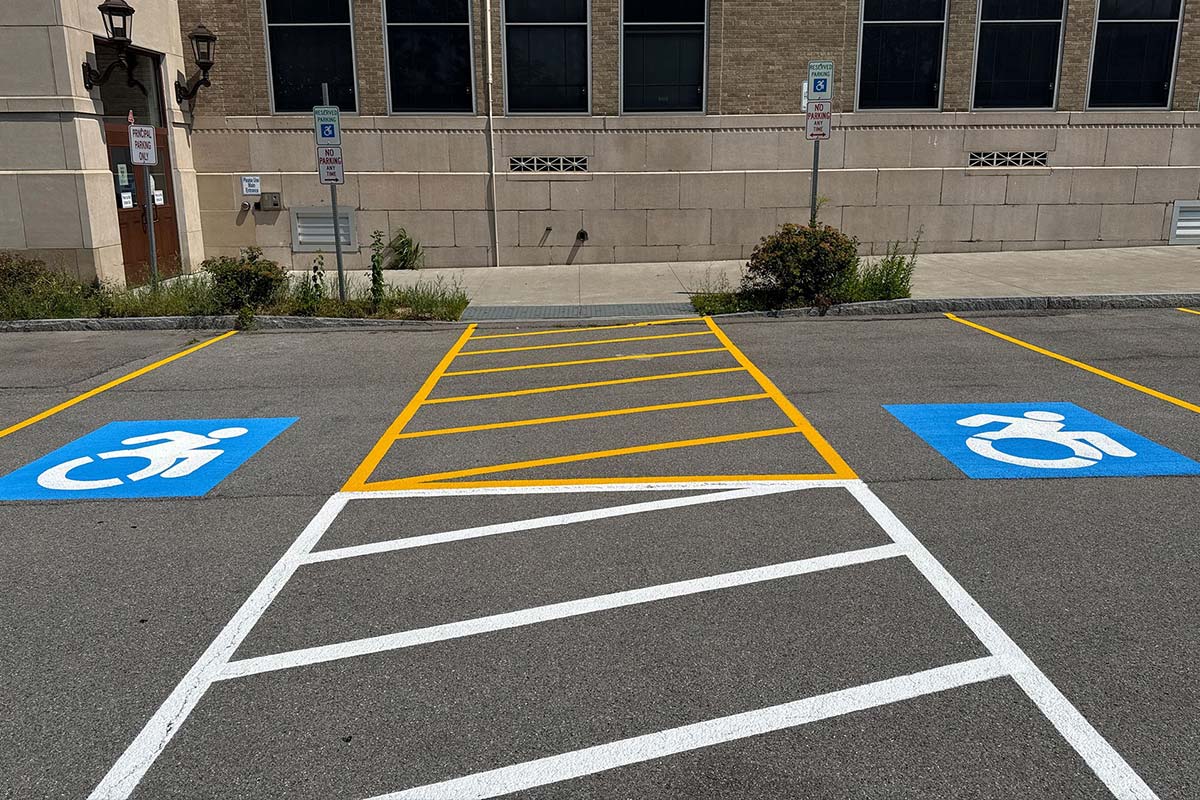
The visual cue is straightforward: when stall lines, ADA symbols, or fire-lane markings start blending into the asphalt at 30 feet of viewing distance, the lot is past due. Most commercial parking lots in Middle Tennessee reach that point on an 18-to-24-month cycle. UV exposure during humid-subtropical summers fades pigment, and Dec–Feb freeze-thaw plus winter salt residue accelerates wear at the high-traffic line crossings.
High-volume properties — the Nashville International Airport perimeter lots, Vanderbilt University commuter lots, downtown event-center parking — often need a 12-month cycle. Lower-volume office and warehouse lots stretch closer to 24 months. Sealcoated lots hold reflectivity longer than weathered asphalt.
The Restriping Process (6-Step Sequence)
Every commercial restripe project we run in Nashville follows the same sequence:
- Assess — walk the lot, document existing stall count, ADA stall count, fire-lane condition, and any directional or special markings. Note pavement defects.
- Coordinate sealcoating and crack fill — schedule any pavement repair before paint goes down (see H2 9 below).
- Sweep / clean — mechanical sweep plus targeted blow-down at the line crossings to remove dust, salt residue, and debris.
- Layout — chalk or string-line layout for stalls (only when stall positions are changing); existing layouts are usually preserved.
- Paint — apply Sherwin-Williams Fast-Dry Traffic Paint with a Graco LineLazer at full mil thickness. ADA stalls and fire lanes mark first, while paint is at peak.
- Cure and walk-off — protect the cure window (30–60 minutes at 70°F) with cones; final walkthrough with the property manager to confirm scope.
Traffic Paint vs Thermoplastic for Restripe Work
Standard parking lot stall lines almost always use traffic paint — it cures fast (30–60 minutes), costs less per linear foot, and lasts the full 18–24 month cycle in Middle Tennessee weather. Thermoplastic (applied at roughly 400°F per AASHTO M249) is the right call for stop bars, crosswalks, directional arrows, and fire lanes that take repeated tire impact and need a 6–8 year service life. Most Nashville commercial restripe projects mix both: traffic paint for the bulk of the lot, thermoplastic for high-impact pavement markings.
Sherwin-Williams Fast-Dry Traffic Paint Spec
The paint we standardize on for traffic paint work meets the TDOT Standard Specifications Section 716 reference for fast-dry waterborne traffic paint and meets the federal MUTCD color and reflectivity requirements. Application thickness is typically 15 wet mil / 5 dry mil for parking lot stalls, with the option to step up to 20 wet mil / 8 dry mil for fire lanes and high-wear pavement markings. Glass beads are added at 6 lb per gallon for nighttime retroreflectivity.
Restripe Season: April Through October
April through October is the active restripe window in Middle Tennessee because surface temperatures stay above the 50°F minimum required by Sherwin-Williams traffic paint cure specifications. Dec–Feb temperature swings make cure unreliable; January application typically results in tracking, lifting, or premature fade.
April–May is peak demand — property managers want crisp lines before peak retail and warehousing season. We use the Dec–Feb window for layout design, takeoffs, ADA assessments, and multi-property scheduling for the spring rebound.
Surface Temperature, Cure Window, and Weather
We monitor pavement surface temperature (not air temperature) before mobilizing. The 50°F minimum applies to the receiving surface for at least 6 hours after application. Pavement holds heat longer than air, which extends the working day in shoulder-season weather but also means a sun-baked asphalt surface in mid-summer can hit 130°F and require a different cure approach. We don’t apply traffic paint on wet pavement — the bond fails immediately and the paint scrubs off within days.
How We Mark ADA Stalls During a Restripe
ADA stalls and access aisle hatching mark first during a restripe project, while paint is at full mil thickness and reflectivity is at peak. Tennessee enforces the 2010 ADA Standards for Accessible Design through the Tennessee Department of Commerce & Insurance — Codes Enforcement program. Faded ISA symbols are the most common ADA citation in Middle Tennessee inspections — a routine restripe that prioritizes the ADA marking visibly improves a property’s compliance posture without changing the lot’s stall count.
Fire Lanes Restripe at the Same Time as the Lot
Fire-lane stripes and curb paint typically restripe at the same time as the lot-wide cycle. Nashville-area jurisdictions enforce the International Fire Code (IFC §503), adopted statewide by the Tennessee State Fire Marshal (Tenn. Comp. R. & Regs. 0780-02-02-.01) and enforced by local fire departments. A faded NO PARKING – FIRE LANE marking is one of the most frequent fire-marshal citations across Davidson and Williamson counties. Bundling fire-lane restripe with the lot restripe keeps both compliance threads on the same cycle and reduces total mobilizations across the year.
Crack Fill and Sealcoating Sequencing
The right sequence is crack fill → sealcoating → cure → restripe. Stripes painted over open cracks or peeling sealcoat lose retroreflectivity within months because the failing substrate telegraphs through the paint. We don’t perform crack fill or sealcoating ourselves — those are upstream services handled by the property’s pavement contractor — but we coordinate the timing so the restripe lands on a properly prepared surface. For property managers managing a lot-wide refresh, the typical order is: assess pavement condition, schedule crack fill 30–60 days ahead of paint, schedule sealcoating to fully cure (24–48 hours), then restripe.
Reflectivity and Mil Thickness Across the Cycle
Manual on Uniform Traffic Control Devices (MUTCD) sets retroreflectivity baselines for road markings; commercial parking lots are not bound by the spec but most Nashville property managers track it as a quality benchmark. Fresh waterborne traffic paint applied at 5 dry mil with 6 lb/gallon glass beads typically reads 200–300 mcd/m²/lx retroreflectivity. The reading degrades along a known curve over 18–24 months; once it drops below ~100 mcd/m²/lx the markings are visually faded and a restripe is justified. We include retroreflectivity in our condition assessment when property managers want it documented.
Common Defects We Find Before Restriping
The five most common pavement-condition issues we flag during a Nashville restripe assessment:
- Cracking that telegraphs through the line crossings — needs crack fill before paint.
- Peeling sealcoat — needs new sealcoating before paint.
- Standing water around catch basins — paint adhesion fails; pavement contractor needs to address grading.
- Stripped pavement texture from prior pressure-washing — paint absorbs unevenly; we adjust mil thickness.
- ADA non-compliance from drift — original layout may have been compliant in 2008 but no longer meets the 2010 ADA Standards.
We document each issue in the assessment so the property has a written record of what’s pending pavement work versus what we corrected during the restripe.
Phasing a Multi-Tenant Lot Restripe
Multi-tenant retail centers, office parks, and warehouse facilities along the I-24, I-40, I-65, and I-440 corridors need restripe work that does not interrupt tenant operations. We typically phase a project across two or three weekend nights so no tenant loses more than a third of capacity at one time. The phasing plan accounts for:
– Tenant peak hours — restaurants restripe during morning hours; retail restripes overnight; warehouses restripe between shift changes. – Cure windows — paint cures in 30–60 minutes; we plan tenant access around the cure schedule. – ADA stall continuity — at least one ADA stall remains accessible at every phase of the project. – Fire access continuity — fire lanes never go entirely out of service; we restripe alternating runs.
Working With Property Managers, REITs, and HOAs
Most of our Nashville restripe work runs through commercial property management firms, REIT-owned retail and office portfolios, and HOA / condo association boards in Brentwood, Franklin, Hendersonville, Murfreesboro, and Mount Juliet. We hold general liability insurance, workers’ compensation coverage, and can provide a current certificate of insurance to property managers and general contractors before mobilization. Multi-property restripe contracts across Davidson, Williamson, Rutherford, Sumner, and Wilson counties are routine — we batch the work into seasonal sweeps and bill against a single master agreement.
How to Schedule a Restripe Assessment
The fastest path is a phone call to (615) 949-6700 or a request for an on-site assessment through our website. We typically deliver an estimate within 24 hours of a site visit and can schedule the project within 2–3 weeks during the active restripe season. For multi-property portfolios, we provide a master schedule that batches the work across the spring and fall windows. The assessment is free, and the only commitment until you approve the estimate is a 30-minute walk-through of your lot.
For a full list of our pavement marking services, visit our parking lot striping in Nashville page.
Businesses We Serve


How it Works

GET A FREE ESTIMATE
Contact us today and we’ll have a quote to you in 24 hours

SCHEDULE AN INSTALLATION
We’ll have your installation scheduled in less than 7 days, without affecting your business hours

GET A PARKING LOT THAT POPS
For a budget-friendly price, you’ll get a parking lot that looks like new
We proudly work with:


We proudly work with:
Frequently Asked Questions About Parking Lot Restriping in Nashville, TN
How often should commercial parking lots in Nashville be restriped?
Most commercial lots in Middle Tennessee need restriping every 18 to 24 months. The exact cycle depends on traffic volume, paint type, surface condition, and how aggressive the winter snow-and-salt season has been. Lots with daily forklift traffic or fleet vehicles wear faster — closer to 12 months. Sealcoated lots restripe better and hold reflectivity longer than weathered asphalt that has not been sealed.
What is the difference between traffic paint and thermoplastic for restriping?
Traffic paint is the standard for parking lot stripes — it cures in 30–60 minutes, costs less per linear foot, and lasts 18–24 months in Middle Tennessee weather. Thermoplastic is applied at roughly 400°F per AASHTO M249 spec, embeds into the asphalt, lasts 6–8 years, and is the right choice for stop bars, crosswalks, and high-wear arrows. Most lots use traffic paint for stalls and thermoplastic for high-impact pavement markings.
When is the right season to restripe in Tennessee?
April through October is the active restriping window in Middle Tennessee. Surface temperatures need to stay above 50°F for at least 6 hours after application — that is the floor for Sherwin-Williams Fast-Dry Traffic Paint to cure properly. We schedule heavy restripe work between April and October and reserve the Dec–Feb freeze-thaw window for project planning, layout design, and pavement assessment.
Should cracks be filled before restriping?
Yes — always fill structural cracks and complete sealcoating before restriping. Stripes painted over open cracks or peeling sealcoat lose retroreflectivity within months because the failing substrate telegraphs through the paint. We coordinate with sealcoating contractors so the sequence runs in the right order: crack fill → sealcoating → cure → restripe. If your lot needs all three, we can recommend a sealcoating partner and stage our work around their schedule.
Do you restripe during winter in Middle Tennessee?
Generally no. Once nighttime temperatures drop into the 30s consistently and pavement surface temps fall below 50°F, traffic paint cure is unreliable. Most Dec–Feb restripe attempts result in tracking, lifting, or premature fade. We use the winter window for layout design, takeoffs, ADA assessments, and multi-property scheduling for the spring rebound. Emergency fire-lane re-marking can sometimes be done with a thermoplastic alternative on warmer days.