Warehouse Line Painting
In Providence, RI
OSHA-Compliant Safety Markings
1-800-STRIPER provides professional warehouse line painting in Providence, RI — OSHA-compliant aisle lines, pedestrian walkways, and safety zone markings per OSHA 1910.22 requirements using durable epoxy and traffic paint for distribution centers and industrial facilities along the I-95 corridor.
1-800-STRIPER® of Providence PROVIDes Warehouse Floor Markings Services NEAR YOU
Want your indoor space to operate more efficiently?
Warehouse and interior markings ensure clear traffic lanes, organized storage zones, and designated spaces designed to help your business operate safely and efficiently.
Benefits:
What Warehouse Line Painting Covers
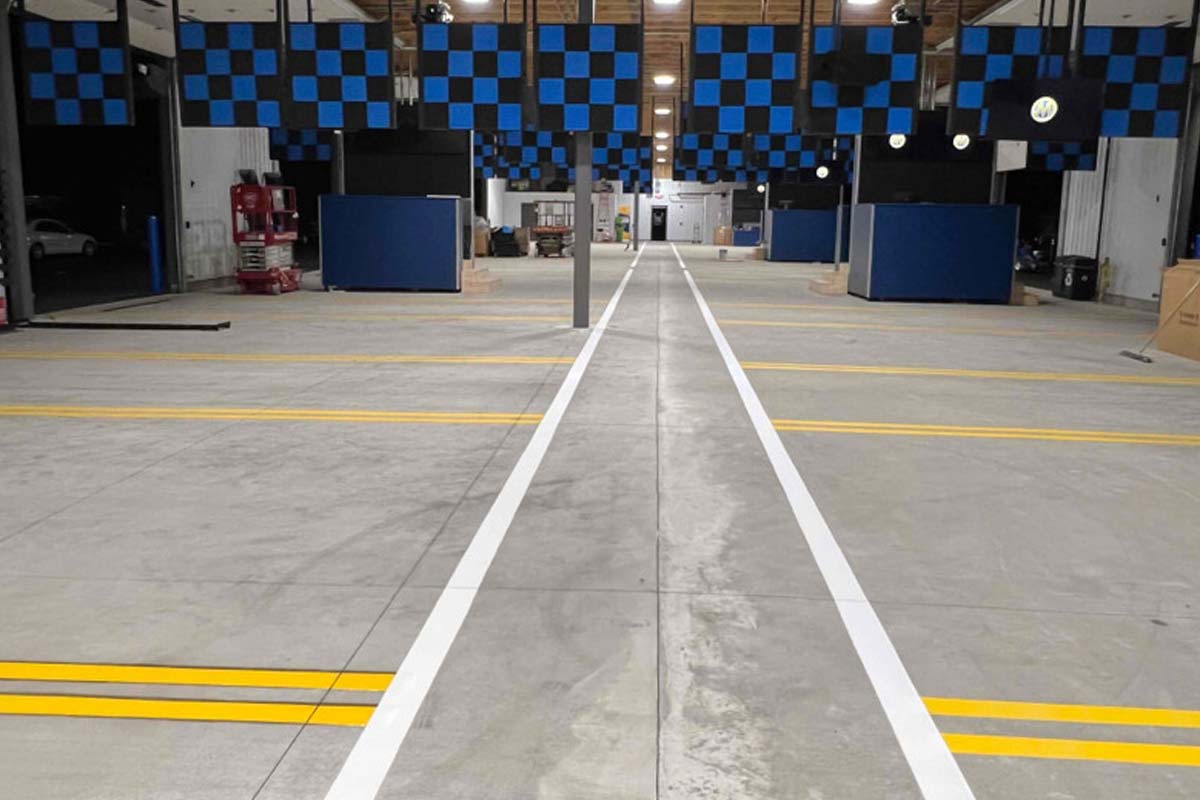
Four marking categories show up on every warehouse floor plan: aisle lines, pedestrian walkways, safety zones, and equipment-staging boundaries. Aisle lines define vehicle and pedestrian routes through the facility, typically 4 inches wide in yellow per the ANSI safety color code. Pedestrian walkway markings separate foot traffic from forklift lanes, often shown as parallel lines with hatched cross-walks at intersections. Safety zone markings call out hazards: red for fire equipment, blue for information, green for safety equipment and emergency egress, and black-yellow diagonals for caution-on-the-floor obstacles. Equipment-staging boundaries and material-storage outlines complete the system, defining where pallets, racks, and equipment can sit without intruding on traffic or egress paths.
OSHA 1910.22 Walking-Working Surfaces
OSHA 1910.22 governs walking-working surfaces in industrial facilities. Aisles, passageways, and storage areas have to be marked clearly when “mechanical handling equipment is used” — which covers virtually every modern distribution center, warehouse, and manufacturing facility in the Providence metro. The same standard demands workplace surfaces be safe to walk on, slip-hazard-free, well-lit, and connected to clear emergency egress paths. Line painting answers the marking requirement on most floors, with re-application running 12 to 24 months for water-based paint and 3 to 7 years for two-component epoxy.
ANSI Z535.2 Safety Color Coding
ANSI Z535.2 sets the safety color code that most distribution centers and industrial facilities follow alongside OSHA 1910.22. Yellow marks aisles, traffic lanes, and physical-hazard caution zones. Red marks fire-protection equipment, fire alarms, and emergency stops. Blue is informational signage. Green marks safety equipment, first-aid stations, and eye-wash stations. Black-yellow diagonals call attention to caution-on-the-floor obstacles such as low-hanging beams or floor-level pinch points. Where corporate safety programs specify a different color convention (typical at large national retailers and pharma distribution), the property’s existing convention wins over ANSI defaults.
| Color | ANSI Z535.2 meaning | Common warehouse application |
|---|---|---|
| Yellow | Caution / physical hazard | Aisles, forklift lanes, traffic guides |
| Red | Fire / emergency stop | Fire extinguishers, pull-stations, e-stop perimeter |
| Blue | Information | Wayfinding, equipment-status markers |
| Green | Safety / first-aid | First-aid stations, eye-wash, AED locations |
| Black-yellow stripes | Caution on the floor | Low-clearance, pinch points, ramps |
| Orange | Energy hazard | High-voltage cabinets, machinery enclosures |
Epoxy vs Traffic Paint — Choosing the Right Coating
Two-component epoxy and water-based traffic paint cover different jobs in a warehouse. Epoxy applied to clean, prepped concrete typically lasts 3 to 7 years in heavy-forklift traffic before needing a refresh; water-based traffic paint lasts 12 to 24 months in the same conditions. The cost trade-off favors paint for low-traffic and seasonal work, and epoxy for 24/7 forklift operations where shutdown windows for re-stripe get expensive. Hot-pour thermoplastic shows up occasionally on stop bars and crosswalks at warehouse loading docks and yard-tractor pathways, where service-life and cost-per-foot economics resemble exterior parking-lot striping.
Working in Active Distribution Centers
Most warehouse line painting work happens during weekend or off-shift windows in active distribution centers across the Providence metro and along I-95 into southeastern Massachusetts. Low-VOC water-based traffic paint dries fast enough that aisles return to operation within hours of the crew finishing. Two-component epoxy needs a longer cure window and usually goes down during a full weekend shutdown so the facility can stay closed through the cure cycle. The crew coordinates with the warehouse manager on rack relocation, equipment moves, and pedestrian routing during the marking work, and on equipment-staging zones that need to clear so the crew can reach the floor surface where lines go.
I-95 Distribution Corridor — A Core Warehouse Market
The I-95 distribution corridor through Providence and into southeastern Massachusetts is core warehouse territory. Distribution centers in Cranston, Warwick, East Providence, Pawtucket, and across the state line in Attleboro, Mansfield, and Foxborough see steady volume from regional fulfillment, third-party logistics, and pharmaceutical operations. Facility managers bring us in on annual or semi-annual line-painting cycles that follow OSHA 1910.22 requirements and the ANSI Z535.2 color code their corporate safety programs require. Multi-property contracts across a single 3PL operator simplify scheduling and keep marking work landing between peak shipping seasons rather than during them.
Surface Preparation Before Line Painting
Surface prep determines how long warehouse line painting lasts. Concrete has to be free of dust, oil, rubber tire-track residue, and prior paint flaking before fresh marking goes down. Light cases call for a broom-clean and degreaser scrub. Heavier residue needs mechanical surface prep — diamond grinding, shot-blasting, or pressure washing followed by a full dry cycle. Epoxy bonding requires a profile that traffic paint does not, which is why epoxy installation typically pairs with a more aggressive prep step and a longer mobilization window. Skip the prep and the coating life suffers: fresh paint over old grease or polished concrete will lift within months under forklift traffic.
For a full list of our pavement marking services, visit our parking lot striping in Providence page.
Businesses We Serve




How it Works

GET A FREE ESTIMATE
Contact us today and we’ll have a quote to you in 24 hours

SCHEDULE A STRIPING
We’ll have your space restriped in less than 7 days, without affecting your business hours

GET A PARKING LOT THAT POPS
For a budget-friendly price, you’ll get a parking lot that looks like new
We proudly work with:


We proudly work with:

Frequently Asked Questions About Warehouse Line Painting in Providence, RI
What does OSHA require for warehouse floor markings?
OSHA 1910.22 governs walking-working surfaces in industrial facilities and requires aisles, passageways, and storage areas to be marked clearly. Aisle lines, pedestrian walkways, hazard zones, and equipment-staging areas all fall under the marking requirement. ANSI Z535.2 supplements OSHA on safety color coding — yellow for caution and physical hazards, red for fire-protection equipment and emergency stops, blue for information, green for safety equipment, and black-yellow stripes for caution-on-the-floor obstacles.
What colors should warehouse floor lines be?
ANSI Z535.2 sets the safety color code that most distribution centers and industrial facilities follow alongside OSHA 1910.22. Yellow marks aisles and traffic lanes plus caution areas. Red marks fire equipment and emergency stops. Blue is informational. Green marks safety equipment, first aid, and eye-wash stations. Black-yellow diagonals call attention to caution-on-the-floor obstacles. The property’s existing color convention takes priority when one already exists, with the ANSI standard applied when starting from scratch.
Can you work in active warehouses?
Yes — most warehouse line painting work happens during weekend or off-shift windows in active distribution centers. Low-VOC water-based traffic paint dries fast enough that aisles return to operation within hours. Epoxy floor markings for high-wear forklift lanes need a longer cure window and usually go down during full weekend shutdowns. The crew coordinates with the warehouse manager on rack relocation, equipment moves, and pedestrian routing during the marking work.
How long does warehouse epoxy line paint last?
Two-component epoxy floor paint applied to clean, prepped concrete typically lasts three to seven years in heavy-forklift warehouse traffic before needing a refresh. Standard water-based traffic paint lasts roughly 12 to 24 months in the same conditions. The trade-off is cost and downtime: epoxy costs more per linear foot and requires longer cure windows, but pays back on facilities running 24/7 forklift operations where shutdown windows for restripes are expensive.
Do you work along the I-95 distribution corridor?
Yes — the I-95 distribution corridor through Providence and into southeastern Massachusetts is core warehouse territory. Distribution centers in Cranston, Warwick, Pawtucket, and across the state line in Attleboro and Mansfield see steady volume from regional fulfillment operations. Facility managers bring us in on annual or semi-annual line-painting cycles that follow OSHA 1910.22 requirements and the ANSI Z535.2 color code their corporate safety programs require.