Warehouse Line Painting
In West Cleveland, OH
OSHA-Compliant Safety Markings
1-800-STRIPER provides professional warehouse line painting in West Cleveland, OH — OSHA-compliant aisle lines, pedestrian walkways, forklift travel paths, and safety-zone markings per OSHA 1910.22 and ANSI Z535.1 color standards using durable epoxy and traffic paint for industrial facilities.
1-800-STRIPER® of Cleveland West PROVIDes Warehouse Floor Markings Services NEAR YOU
Want your indoor space to operate more efficiently?
Warehouse and interior markings ensure clear traffic lanes, organized storage zones, and designated spaces designed to help your business operate safely and efficiently.
Benefits:
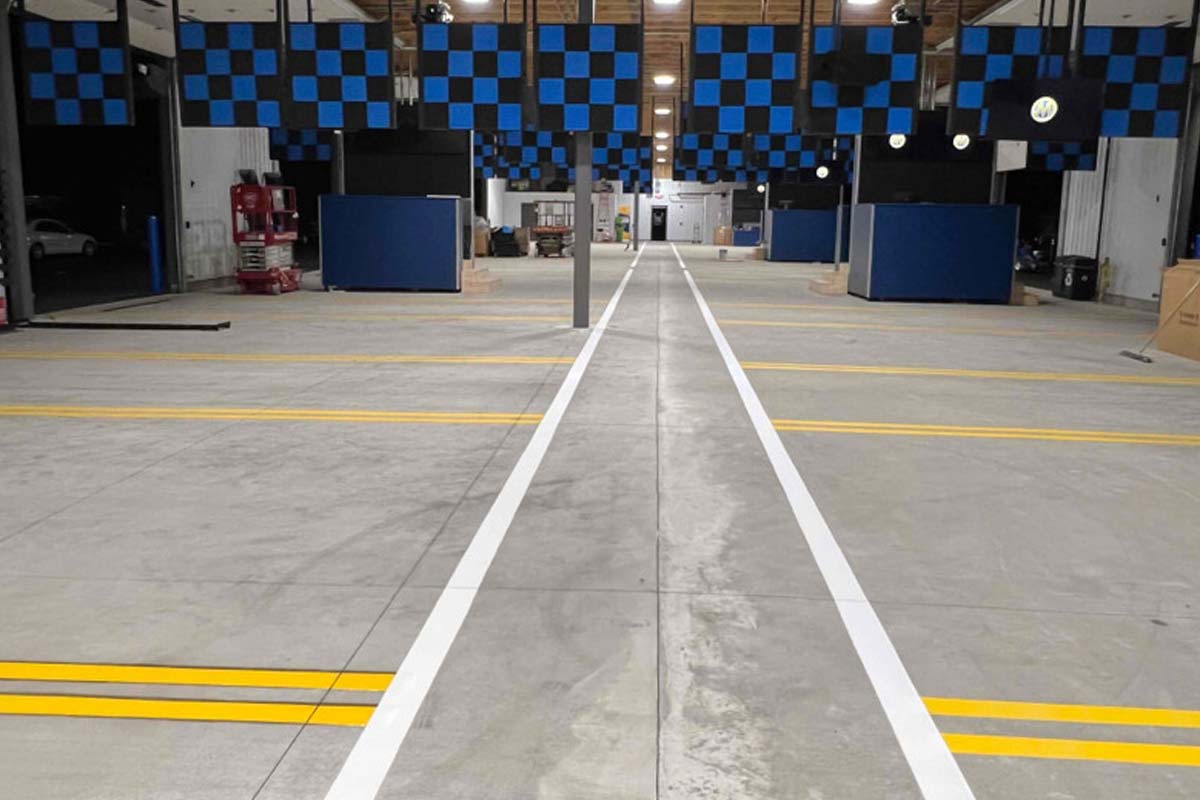
OSHA 1910.22 Requirements for Warehouse Floor Markings
OSHA 29 CFR 1910.22 — “General requirements” under Subpart D Walking-Working Surfaces — is the federal regulation that drives warehouse floor marking on industrial-occupancy property.
§1910.22(a) requires walking-working surfaces to be kept in a clean and orderly condition. §1910.22(b) requires aisles and passageways to be kept clear and in good repair, with no obstruction across or in aisles that could create a hazard. Where mechanical handling equipment is used — forklifts, pallet jacks, electric tugs — sufficient safe clearances are required for aisles, at loading docks, through doorways, and wherever turns or passage must be made.
§1910.22(b)(2) specifically requires permanent aisles and passageways to be appropriately marked. The OSHA standard doesn’t dictate a specific color or line width — it delegates that to consensus standards (ANSI Z535.1) and to the employer’s hazard assessment under the General Duty Clause.
In practice, warehouse-floor marking under OSHA 1910.22 covers aisle definition, pedestrian-walkway separation, forklift-travel-path designation, and hazard-zone marking. The marking system has to be visible enough that workers and equipment operators can identify aisles and clearances under normal operating conditions, and durable enough to remain legible through the warehouse’s daily wear cycle.
OSHA inspections that result in warehouse-floor-marking citations typically cite §1910.22(b) for inadequate aisle marking, §1910.22(c) for clearances that don’t accommodate the equipment used, or §1910.176 (Handling materials — general) for storage that encroaches into marked aisles.
ANSI Z535.1 Color Code System
ANSI Z535.1 — Safety Colors — is the American National Standards Institute consensus standard that warehouse-floor markings reference for color assignment. Z535.1 defines safety color meanings that have become the de facto warehouse-floor color code, even though the standard itself addresses signage rather than floor markings.
The six-color floor-marking system commonly used in warehouses:
- Yellow — caution, physical hazards. Aisle definition, forklift travel paths, edges of stairs and other hazard locations.
- White — equipment and fixtures with no other color assignment. Workstation locations, racking footprints, machinery locations, pallet drop-zones.
- Red — danger, emergencies, stop. Fire-equipment locations, emergency-eyewash stations, defective-equipment areas, hold-or-stop areas, prohibited zones.
- Orange — warning of energized equipment. Energized electrical panels, equipment expected to be inspected before service.
- Green — safety, first aid. First-aid stations, safety-equipment locations.
- Blue — information, raw materials or work-in-progress. Pre-production stock, work-in-progress, awaiting-inspection items.
Z535.1 sets the color spec but not the line-width or marking-pattern spec. Most warehouses standardize on 4-inch line widths for aisle marking and 2-inch line widths for workstation and racking footprints. The color-coding system gets walked through during the line-painting project planning so the warehouse manager can confirm which colors are in scope.
Aisle Width Standards by Forklift Class
Aisle width is the single biggest variable in warehouse-floor marking, and the correct width depends on the forklift classes operating in the aisle.
Class I (Electric Motor Rider Trucks) — common counterbalanced electric forklifts up to 5,000-pound capacity, typically 38 to 42 inches wide at the chassis. Minimum aisle width for two-way Class I traffic is generally 12 to 13 feet center-to-center; minimum aisle width for one-way Class I traffic plus pedestrian passage is generally 9 to 10 feet.
Class II (Narrow Aisle Trucks) — reach trucks, order pickers, and very-narrow-aisle (VNA) turret trucks. These are specifically engineered for aisles in the 6 to 10-foot width range. VNA turret aisles can run as narrow as 5 feet 6 inches if guided-aisle hardware (rails or wire guidance) is installed.
Class III (Electric Motor Hand Trucks) — walkie pallet trucks and walkie-rider stackers. Minimum aisle for two-way Class III is generally 8 to 10 feet; for single-direction traffic 6 to 7 feet is workable.
Class IV and V (Internal Combustion Cushion Tire and Pneumatic Tire) — IC sit-down forklifts, common for outdoor and yard work, with 48 to 54-inch chassis widths. Minimum two-way aisle 13 to 14 feet; minimum one-way aisle 10 to 11 feet.
The OSHA general standard is sufficient safe clearance for the equipment used (§1910.176). Industry practice is forklift-chassis width plus 6 feet for two-way aisles, or chassis width plus 3 feet for one-way aisles. We confirm the forklift classes operating in your warehouse during the project survey before any paint goes down.
Pedestrian Walkway Markings
Pedestrian walkway separation is the second-most-common warehouse-floor citation under OSHA, after aisle marking.
The standard marking is a 4-inch yellow line defining the walkway edge, with 4-inch yellow cross-hatching at the entry to the walkway and at any crossing of a forklift travel path. Walkway widths are typically 36 to 48 inches for single-file pedestrian flow, with 60 to 72 inches for two-way pedestrian flow.
In warehouses with high forklift traffic, walkways are often defined with a contrasting color floor coating (typically green for safety-zone designation per ANSI Z535.1) inside the yellow boundary lines — creating a visual cue that pedestrians have right-of-way inside the walkway and forklifts are excluded.
At points where pedestrian walkways cross forklift travel paths, we mark “PEDESTRIAN CROSSING” stenciling on the forklift path approach, with a yield-to-pedestrians arrow and crosshatch pattern across the crossing zone. Some warehouses add convex mirrors at blind crossings, which fall outside our scope but get noted during the project survey.
Forklift Travel Path Markings
Forklift travel paths are marked with 4-inch yellow boundary lines defining the travel-path edges, with directional arrows painted at intervals along straight runs and at intersections.
The travel-path marking includes intersection definition (which forklift has right-of-way at a four-way intersection), turning radii at corners (so the forklift operator can hold the lane through a turn without crossing into the pedestrian walkway), and dock-approach marking (where forklift traffic transitions from open warehouse floor to loading-dock staging).
For warehouses with one-way forklift traffic patterns, we paint directional arrows at the start of each one-way segment plus at every intersection. For two-way traffic, the centerline of the forklift path is marked with a dashed center line (4-inch dashes, 4-inch gaps) to provide lane discipline.
Color is typically yellow for forklift travel paths per the ANSI Z535.1 caution-and-physical-hazard color assignment. Some warehouses use a different color (often blue) for travel paths that carry work-in-progress materials, to distinguish from general-traffic aisles.
Safety Zone and Hazard Markings
Safety zones and hazard markings cover the warehouse-specific hazards that don’t fit the aisle-or-walkway pattern.
Red zones — fire-equipment locations, defective-equipment areas, emergency-eyewash stations, prohibited zones. The standard is 4-inch red boundary line with red interior cross-hatching at 12-inch spacing.
Yellow-and-black diagonal striping — danger zones requiring attention but where work activity continues. Common at the front of high-pile rack rows where a load could fall, at the perimeter of energized-electrical-panel access zones, at equipment-pinch-point locations.
Green zones — first-aid stations, safety-equipment locations, designated safe-meeting-point locations during emergencies. 4-inch green boundary line with green interior color coating inside the boundary.
White zones — equipment and fixture locations. Standard for marking workstation footprints, machinery locations, rolling-equipment storage zones, and pallet drop-zones inside the warehouse-floor layout.
The specific hazard-zone marking plan is set during the project survey, with the warehouse manager walking the floor with our project lead to identify the marking-required zones before any paint goes down.
Loading Dock and Bay Markings
Loading-dock and bay markings cover the dock-edge boundary, the trailer-staging zone, and the dock-approach forklift travel path.
Dock edge. A 4-inch yellow boundary line at the dock edge, often with 4-inch yellow diagonal cross-hatching extending 18 to 24 inches into the warehouse floor as a fall-protection visual cue. Some operations add a red boundary line at the absolute dock edge as a stop-line for forklift traffic.
Trailer-staging zone. The interior zone where forklifts stage loads for trailer loading — typically marked with a 4-inch yellow boundary line defining the staging perimeter and a number or letter indicating which dock the staging zone serves.
Dock-approach forklift path. The travel path from the warehouse-floor aisle to the dock-staging zone, marked with 4-inch yellow boundary lines and directional arrows showing the approach direction.
Bay numbering. Each dock bay is marked with a large stenciled number on the floor near the dock so forklift operators can identify the correct bay without looking up at the door header.
Paint Selection — Epoxy Versus Traffic Paint
Warehouse-floor paint selection comes down to two systems: high-build epoxy and acrylic traffic paint.
Two-component epoxy. A two-part epoxy resin system that cures by chemical reaction (not by water evaporation) and produces a high-build, chemically-resistant, abrasion-resistant film. Life-cycle is 5 to 8 years in typical warehouse-aisle traffic. Application requires controlled humidity and surface temperature during cure (typically 55 to 85°F surface, less than 80 percent relative humidity), and full cure to walk-on hardness runs 24 hours, with full chemical resistance at 7 days. Epoxy is the right choice for aisles, pedestrian walkways, and dock-edge marking on high-traffic warehouse floors.
Acrylic traffic paint. Single-component water-based acrylic, similar to outdoor parking-lot striping paint but formulated for indoor concrete substrates. Life-cycle is 18 to 36 months in typical warehouse traffic. Application is simpler and cure-window is shorter (60 to 90 minutes vehicle-traffic-ready), and the cost-per-linear-foot runs 30 to 40 percent below epoxy. Traffic paint is the right choice for hazard-zone marking, low-traffic equipment-footprint marking, and warehouses where the marking layout is expected to change within a few years (lean-manufacturing layout iterations, rack-relocation projects, expansion planning).
For most West Cleveland warehouse projects we recommend epoxy for permanent aisle and walkway marking and acrylic traffic paint for temporary or hazard-zone marking. The project survey walks through which marking elements warrant which paint system based on traffic load and expected layout stability.
For a full list of our pavement marking services, visit our parking lot striping in West Cleveland page.
Businesses We Serve




How it Works

GET A FREE ESTIMATE
Contact us today and we’ll have a quote to you in 24 hours

SCHEDULE A STRIPING
We’ll have your space restriped in less than 7 days, without affecting your business hours

GET A PARKING LOT THAT POPS
For a budget-friendly price, you’ll get a parking lot that looks like new
We proudly work with:


We proudly work with:

Frequently Asked Questions About Warehouse Line Painting in West Cleveland, OH
What does OSHA require for warehouse aisle marking?
OSHA 29 CFR 1910.22(b) requires permanent aisles and passageways to be appropriately marked, with sufficient safe clearance for the mechanical handling equipment in use. The standard delegates color choice and line-width specifics to consensus standards (ANSI Z535.1) and to the employer’s hazard assessment under §1910.22 and the General Duty Clause. The practical requirement: aisles need to be clearly defined, sized for the equipment operating in them, and durable enough to remain legible through the warehouse’s daily wear cycle.
Are warehouse floor marking colors standardized?
ANSI Z535.1 defines safety colors that have become the de facto warehouse-floor color code: yellow for caution and aisle marking, white for equipment and fixture footprints, red for danger and stop zones, orange for energized-equipment warnings, green for safety and first-aid, blue for raw-material and work-in-progress areas. ANSI Z535.1 addresses signage formally but the color assignments are widely adopted for floor marking too. Some warehouses customize the system based on operational needs — your existing color convention gets confirmed during the project survey.
What’s the difference between epoxy and acrylic floor paint?
Two-component epoxy is a chemical-cure system that produces a 5-to-8-year-lifetime, high-build, abrasion-and-chemical-resistant film — the right choice for high-traffic warehouse aisles, pedestrian walkways, and dock-edge marking. Acrylic traffic paint is a single-component water-based system with an 18-to-36-month service life and a 30-to-40-percent lower cost per linear foot — the right choice for hazard-zone marking, low-traffic equipment-footprint marking, and warehouses with frequently-changing layouts. Most projects use both systems based on the traffic load of each marked area.
How long does warehouse line painting take?
Project duration depends on warehouse size and paint-system selection. A typical 50,000-square-foot warehouse with epoxy aisle marking, ANSI Z535.1 hazard-zone marking, and dock-area marking runs three to five working days including surface prep, paint application, and cure time. Traffic paint shortens the cure window and can compress a similar scope to two to three days. We sequence the work to keep the warehouse operationally functional during the project where possible.
Do I need to shut down operations during line painting?
Partial operation during line painting is normal — we sequence the work zone-by-zone so the warehouse can keep moving product through unaffected aisles while the painted zones cure. Acrylic traffic paint reopens to forklift traffic in 60 to 90 minutes; two-component epoxy reopens to forklift traffic in 24 hours at 70°F. Full shutdowns are typical only for new-installation projects where the entire floor is being marked at once.
Can you handle line painting for distribution centers and 3PL facilities?
Yes — large distribution centers (100,000 square feet and up), 3PL cross-dock facilities, and multi-tenant industrial parks are regular project categories across Cuyahoga, Lorain, Medina, and Summit counties. The larger the warehouse, the more important pre-project surveying becomes — we walk the full floor with the operations manager to identify aisle layouts, forklift classes, pedestrian walkway routes, and hazard-zone marking requirements before any paint goes down.