Fire Lane Striping
In West Cleveland, OH
Code-Compliant Fire Lane Markings
1-800-STRIPER provides professional fire lane striping in West Cleveland, OH — marking compliant fire lanes, curbs, and no-parking zones per the Ohio Fire Code (OAC 1301:7-7-05) for commercial properties throughout Cuyahoga, Lorain, Medina, and Summit counties.
1-800-STRIPER® of Cleveland West PROVIDes Fire Lane Striping Services NEAR YOU
Is your parking lot ready for first responders?
Our team is well-versed in local fire regulations and will parter with you to design a fire lane striping plan that creates unobstructed emergency access to protect your customers and property.
Core Services:
Fire Lane Striping Scope
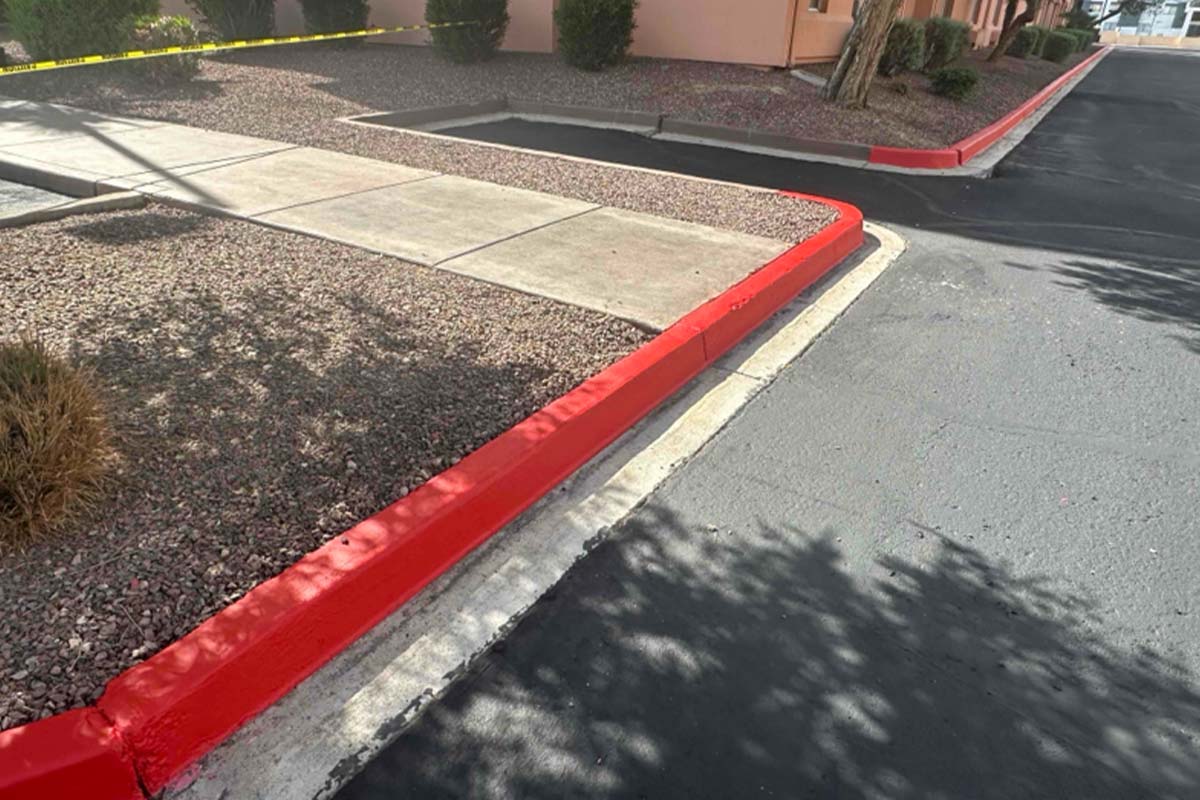
Fire-lane striping covers the painted curbs, lane edges, stencils, and no-parking-zone markings that keep fire-apparatus access routes clear on commercial property.
The typical commercial fire-lane scope includes four marking elements. First, painted red curb paint along the full length of every designated fire lane — this is what the fire marshal sign-off checks. Second, fire-lane stencils with “FIRE LANE NO PARKING” lettering placed at intervals along the lane (typically every 50 feet, plus one at each lane end). Third, the painted lane edge on the pavement where the fire lane runs through a parking-lot drive aisle rather than along a curb. Fourth, fire-department-connection (FDC) and fire-hydrant access markings — the four-foot clear-access markings around hydrants and Siamese FDC valves.
For larger commercial properties — hospitals, shopping centers, distribution warehouses, multi-tenant office parks — the scope often extends to apparatus turning-radius confirmation, hammerhead and dead-end-road markings per the local fire code, and emergency-vehicle-access roadway markings on private drives.
The scope your specific property needs is set by your local AHJ — the city or county fire marshal who issues the sign-off. We coordinate with the AHJ during the estimate so the install matches the marshal’s plan-review.
Fire Apparatus Access Road Requirements
Fire-lane requirements in Ohio come from the Ohio Fire Code, which incorporates Chapter 5 of the 2021 International Fire Code by reference (OAC 1301:7-7-01, §101.1.1). Fire apparatus access roads — and, in Ohio, fire lanes specifically — are governed by Section 503, adopted and modified at OAC 1301:7-7-05.
Section 503 sets the core fire-apparatus access road requirements:
- Width: Not less than 20 feet of unobstructed width, exclusive of shoulders (§503.2.1). The fire code official is authorized to require greater width where the standard width is inadequate for fire or rescue operations (§503.2.2).
- Vertical clearance: Minimum 13 feet 6 inches of unobstructed vertical clearance above the access road.
- Turning radius: Apparatus turning radii as required by the local AHJ — typical minimum 28-foot inside / 48-foot outside for full-size fire apparatus.
- Surface: All-weather driving surface capable of supporting the imposed loads of fire apparatus.
- Marking: Where required by the fire code official, fire apparatus access roads must carry approved signs, notices, or markings bearing the words “NO PARKING — FIRE LANE” (§503.3); the local AHJ sets the specific marking method (red curb paint plus stenciled lettering is the Ohio default).
Section 503.3 makes marking conditional on the fire code official: approved signs, notices, or markings are required where that official requires them, and the means by which fire lanes are designated must be kept clean, legible, and repaired as needed. That conditional language delegates the marking-specifics decision to the local AHJ — which is why the per-county fire marshal sign-off matters.
Ohio Fire Code (OAC 1301:7-7) — State Adoption Layer
Ohio adopts the International Fire Code with Ohio-specific amendments through the Ohio Fire Code, codified at Ohio Administrative Code Chapter 1301:7-7. The current edition became effective November 20, 2025, and is administered by the Division of State Fire Marshal under the Ohio Department of Commerce.
OAC 1301:7-7-05 (“Fire service features”) adopts Chapter 5 of the 2021 International Fire Code and modifies it for Ohio. Two of those modifications matter on a commercial lot: §503.1 is amended to read “fire apparatus access roads and fire lanes (as defined in Chapter 2),” which places private-lot fire lanes squarely inside Section 503; and §503.2.3 adds that the all-weather driving surface must be “as approved by the fire code official.” The §503.2.1 dimensions — 20 feet of unobstructed width and 13 feet 6 inches of vertical clearance — are adopted unmodified. Ohio does not adopt the International Fire Code appendices statewide (OAC 1301:7-7-01, §101.2.1), so Appendix D’s aerial-apparatus road widths apply only where your municipality has adopted them into local law.
OAC 1301:7-7-01 (“Scope and administration”) delegates plan-review and sign-off authority to the local AHJ — typically the city or county fire marshal with jurisdiction over the property’s address. The state code sets the floor; the local AHJ can require additional or more-stringent marking, and routinely does for properties with specific risk factors (high-occupancy buildings, hazardous-materials facilities, healthcare occupancies).
For commercial property owners across our four-county service area, the practical takeaway is: the International Fire Code sets the technical baseline, the Ohio Fire Code adopts and amends it into Ohio law, and the city or county fire marshal makes the marking-and-sign-off call for your specific property.
County and City Fire Marshal Sign-Off
Within our four-county service area, the AHJ varies by property location.
Cuyahoga County properties inside city limits report to the city fire department (Cleveland Division of Fire for west-side Cleveland addresses; Lakewood Fire, Rocky River Fire, Westlake Fire, Parma Fire, Strongsville Fire, North Olmsted Fire, and the others for their respective municipalities). Unincorporated Cuyahoga County is rare on the west side; most commercial property sits inside a city.
Lorain County properties report to the city fire department where one exists (Lorain, Avon, Avon Lake, North Ridgeville) or to the township volunteer fire department for unincorporated areas. Some Lorain County townships rely on county-level fire service for plan review.
Medina County properties (Brunswick, Hinckley Township, Valley City / Liverpool Township) report to the city or township fire department, with Medina County administering plan review for some smaller jurisdictions.
Summit County properties (Richfield in our service area) report to Richfield Joint Fire District for plan review.
We coordinate with the AHJ during the estimate — pulling the parcel address through the AHJ’s plan-review system, confirming whether the property has an existing fire-lane plan on file, and matching the install to whatever marking specifics the marshal requires (some marshals require the stencil interval at 30 feet rather than the 50-foot default; some require additional FDC-perimeter marking that goes beyond the code minimum). The sign-off is the deliverable; the install is what gets signed off.
Paint Selection and Stencil Specifications
The paint and stencil specs for compliant fire-lane marking are tighter than for standard parking-stall striping.
Curb paint is Sherwin-Williams ProMar Traffic Marking Latex in standard traffic red, applied at a 12 to 14 mil wet-film thickness across the full vertical face of the curb plus the top horizontal surface. Two coats for new installations on bare curb; one coat for restripe over existing intact curb paint. Coverage spec is roughly 80 to 100 linear feet of standard 6-inch curb per gallon at the two-coat rate.
Lane-edge paint on pavement (for fire lanes that run through drive aisles rather than along curbs) is the same Sherwin-Williams ProMar traffic latex, applied as 8-inch-wide solid red lines per the most common AHJ specification. Some marshals accept a 4-inch line; we default to 8-inch unless the AHJ’s plan-review specifies otherwise.
Stencils use 18-inch tall white “FIRE LANE NO PARKING” lettering, applied with stencil mask and traffic-paint roller. The 18-inch height is the Ohio default; some AHJs accept 12-inch but the larger size is more legible from a fire-apparatus driver’s seat. Stencils are placed at the start of each fire lane, at any change in direction, and at 50-foot intervals along straight-run segments.
Cure time for both the curb paint and the stenciled lettering is 60 to 90 minutes vehicle-traffic-ready at 70°F, longer in cooler conditions. We schedule fire-lane work on the same lot-restripe day where possible — the prep, the equipment, and the paint specs overlap cleanly.
Our Fire Lane Installation Process
Fire-lane installation runs as a five-step process from AHJ coordination through final sign-off.
- AHJ coordination. We pull the parcel address through the local fire marshal’s plan-review system, confirm whether an existing fire-lane plan is on file, and identify any AHJ-specific marking requirements (stencil interval, FDC-perimeter marking, hydrant-clearance markings).
- Lot survey. Field measurement of the designated fire-lane footprint, confirmation of Ohio Fire Code minimums (20-foot width, 13’6″ vertical clearance, turning radii), identification of any obstructions that would block fire-apparatus access.
- Surface prep. Power-sweep the lane, hot-water pressure wash any heavily oil-stained sections, scrape away any failed existing paint that would prevent new-coat adhesion.
- Paint and stencil application. Curb paint and lane-edge paint applied with Graco LineLazer airless striper; stencils applied by hand with stencil mask and traffic-paint roller; FDC and hydrant-clearance markings applied last with hand-brushed cut lines.
- AHJ sign-off. Coordinate the marshal’s final walkthrough; document the install with photos and a marked-up site plan for the property file.
Total project duration for a typical commercial lot with 200 to 500 linear feet of fire lane is one working day.
For a full list of our pavement marking services, visit our parking lot striping in West Cleveland page.
Businesses We Serve




How it Works

GET A FREE ESTIMATE
Contact us today and we’ll have a quote to you in 24 hours

SCHEDULE AN INSTALLATION
We’ll have your installation scheduled in less than 7 days, without affecting your business hours

GET A PARKING LOT THAT POPS
For a budget-friendly price, you’ll get a parking lot that looks like new
We proudly work with:


We proudly work with:


Frequently Asked Questions About Fire Lane Striping in West Cleveland, OH
What’s the minimum fire lane width in Ohio?
20 feet of unobstructed width, per Section 503.2.1 of the International Fire Code as adopted by the Ohio Fire Code (OAC 1301:7-7-05). The Ohio Fire Code can require greater widths where the local AHJ — your city or county fire marshal — determines additional width is needed for ladder-truck setbacks, hammerhead turnarounds, or specific occupancy risks (Group I-1 nursing homes, Group I-2 hospitals, Group A large-assembly). Confirm with the local fire marshal during plan review; the state code sets the floor, the marshal can raise it.
Who has authority over fire lane marking on my property?
The local AHJ — the city or county fire marshal with jurisdiction over your property’s address. The International Fire Code is the technical standard, the Ohio Fire Code (OAC 1301:7-7) adopts it into Ohio law, and the local fire marshal signs off on the specific install. Within our service area, that means Cleveland Division of Fire for west-side Cleveland addresses, the relevant city fire department for cities like Lakewood, Rocky River, Westlake, Parma, Strongsville, Lorain, Avon, Brunswick, and others, and the county or township fire department for unincorporated areas.
How often do fire lanes need to be restriped?
Annual inspection by the property owner is the floor; restripe is triggered by visible degradation of the red curb paint or the stenciled lettering. In Cleveland’s deicing-salt environment, fire-lane curb paint typically holds three to four winters before requiring a recoat; the white stenciled lettering holds two to three winters. Some AHJs require annual restripe regardless of visual condition — Ohio AHJs vary on this; ask during your annual fire-marshal inspection.
Can I just paint over my faded fire lane stripes?
Only if the existing paint is structurally intact — no peeling, no large gaps, no chalking. If the existing paint has failed, you need to scrape and recoat or you’ll get adhesion failure on the new paint within the first winter. The Sherwin-Williams ProMar traffic latex we use is rated for one-coat recoat over intact existing traffic-paint surfaces; it requires two-coat application over bare concrete or asphalt curb.
Do fire lane stencils have to say “FIRE LANE NO PARKING”?
The “FIRE LANE NO PARKING” lettering is the Ohio default; some AHJs accept “FIRE LANE” alone, some require additional marking like “TOW-AWAY ZONE” or municipal-code citation numbers. The stencil interval — typically every 50 feet on straight runs, plus at each end and at any direction change — is also AHJ-specific. We confirm the specific stencil text and interval with the local fire marshal during the AHJ-coordination step before any paint goes down.
What happens if my fire lane doesn’t pass inspection?
The local AHJ will issue a notice of violation with a compliance window — typical windows run 30 to 90 days depending on the marshal and the severity of the issue. The remedies are within the same scope we work in: re-marking faded curb paint, re-stenciling lettering that’s worn below legibility, widening lanes that have been narrowed by encroaching obstructions, adding markings the original plan missed. We’re often called in after a violation notice to bring the lot back into compliance before the next inspection.
Do fire-hydrant and FDC zones need separate marking?
Yes — fire-hydrants and fire-department-connection (FDC) valves require unobstructed access clear of parked vehicles, marked separately from the fire-lane itself. The Ohio Fire Code requires that access to fire hydrants be kept unobstructed at all times (OAC 1301:7-7-05, §507.5.4) and that a 3-foot clear space be maintained around the hydrant circumference (§507.5.5); Ohio adds its own §507.1.1 requiring that fire-department access to water supplies never be hindered. Your AHJ sets the marked no-parking setback and any FDC-perimeter marking. Both zones are typically marked with the same red curb paint plus “NO PARKING” stenciling that the fire-lane uses, applied as separate boundaries from the main fire-lane envelope so the marshal can sign off on each access requirement individually during the plan review.
Can you handle apparatus turning-radius markings on tight lots?
Yes — apparatus turning-radius issues are a frequent complication on older urban and infill commercial lots where the original site plan predated current fire-apparatus access requirements. We coordinate the turning-radius confirmation with the local fire marshal, work with the property’s site engineer if one is engaged, and mark the apparatus path so the marshal can verify clearance during sign-off. For lots where the existing geometry can’t accommodate current apparatus radii, the marshal usually grants a variance with additional compensating marking — typically hammerhead turnaround markings or expanded curb-painted no-parking zones that effectively widen the apparatus access envelope.
What about temporary fire-lane closures during striping work?
We coordinate temporary closures with the local fire marshal in advance. For commercial properties where the fire lane is the primary fire-apparatus access route, the marshal typically wants written notification 48 to 72 hours before the work and confirmation that an alternative apparatus access path is available during the closure window. Most fire-lane restripe projects close the lane for two to four hours during paint cure — the marshal accepts that window when the alternate-access path is documented and the work is scheduled outside high-occupancy periods (no Sunday-morning shopping-center closures, no overnight hospital fire-lane closures without backup access).