Sports Court Striping
In Cherry Hill, NJ
Multi-Sport Court Line Marking
1-800-STRIPER® provides professional sports court striping in Cherry Hill, NJ — marking pickleball courts to USA Pickleball specifications, basketball courts, tennis courts, and playground game markings using durable acrylic traffic paint.
1-800-STRIPER® of Cherry Hill PROVIDes Sport Court and Playground Markings Services NEAR YOU
Want to get people to come out to play?
Brighten up your faded sport courts or turn your playground into a safe, colorful, and engaging space that entices people to come out and play.
Sport Court Specialties:
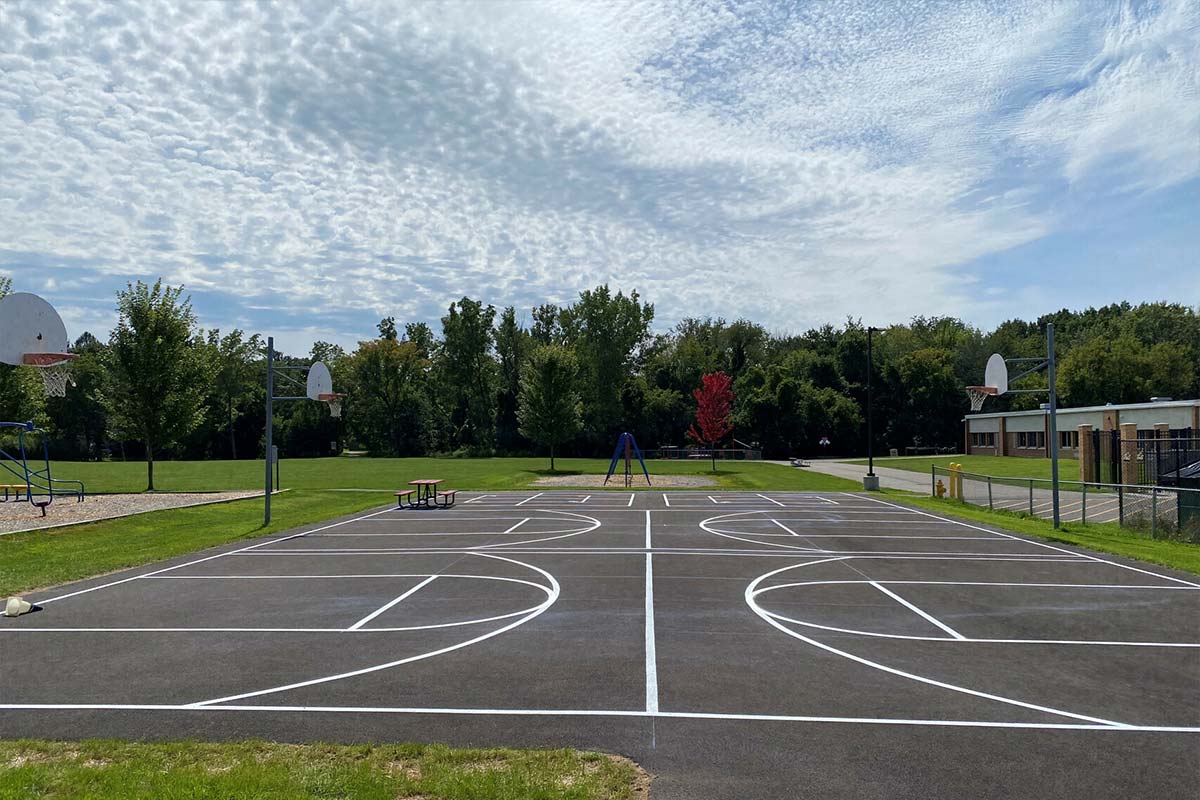
Sports Court Striping Services in Cherry Hill, NJ
Sports court striping lays down accurate, durable game lines on courts and play surfaces. We stripe sports courts across Camden and Burlington counties — pickleball, basketball, and tennis courts, plus playground game markings — for schools, parks, HOAs, apartment communities, and commercial properties. Accurate dimensions matter: a court striped to spec plays right and looks professional, while a court that’s off by inches plays wrong and shows it.
We work on asphalt and acrylic-coated surfaces, marking new courts and refreshing faded lines on existing ones, with each sport striped to its governing specification.
Pickleball Court Striping
Pickleball is the fastest-growing court sport, and demand for accurate striping has grown with it. A regulation pickleball court is 20 feet wide by 44 feet long, with a 7-foot non-volley zone — the “kitchen” — on each side of the net, marked per the USA Pickleball Official Rulebook. The total recommended playing area is larger to allow safe movement around the lines.
We stripe dedicated pickleball courts and add pickleball lines to existing surfaces, using line colors that contrast clearly with the court color and any other sport’s lines already present. Accurate kitchen and baseline placement is what separates a court that plays right from one that frustrates players.
Demand in South Jersey has pushed many HOAs, apartment communities, and parks to convert underused tennis courts and open blacktop into pickleball play. A single tennis court can often host multiple pickleball courts, and an open recreation pad can be laid out as a dedicated court. We measure the available surface, confirm the regulation dimensions and surrounding clearance, and lay out the lines so the finished court meets spec and leaves safe room to move.
Basketball Court Striping
Basketball courts are striped to the dimensions for their level of play. A high school court is 84 feet long by 50 feet wide, while NBA and college courts are 94 feet by 50 feet. Striping includes the boundary lines, center circle, free-throw lane (the key), free-throw line, and the three-point arc set to the appropriate distance for the level.
We mark full courts and half courts, on dedicated surfaces or shared multi-sport courts, using durable acrylic paint that holds up to outdoor play and weather. For shared courts we plan line color and layering so each sport’s markings stay readable.
Half-court layouts are a frequent request for driveways, school yards, and community pads where space is limited — a single hoop with a key and three-point arc gives a usable game without a full 84- or 94-foot footprint. Whether it’s a full regulation court for a school or a half court for an apartment community, we set the key, free-throw line, and arc to the correct distances for the level of play so the court is accurate, not just close.
Tennis Court Striping
A regulation tennis court is 78 feet long, 27 feet wide for singles and 36 feet wide for doubles, marked to the USTA 78-foot court layout specification. Striping includes the baselines, sidelines, service lines, center service line, and center marks, all at the specified line widths.
We stripe new tennis courts and refresh faded lines, and we frequently add pickleball lines to existing tennis courts for shared use — a common request as pickleball demand grows. When sports share a surface, we use contrasting colors so players can pick out their court at a glance.
Playground and Game Markings
Beyond regulation courts, we paint playground and recreational game markings on school and park surfaces — hopscotch, four-square, foursquare grids, number and alphabet grids, running tracks, and custom layouts. These markings turn a plain blacktop into an active play space and are striped with the same durable acrylic paint used on the sport courts so they stand up to constant foot traffic and weather.
Custom layouts are planned to fit the available surface and the age group, so the markings are sized to be usable rather than just decorative.
Court Surfaces, Acrylic Coatings, and Our Process
Court striping is only as good as the surface under it and the timing of the application. We mark asphalt and acrylic-coated surfaces, and on new or resurfaced courts we coordinate striping after the surface coating has properly cured. Acrylic court paint is the standard for durability and color retention outdoors.
Weather drives the schedule: court paint goes down best on a clean, dry surface in moderate temperatures, generally between about 50 and 85 degrees, avoiding extreme heat or cold so the paint cures and adheres correctly. Our process is straightforward:
- Confirm sport and dimensions to the governing specification.
- Prepare the surface — clean and dry, with coating cured on new courts.
- Lay out and verify the lines before painting.
- Stripe with durable acrylic paint and allow proper cure time.
For a full list of our pavement marking services, visit our parking lot striping in Cherry Hill page.
Businesses We Serve




How it Works

GET A FREE ESTIMATE
Contact us today and we’ll have a quote to you in 24 hours

SCHEDULE AN INSTALLATION
We’ll have your play space restriped in less than 7 days, without affecting your playtime

GET A PARKING LOT THAT POPS
For a budget-friendly price, you’ll get a parking lot that looks like new
We proudly work with:


We proudly work with:

Frequently Asked Questions About Sports Court Striping in Cherry Hill, NJ
What are the dimensions of a pickleball court?
A regulation pickleball court is 20 feet wide by 44 feet long, including the lines, with a 7-foot non-volley zone — the “kitchen” — on each side of the net, per the USA Pickleball Official Rulebook. The recommended total playing area is larger to give players room to move safely around the court. We stripe dedicated courts and add accurate pickleball lines to existing surfaces.
Can a tennis court be striped for pickleball?
Yes — adding pickleball lines to an existing tennis court is one of our most common requests as the sport grows. We mark regulation 20-by-44-foot pickleball courts within the tennis court footprint using a contrasting line color so both sports stay readable. Depending on the court size, one tennis court can host one or more pickleball courts. We confirm the best layout for your surface.
What are standard basketball court dimensions?
A high school basketball court is 84 feet long by 50 feet wide, while NBA and college courts measure 94 feet by 50 feet. Striping includes the boundary lines, center circle, free-throw lane and line, and the three-point arc set to the distance for the level of play. We stripe full and half courts on dedicated or shared surfaces using durable acrylic paint.
Can multiple sports share one court?
Yes. Multi-sport courts are common for schools, parks, and HOAs, and we plan line color and layering so each sport’s markings stay clear and distinguishable. For example, pickleball lines are frequently added to tennis and basketball courts. We use contrasting colors and accurate dimensions for each sport so players can identify their court at a glance without confusion.
What kind of paint is used for sports courts?
We use durable acrylic court paint, which is the standard for outdoor courts because it resists weather and holds its color and line definition under constant play. It’s applied to clean, dry asphalt or acrylic-coated surfaces, and on new or resurfaced courts after the coating has cured. Acrylic paint adheres well and is easy to refresh when lines eventually fade.
When is the best time to stripe a court?
Court striping is best done on a clean, dry surface in moderate weather — generally between about 50 and 85 degrees — avoiding extreme heat, cold, or damp conditions that interfere with cure and adhesion. In South Jersey that means late spring through early fall is ideal for outdoor courts. On new or resurfaced courts, we schedule striping after the surface coating has fully cured.