Parking Lot Layout Design
In Cherry Hill, NJ
Customized Parking Lot Layouts
1-800-STRIPER® provides professional parking lot layout design in Cherry Hill, NJ — custom-engineered layouts that maximize parking capacity, ensure ADA compliance per the 2010 ADA Standards for Accessible Design, and meet MUTCD pavement marking specifications using Graco LineLazer precision striping equipment.
1-800-STRIPER® of Cherry Hill PROVIDes New Layouts Services NEAR YOU
Are you ready to create a great first impression?
A proper parking lot layout with clear markings is critical for any business that serves the public. Let us help you make a great first impression with an attractive, well-organized, and safe parking lot.
Benefits:
Parking Lot Layout Design Services in Cherry Hill, NJ
A well-designed parking lot fits more cars, moves traffic safely, and meets code on the first inspection. We design and stripe commercial lot layouts across Camden and Burlington counties — new construction, full reconfigurations, and restripe-to-reconfigure projects on existing asphalt. The goal is simple: get the most usable, compliant spaces out of the pavement you have, without creating blind corners or pinch points.
Every layout balances three things — capacity, circulation, and compliance. Pack stalls too tightly and drivers clip mirrors; leave aisles too wide and you lose rows. We work the geometry so the count goes up and the lot still drives well, then mark it to the Manual on Uniform Traffic Control Devices (MUTCD) conventions that local plan reviewers expect.
Maximizing Parking Capacity
Stall angle is the single biggest lever on capacity. Three layouts cover most commercial lots:
- 90-degree (perpendicular): the most spaces per square foot and two-way traffic in every aisle. Best for high-turnover retail when the lot is wide enough for the drive aisles.
- 60-degree angled: easier entry and exit, narrower drive aisles, slightly fewer stalls. A strong middle option for office and medical lots.
- 45-degree angled: the easiest one-way circulation and the gentlest turn-in, at the cost of the most lost capacity.
Standard stalls run about 9 feet wide by 18 feet deep, with drive aisles sized to the stall angle — wider for two-way 90-degree layouts, narrower for one-way angled rows. We model a few angle options against your actual lot dimensions before any paint goes down, so you can see the trade-off between total count and ease of use.
Capacity isn’t only about the stalls. Drive-aisle width, end-island placement, and how cleanly the rows align with the building entrances all change how many usable spaces a lot really has. A row that forces a three-point turn or an aisle too tight for two-way traffic costs you spaces in practice even if they fit on paper. We design the whole circulation pattern, not just the stall count, so the lot drives the way the number promises.
ADA-Compliant Layouts
Accessibility is designed into the layout from the start, not added at the end. The federal 2010 ADA Standards for Accessible Design set the number of accessible spaces by total lot size, and New Jersey layers its own Barrier Free Subcode (N.J.A.C. 5:23-7) on top, adopting the ICC/ANSI A117.1 technical standard. Accessible spaces have to sit on the shortest accessible route to the building entrance, which is a placement decision made at the layout stage.
The U.S. Access Board’s guidance on parking (Chapter 5, §502) governs the stall and access-aisle dimensions: an 8-foot accessible stall paired with a 5-foot access aisle, and van-accessible stalls sized wider with a 96-inch aisle. At least one in every six accessible spaces must be van-accessible. Getting these counts and routes right on paper avoids the most common re-stripe call we get — a finished lot that fails its accessibility review.
Traffic Flow and MUTCD Markings
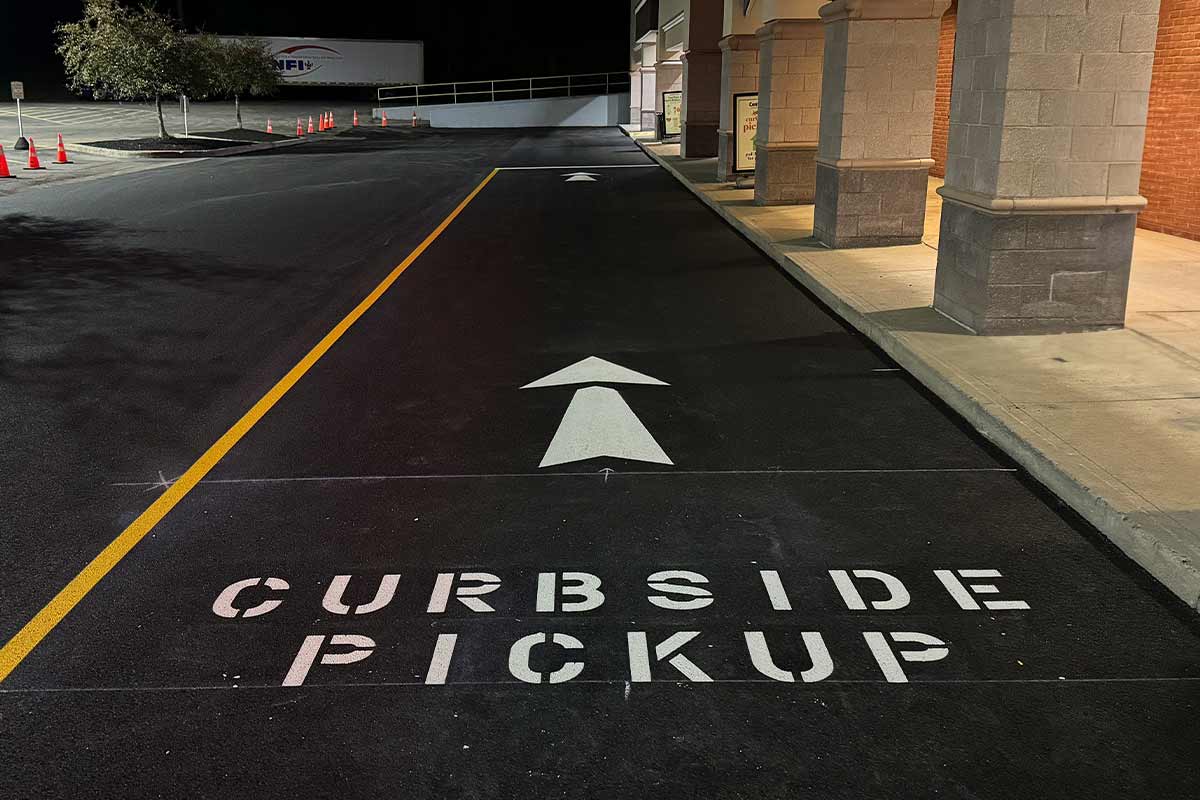
Good circulation keeps cars moving in one predictable direction and separates them from people on foot. A complete layout includes the markings that make that happen: directional arrows, stop bars at exits, painted crosswalks on the pedestrian routes from the far rows to the door, and loading or fire-lane zones where they’re required. We mark all of it to MUTCD color and pattern conventions so it reads the same way to every driver.
Crosswalk placement and arrow direction are decided with the stall layout, not after it. Where the lot connects to a public road, the entrance and exit geometry is set so turning movements line up with the street and sightlines stay clear.
Our Layout Design Process
We keep the process tight and visual so you can approve the plan before any paint is committed:
- Site assessment. We measure the lot, note grades and drainage, locate the building entrances, and confirm the required accessible count for the size.
- CAD layout. We draft stall angles, aisle widths, accessible spaces and routes, and traffic markings, then check the design against ADA, the NJ Barrier Free Subcode, and MUTCD.
- Review and approve. You see the proposed count and circulation, and we adjust angles or rows to hit your priorities.
- Layout and stripe. We chalk the layout on the pavement, verify it, then stripe with airless striping equipment for crisp, consistent lines.
For a full list of our pavement marking services, visit our parking lot striping in Cherry Hill page.
Businesses We Serve




How it Works

GET A FREE ESTIMATE
Contact us today and we’ll have a quote to you in 24 hours

SCHEDULE AN INSTALLATION
We’ll have your installation scheduled in less than 7 days, without affecting your business hours

GET A PARKING LOT THAT POPS
For a budget-friendly price, you’ll get a parking lot that looks like new
We proudly work with:


We proudly work with:


Frequently Asked Questions About Parking Lot Layout Design in Cherry Hill, NJ
Can you redesign my existing lot to fit more spaces?
Often, yes. Many older lots were striped at 90 degrees with oversized aisles, or never optimized at all. By testing 60- or 45-degree angles and right-sizing drive aisles, we can frequently recover rows without touching the asphalt. We model the options against your real dimensions first, so you see the new count and circulation before committing. The gain depends on the lot’s shape, grades, and required accessible spaces.
How many accessible spaces does my lot layout need?
The federal 2010 ADA Standards set the minimum by total space count — for example, one accessible space for lots up to 25 spaces, two for 26–50, and scaling up from there. New Jersey’s Barrier Free Subcode (N.J.A.C. 5:23-7) applies alongside it. At least one in six accessible spaces must be van-accessible. We confirm the exact count for your lot size during the site assessment.
What stall dimensions do you use?
Standard commercial stalls are about 9 feet wide by 18 feet deep, though we adjust to your use — wider for high-turnover retail, tighter for employee lots. Accessible stalls follow the U.S. Access Board parking guidance: 8 feet wide with a 5-foot access aisle, and van-accessible stalls sized wider with a 96-inch aisle. Drive-aisle width is set by the stall angle and one-way versus two-way flow.
Which stall angle gives the most parking?
A 90-degree perpendicular layout generally yields the most spaces per square foot and allows two-way aisles, which is why it dominates retail. Angled layouts at 60 or 45 degrees trade some capacity for easier entry and narrower one-way aisles. The best choice depends on lot width and how much circulation room you need, so we compare options on your actual dimensions before recommending one.
Do you handle the pavement markings as well as the design?
Yes — design and striping are one service. After you approve the CAD layout, we chalk it on the pavement, verify the geometry, and stripe the stalls, accessible spaces, arrows, stop bars, and crosswalks. All markings follow MUTCD color and pattern conventions so the lot reads clearly and passes review.
How long does a layout design and striping project take?
A typical commercial lot is designed, approved, and striped within a few visits — one for the site assessment and measurements, a short turnaround for the CAD layout and your review, and the striping itself, which is usually a single day for most lots. Cure time depends on weather, so we schedule the paint around a dry window and your operating hours.