
Wheel Stop Installation
In St. Louis Metro East, IL
Wheel Stops for Commercial Lots
1-800-STRIPER provides professional wheel stop installation in St. Louis Metro East, IL — setting and anchoring wheel stops at stall heads to keep parked vehicles from overhanging sidewalks, storefronts, and the accessible routes that ADA Standards section 502.7 requires stay clear, for commercial properties across Madison, St. Clair, and Monroe counties.
1-800-STRIPER® of St Louis Metro East PROVIDes Wheel Stop Installation Services NEAR YOU
Need to protect vehicles or walls from accidental damage?
Wheel stops (also called parking blocks) protect your property, enhance safety, and improve parking lot organization.
Benefits:
Wheel stops prevent vehicles from parking too far into a space or overextending into other spots, pedestrian walkways, and other areas, while also helping with vehicle alignment. They can prevent damage to buildings, curbs, or landscaping. Wheel stops also serve as clear visual cues for proper parking and are sometimes used on slopes to prevent cars from rolling.
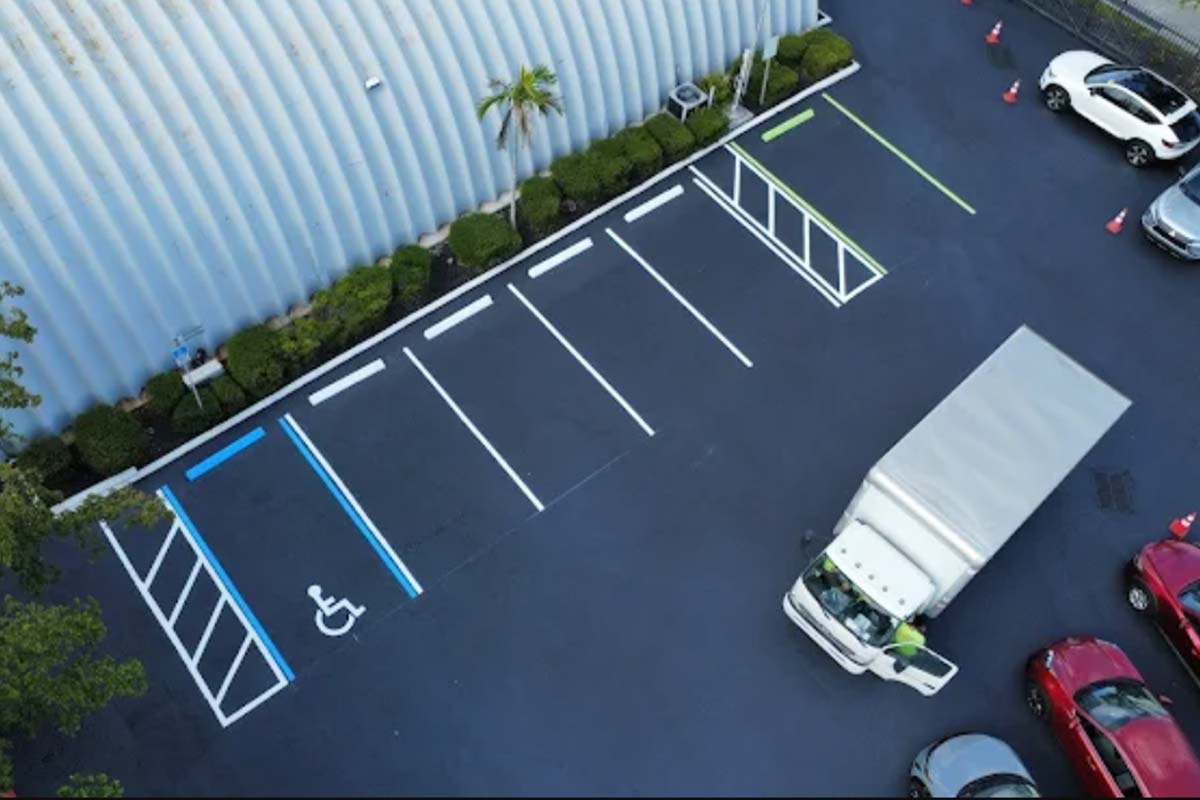
Wheel Stop Installation in St. Louis Metro East, IL
A wheel stop is a simple piece of hardware that solves an expensive problem. Cars park nose-in, front tires roll past the line, and the bumper ends up over the sidewalk, against the storefront, or in the middle of the path a wheelchair user needs. We install and anchor wheel stops for commercial properties across Belleville, Granite City, O’Fallon, Collinsville, and the rest of the Metro East, positioned so the vehicle stops where the stall ends. It’s usually a same-visit job, and it pairs naturally with restriping since the stall layout and the stop placement are the same decision.
What the ADA Actually Says About Wheel Stops
This is worth getting right, because the industry routinely overstates it. The 2010 ADA Standards for Accessible Design do not require wheel stops. Section 502.7 sets an outcome: “Parking spaces and access aisles shall be designed so that cars and vans, when parked, cannot obstruct the required clear width of adjacent accessible routes.” That’s the rule — the route stays clear.
The phrase “wheel stop” appears exactly once in the entire document, and it appears in an advisory note to that section: “Wheel stops are an effective way to prevent vehicle overhangs from reducing the clear width of accessible routes.” Advisories are explanatory. The Department of Justice regulation at 28 CFR 36.406(b) says so directly — advisory notes “explain or illustrate the requirements of the rule; they do not establish enforceable requirements.”
So the honest answer is this: nothing obligates you to install a wheel stop. What obligates you is the result. If your accessible route runs along the head of a stall and a parked sedan’s bumper narrows it, you have a compliance problem, and a wheel stop is the method the Access Board itself calls effective. We install them to hit the outcome the rule actually sets — not because a code section names the product.
Where Wheel Stops Earn Their Keep
The accessible route is the case with a rule attached, but it isn’t the only place a stop pays for itself. Overhang damage is the common one — bumpers against brick, cracked storefront glass, bent downspouts, and the slow destruction of a sidewalk edge that was never meant to take a vehicle. Stops at the head of a stall end that.
Overhang can also be a code problem in its own right, separate from the ADA. Belleville’s ordinance, for instance, requires that a required parking space “shall be situated so that no part of any parked vehicle overhangs public right-of-way” (§ 162.438(A)) — that is a local rule about where the car ends up, and a stop is a direct way to make sure it ends up there. Metro East towns are not uniform on this, so yours may or may not say something similar; we check before we assume.
They also do real work in these spots:
- Accessible stalls and access aisles. The ADA sets the access aisle and requires it adjoin an accessible route (section 502.3). A stop keeps a parked vehicle from eating into either.
- Sidewalk-fronting rows. Anywhere a stall head meets a walkway, the overhang comes out of the pedestrian’s clear width.
- Curbless lots. With no curb to act as a backstop, the stop is the only thing defining where the stall ends.
- Tight drive aisles. Overhang from both sides narrows the aisle, which matters for delivery trucks and fire apparatus access.
- Stall heads facing landscaping or lighting. Bollards protect the pole; a stop keeps the car off the island in the first place.
What We Can and Can’t Tell You About Specs
We’d rather say this plainly than pad the page. There is no Illinois state rule setting a wheel stop’s height, length, material, setback, or anchoring method. We checked the obvious place: the Illinois Accessibility Code (71 IAC 400) — the 2018 code that implements the Environmental Barriers Act and, in the Capital Development Board’s words, “has the force of a building code in Illinois.” Searched end to end, it does not contain the phrase “wheel stop” at all. Not once. It reaches private commercial lots, and it still has nothing to say about them.
That is not a loophole, and it does not mean nobody cares. It means Illinois wrote the rule the same way the ADA did — as a performance standard. The Illinois code’s own section 502.7 reads: “Parking spaces and access aisles shall be designed so that vehicles, when parked, cannot obstruct the required clear width of adjacent accessible routes.” Design for the result; the method is yours.
Two more things worth knowing, because both get misquoted:
- The Board is explicit that the state floor is not the ceiling. The Code “constitutes the minimum requirements and any governmental unit may enact stricter standards to increase access.” Your village can be tougher than Springfield, and some Metro East villages are.
- Illinois removed the advisories. The ADA’s wheel-stop line lives in an advisory note; the Illinois code carries no advisory notes at all. So the one sentence in federal law that mentions wheel stops has no Illinois counterpart whatsoever.
Local zoning and parking standards vary town to town across Madison, St. Clair, and Monroe counties, and they are genuinely not uniform. We check your jurisdiction before we set anything rather than assume, and we place stops to satisfy the section 502.7 outcome, which applies to your lot regardless of what the local code says. If your property manager or architect has a spec, we build to it. If you need a written answer for a tenant or an inspector, ask us and we’ll get it from the authority rather than from a template.
Our Wheel Stop Installation Process
We start at the stall head. Where a lot is being restriped, we set the layout first, because stop placement follows the stall geometry and doing it in the other order means moving hardware twice. We mark the positions, confirm anything that touches an accessible route against the required clear width, then set and anchor each stop to the pavement. On asphalt and on concrete the anchoring differs, and we use what the surface takes.
Where stops are replacing broken ones — and in the Metro East that is most of the work, because plows catch them every winter — we pull the old units and the old anchors, patch what needs patching, and reset to the current layout rather than the one that was there in 2009. If a stop sits on an accessible route, that’s the one we look at hardest, because that’s the one with a federal rule behind it.
For a full list of our pavement marking services, visit our parking lot striping in St. Louis Metro East page.
Businesses We Serve




How it Works

GET A FREE ESTIMATE
Contact us today and we’ll have a quote to you in 24 hours

SCHEDULE AN INSTALLATION
We’ll have your installation scheduled restriped in less than 7 days, without affecting your business hours

GET A PARKING LOT THAT POPS
For a budget-friendly price, you’ll get a parking lot that looks like new
We proudly work with:


We proudly work with:


Frequently Asked Questions About Wheel Stop Installation in St. Louis Metro East, IL
Does the ADA require wheel stops?
No. The 2010 ADA Standards require an outcome, not a product: section 502.7 says parking spaces and access aisles must be designed so parked cars and vans cannot obstruct the clear width of an adjacent accessible route. The phrase “wheel stop” appears once in the whole document, in an advisory note calling them “an effective way” to prevent that overhang — and 28 CFR 36.406(b) states that advisory notes do not establish enforceable requirements. Wheel stops are a proven method of meeting the rule, not the rule itself.
Does Illinois law require wheel stops in a parking lot?
We could not find an Illinois statute or state code provision that requires them, and we won’t tell you one exists when we haven’t read it. What does apply statewide is the Illinois Accessibility Code, which the Capital Development Board describes as having “the force of a building code in Illinois” and as setting minimum requirements that any governmental unit may exceed. Your municipality may have its own parking standards. We check your jurisdiction before we install.
How far from the curb should a wheel stop sit?
There is no Illinois or federal figure we can point you to, so we won’t invent one. The placement that matters is functional: the stop goes where it keeps the parked vehicle’s overhang out of the sidewalk, the storefront, or the accessible route. That distance depends on the stall depth and what sits at the head of it, which is why we set placement on site rather than from a table.
What are wheel stops made of?
Wheel stops are commonly available in concrete, recycled rubber, and plastic composite, and each anchors differently depending on whether the stall is asphalt or concrete. We’ll go over the options for your lot and what holds up best in the spot you’re putting them. If your property manager or architect has specified a material, we install to that spec.
Can you replace wheel stops that snowplows have broken?
Yes, and it’s most of what we do. Metro East winters are hard on stops — plows catch them, salt works on the anchors, and a cracked stop is a trip hazard rather than a barrier. We remove the broken units and the old anchors, patch the pavement where needed, and reset to your current stall layout instead of the layout that happened to be there when the originals went in.
Should we install wheel stops at the same time as restriping?
If you’re doing both, yes. Stop placement follows the stall geometry, so setting the layout first and the hardware second means the work only happens once. Doing it in the other order usually means pulling stops back up. It’s the same visit and the same crew either way.